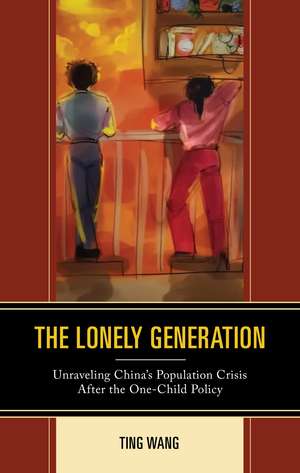
The Lonely Generation: Unraveling China’s Population Crisis After the One-Child Policy
Autor Ting Wangen Limba Engleză Hardback – 22 ian 2025
Preț: 541.74 lei
Preț vechi: 818.25 lei
-34%
Puncte Express: 813
Preț estimativ în valută:
95.94€ • 112.05$ • 83.34£
95.94€ • 112.05$ • 83.34£
Carte tipărită la comandă
Livrare economică 21 februarie-07 martie
Preluare comenzi: 021 569.72.76
Specificații
ISBN-13: 9781793610706
ISBN-10: 1793610703
Pagini: 262
Ilustrații: 18 BW Illustrations, 21 Tables
Dimensiuni: 160 x 230 x 24 mm
Greutate: 0.5 kg
Editura: Bloomsbury Publishing
Colecția Lexington Books
Locul publicării:New York, United States
ISBN-10: 1793610703
Pagini: 262
Ilustrații: 18 BW Illustrations, 21 Tables
Dimensiuni: 160 x 230 x 24 mm
Greutate: 0.5 kg
Editura: Bloomsbury Publishing
Colecția Lexington Books
Locul publicării:New York, United States
Cuprins
Chapter 1. Introduction
Chapter 2. From Dawn to Dusk: Revisiting China's One-Child Policy
Chapter 3. Family: "You Are Our Only Hope!"
Chapter 4. School: "Outpacing boys, even in the P.E. class."
Chapter 5. Job: "Do you have a boyfriend? When will you marry? When do you plan to have children?"
Chapter 6. Marriage and Children: "You're already 26!"
Chapter 7. Mismatched Liberation and Women's Silent Rebellion
Chapter 2. From Dawn to Dusk: Revisiting China's One-Child Policy
Chapter 3. Family: "You Are Our Only Hope!"
Chapter 4. School: "Outpacing boys, even in the P.E. class."
Chapter 5. Job: "Do you have a boyfriend? When will you marry? When do you plan to have children?"
Chapter 6. Marriage and Children: "You're already 26!"
Chapter 7. Mismatched Liberation and Women's Silent Rebellion
Recenzii
Absorbing all the statistics and personal stories Wang has selected to exemplify decades of multifaceted social change in the China Mainland should prove instructive. Recommended. Advanced undergraduates through faculty; professionals.
The Lonely Generation: Unraveling China's Population Crisis After the One-Child Policy is an engaging book that draws on rich qualitative and quantitative data to offer important new insights about factors driving demographic changes in China.
Ting Wang has made a profoundly important contribution to our understanding of a puzzle: given China's loosening of birth restrictions, why are its fertility rates continuing to plummet to the lowest levels ever seen? Through meticulous survey and interview research, she discovers that much like its neighbors, China elevated women's educational status while actively punishing them for the aspirations that naturally derive from it. China has openly dashed the hopes of its women through brazen discrimination within its neoliberal but patriarchal economy, while at the same time planning to use them instrumentally for pro-natalist aims. The iron-jawed defiance of Chinese women to be so used is a testament that there will either rise a new China more conducive to women, or there won't be a China at all in the future.
The Lonely Generation: Unraveling China's Population Crisis After the One-Child Policy offers an insightful analysis of the intersection of history, culture, politics, and social norms in the construction of gender relations in contemporary China. Through a mixed-method approach incorporating data analysis and interviews, the author provides an answer to the puzzling questions of why China's birth rates remain so low despite the lifting of its restrictive population policies and why the country's increased economic growth has been accompanied by a decline in women's empowerment. The book will be of interest to demographers, political scientists, sociologists, and anyone seeking to understand the precariousness of China's geopolitical rise.
The Lonely Generation: Unraveling China's Population Crisis After the One-Child Policy is an engaging book that draws on rich qualitative and quantitative data to offer important new insights about factors driving demographic changes in China.
Ting Wang has made a profoundly important contribution to our understanding of a puzzle: given China's loosening of birth restrictions, why are its fertility rates continuing to plummet to the lowest levels ever seen? Through meticulous survey and interview research, she discovers that much like its neighbors, China elevated women's educational status while actively punishing them for the aspirations that naturally derive from it. China has openly dashed the hopes of its women through brazen discrimination within its neoliberal but patriarchal economy, while at the same time planning to use them instrumentally for pro-natalist aims. The iron-jawed defiance of Chinese women to be so used is a testament that there will either rise a new China more conducive to women, or there won't be a China at all in the future.
The Lonely Generation: Unraveling China's Population Crisis After the One-Child Policy offers an insightful analysis of the intersection of history, culture, politics, and social norms in the construction of gender relations in contemporary China. Through a mixed-method approach incorporating data analysis and interviews, the author provides an answer to the puzzling questions of why China's birth rates remain so low despite the lifting of its restrictive population policies and why the country's increased economic growth has been accompanied by a decline in women's empowerment. The book will be of interest to demographers, political scientists, sociologists, and anyone seeking to understand the precariousness of China's geopolitical rise.