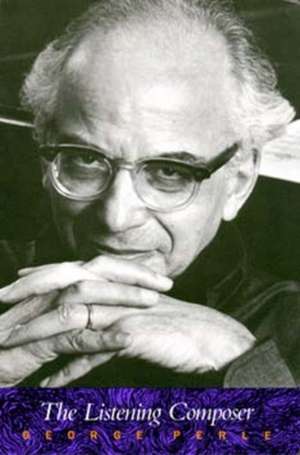
The Listening Composer (Paper): Ernest Bloch Lectures
Autor George Perleen Limba Engleză Paperback – 11 dec 1996
Prezentată sub forma unui ghid portabil de 216 pagini, ediția revizuită a lucrării The Listening Composer (Paper) de George Perle este o invitație tactilă și intelectuală în „atelierul compozitorului”. Publicată de University of California Press în cadrul seriei Ernest Bloch Lectures, această carte nu este doar un tratat teoretic, ci o experiență senzorială care transformă felul în care percepem sunetul modern. Suntem de părere că Perle reușește să demistifice complexitatea muzicii contemporane, propunând o perspectivă în care inovația nu este o negare a trecutului, ci o evoluție organică a acestuia.
Experiența lecturii este marcată de o analiză meticuloasă, aproape chirurgicală, a piesei „Density 21.5” pentru flaut solo de Varèse. Prin acest exercițiu, autorul ne demonstrează cum firele invizibile ale compoziției se leagă de maeștri precum Beethoven sau Wagner. Ca și Exploring Twentieth-Century Music de Arnold Whittall, volumul pune în valoare figuri centrale precum Stravinsky, Bartók sau Schoenberg, dar cu un accent pe intuiția ascultătorului și pe procesul de receptare, nu doar pe tehnica pură. Perle izolează anii 1909-1910 ca punct de inflexiune, oferind o claritate rară asupra tranziției de la tradiția tonală la noi structuri coerente.
Putem afirma că forța acestui volum rezidă în refuzul de a accepta elitismul intelectual. Autorul scrie cu o rigoare academică, dar păstrează un ton accesibil, transformând analiza dodecafonismului într-o explorare fascinantă a posibilităților sonore. Rezultatul este un text echilibrat care, spre deosebire de abordările mai sociologice din Twentieth Century Music and the Question of Modernity, se concentrează pe substanța muzicală și pe legătura intrinsecă dintre compozitor și cel care ascultă.




Preț: 239.98 lei
Carte tipărită la comandă
Livrare economică 06-20 iunie
Specificații
ISBN-10: 0520205189
Pagini: 216
Dimensiuni: 151 x 228 x 18 mm
Greutate: 0.33 kg
Ediția:Revised
Editura: University of California Press
Seria Ernest Bloch Lectures
V-ar putea interesa
-
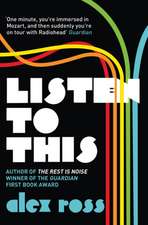 Listen to ThisAlex RossPreț: 89.58 lei
 -
 Oxford History of Western Music: (5 Volumes)Richard Taruskin-23%Preț: 1237.11 lei1606.63 lei
 -
 Processual Tonality and the Psychoacoustics of ChromaticismKyle Hutchinson-31%Preț: 504.88 lei728.80 lei
 -
 Music's Fourth Wall and the Rise of Reflective ListeningMark Evan Bonds-31%Preț: 414.75 lei598.75 lei
 -
 Music Lessons: The Collège de France LecturesPierre BoulezPreț: 196.05 lei
 -
 Music's OdysseyRobin HollowayPreț: 342.20 lei
 -
 Preț: 228.46 lei
 -
 Strunk's Source Readings in Music HistoryLeo TreitlerPreț: 299.57 lei
 -
 Structural Functions of HarmonyArnold SchoenbergPreț: 102.85 lei
 -
 Preț: 117.18 lei
 -
 Twentieth-Century Music in the WestTom PerchardPreț: 239.11 lei
 -
 A Cultural History of Western Music in the Modern AgeWilliam Cheng-31%Preț: 487.32 lei701.96 lei
 -
 The Madman's OrchestraEdward Brooke-Hitching-16%Preț: 189.47 lei224.44 leiRecomandat
 -
 Music as an ArtSir Roger Scruton-32%Preț: 125.24 lei183.53 lei
 -
 Audio Culture, Revised Edition: Readings in Modern MusicProfessor Christoph Cox-22%Preț: 271.61 lei350.03 lei
 -
 Sound TracksGraeme LawsonPreț: 89.77 lei
 -
 The Rest is NoiseAlex RossPreț: 135.64 lei
 -
 Sex Is No EmergencyDorothy Max PriorPreț: 139.05 lei
 -
 Listening to the Music the Machines MakeRichard Evans-18%Preț: 86.34 lei105.38 lei
 -
 20th Century AmbientDusty Henry-38%Preț: 73.16 lei117.59 lei
De ce să citești această carte
Această carte este esențială pentru studenții la conservator și melomanii care doresc să înțeleagă arhitectura muzicii moderne. George Perle oferă instrumentele necesare pentru a decoda operele lui Bartók sau Stravinsky, demonstrând că muzica secolului XX este accesibilă oricui dispune de curiozitate. Veți câștiga o perspectivă nouă asupra modului în care intuiția ghidează atât creația, cât și audiția, transformând o experiență abstractă într-una profund inteligibilă.