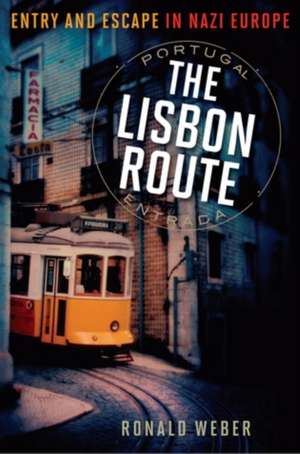
The Lisbon Route
Autor Ronald Weberen Limba Engleză Hardback – 16 mar 2011
Preț: 108.60 lei
Preț vechi: 177.66 lei
-39%
Puncte Express: 163
Carte disponibilă
Livrare economică 13-27 noiembrie
Livrare prin curier în România Termenul estimat este afișat lângă disponibilitate.
Transport gratuit de la 400.00 lei Plată online sau ramburs, în funcție de opțiunile comenzii.
Retur gratuit în 14 zile Comandă securizată și suport în română.
Specificații
ISBN-13: 9781566638760
ISBN-10: 1566638763
Pagini: 376
Dimensiuni: 152 x 232 x 28 mm
Greutate: 0.63 kg
Editura: BLOOMSBURY ACADEMIC
Locul publicării:New York, United States
ISBN-10: 1566638763
Pagini: 376
Dimensiuni: 152 x 232 x 28 mm
Greutate: 0.63 kg
Editura: BLOOMSBURY ACADEMIC
Locul publicării:New York, United States
Cuprins
Chapter 1 Preface
Chapter 2 Hub of the Western Universe
Chapter 3 Tramping Forward
Chapter 4 Whatever We Can
Chapter 5 The Last Lap
Chapter 6 Gaiety, Plenty, and Brilliant Lights
Chapter 7 Living There
Chapter 8 Celebrité de Passage
Chapter 9 Holding Out Hopes
Chapter 10 Gloriously Neutral
Chapter 11 War without Guns
Chapter 12 The Seething Cauldron
Chapter 13 One World to Another
Chapter 14 Wolfram by Day
Chapter 15 Where to Spend One's Holiday
Chapter 16 Sources
Chapter 2 Hub of the Western Universe
Chapter 3 Tramping Forward
Chapter 4 Whatever We Can
Chapter 5 The Last Lap
Chapter 6 Gaiety, Plenty, and Brilliant Lights
Chapter 7 Living There
Chapter 8 Celebrité de Passage
Chapter 9 Holding Out Hopes
Chapter 10 Gloriously Neutral
Chapter 11 War without Guns
Chapter 12 The Seething Cauldron
Chapter 13 One World to Another
Chapter 14 Wolfram by Day
Chapter 15 Where to Spend One's Holiday
Chapter 16 Sources
Recenzii
A leisurely, story-filled account of life in Nazi-occupied Europe's last open door to freedom. During World War II, the port city of Lisbon, in neutral Portugal, was the destination for a flood of refugees fleeing the Nazi terror who hoped to make their way to the United States and elsewhere. An estimated 100,000 or more refugees passed through the old-fashioned European capital, writes Weber (American Studies/Univ. of Notre Dame; News of Paris: American Journalists in the City of Light Between the Wars, 2006, etc.), often waiting for weeks or months for a place on a freighter, fishing boat or plane. At the same time, reporters, diplomats, spies, military leaders and others shuttled in and out freely, and the formerly sleepy city became a frenzied bazaar, charged with energy, conspiratorial feeling and moral uncertainty. . . . Based on newspaper accounts as well as diaries and letters, Weber's book brings the wartime city to life, tracing the machinations of agents and double agents in bars and hotels; Varian Fry's work on behalf of the International Rescue Committee to find safe passage for artists and intellectuals; and secret meetings where belligerents exchanged information. With the war's end, Prime Minister Antonio Salazar's authoritarian government began promoting the country as a postwar tourist destination. An engaging . . . chronicle of a city that was 'a way into Europe as well as a way out.'
During WWII, people hoping to escape Nazi-occupied Europe made their way to a city that was a gateway to the free world. Lisbon, Portugal, was an open city, politically neutral, which made it a prime destination for refugees. But getting there wasn't easy, and getting out of Lisbon wasn't a walk in the park, either. Weber explores the importance of the Lisbon route to freedom by focusing on the stories of men and women who used it, or who made it possible, people like Arthur Koestler, the Jewish writer who decided to get out of occupied Paris in 1940 (which he did by taking an unusual first step-enlisting in the French Foreign Legion); American journalist Varian Fry, who secretly worked for the Emergency Rescue Committee, helping refugees get out of Europe; and Russian-born German spy Lily Sergeyev, who operated as a double agent for the British in Lisbon. . . . The information is educational and very interesting. WWII buffs should definitely give it a read.
As Weber notes, the Lisbon route is largely forgotten as anything more than Ilsa's destination in Casablanca. But the route offered thousands of refugees a path from Nazi-held Europe to neutral Portugal and from there to America. Weber, professor emeritus of American studies at Notre Dame (News of Paris), assembles vignettes into each stand-alone chapter, creating contrast between the breathless escape of pilots such as Chuck Yeager (who crossed the Pyrenees with the help of the Resistance after his plane was downed in France) and easier journeys by Man Ray, Virgil Thomson (who arrived by train), and the duke and duchess of Windsor, (they fled France by car with a diplomatic escort). As the primary city offering air and sea passage to England and the United States, once quiet Lisbon attracted a mixture of wealthy expatriates, desperate intellectuals, and other refugees, along with spies, creating a colorful collage of luxury hotels, and brothels whose prostitutes were paid to spy; Ian Fleming came as a member of British naval intelligence. Weber provides a rich if sober microcosm of one segment of WWII's substantial displaced population.
A vivid depiction of how Lisbon became the antechamber of Nazi Occupied Europe. Weber brings alive the experiences of those who found themselves in a city caught between the Axis and the Allies during the Second World War. His illuminating account shows how reaching Lisbon was a momentous step toward escape for many, at the same time others benefited from unexpected opportunities provided by the conflict.
During WWII, people hoping to escape Nazi-occupied Europe made their way to a city that was a gateway to the free world. Lisbon, Portugal, was an open city, politically neutral, which made it a prime destination for refugees. But getting there wasn't easy, and getting out of Lisbon wasn't a walk in the park, either. Weber explores the importance of the Lisbon route to freedom by focusing on the stories of men and women who used it, or who made it possible, people like Arthur Koestler, the Jewish writer who decided to get out of occupied Paris in 1940 (which he did by taking an unusual first step-enlisting in the French Foreign Legion); American journalist Varian Fry, who secretly worked for the Emergency Rescue Committee, helping refugees get out of Europe; and Russian-born German spy Lily Sergeyev, who operated as a double agent for the British in Lisbon. . . . The information is educational and very interesting. WWII buffs should definitely give it a read.
As Weber notes, the Lisbon route is largely forgotten as anything more than Ilsa's destination in Casablanca. But the route offered thousands of refugees a path from Nazi-held Europe to neutral Portugal and from there to America. Weber, professor emeritus of American studies at Notre Dame (News of Paris), assembles vignettes into each stand-alone chapter, creating contrast between the breathless escape of pilots such as Chuck Yeager (who crossed the Pyrenees with the help of the Resistance after his plane was downed in France) and easier journeys by Man Ray, Virgil Thomson (who arrived by train), and the duke and duchess of Windsor, (they fled France by car with a diplomatic escort). As the primary city offering air and sea passage to England and the United States, once quiet Lisbon attracted a mixture of wealthy expatriates, desperate intellectuals, and other refugees, along with spies, creating a colorful collage of luxury hotels, and brothels whose prostitutes were paid to spy; Ian Fleming came as a member of British naval intelligence. Weber provides a rich if sober microcosm of one segment of WWII's substantial displaced population.
A vivid depiction of how Lisbon became the antechamber of Nazi Occupied Europe. Weber brings alive the experiences of those who found themselves in a city caught between the Axis and the Allies during the Second World War. His illuminating account shows how reaching Lisbon was a momentous step toward escape for many, at the same time others benefited from unexpected opportunities provided by the conflict.