The Lines Between Us
Autor Fadi K Ameren Limba Engleză Paperback – 18 mai 2027
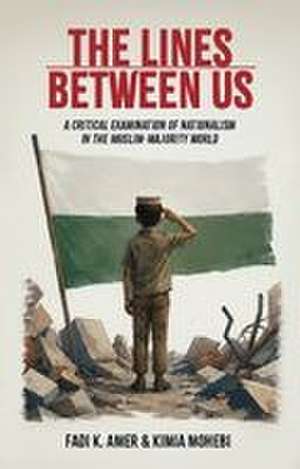
The manuscript further explores nationalism’s ideological dimensions, positioning it as a secular quasi-religion that competes with Islam in defining moral authority, identity, and belonging. Chapter 3 utilizes numerous examples of excerpts from textbooks, constitutions, and national anthems to reveal state efforts to “sacralise the nation” and elevate it to a status above all else. Chapter 4 assesses the spatial dimension by revealing how the nation-state system fragments and imposes borders on previously vast civilizational space that was once defined by open trade routes, free movement, and interdependent ecological space.
Part 1 concludes by tracing the legacies of Prophets Moses, Jesus, and Muhammad, illuminating their enduring influence on the region’s collective irreverent identity and distrust toward man-made institutions. In order to demonstrate that the nation-state model is neither necessary nor inevitable, Part 2 of the manuscript provides and discusses more than half a dozen potential alternatives, including federations, confederations, local models, and regional integration schemes - some of which are inspired by the region’s own pre-colonial styles of governance.
Preț: 125.85 lei
Precomandă
Puncte Express: 189
Carte nepublicată încă
Livrare prin curier în România Precomanda se expediază când titlul devine disponibil.
Transport gratuit de la 400.00 lei Plată online sau ramburs, în funcție de opțiunile comenzii.
Retur gratuit în 14 zile Comandă securizată și suport în română.
Doresc să fiu notificat când acest titlu va fi disponibil:
Se trimite...
Specificații
Notă biografică
Fadi K. Amer was born in Muhata, Jordan to a family of Palestinian refugees and immigrated to the United States in 1990. A Harvard Law School graduate (2005), he built a distinguished legal career, earning accolades such as Los Angeles Magazine’s Outstanding Attorney and Super Lawyers’ Rising Star. Beyond law, Fadi’s lifelong engagement with questions of identity and justice stems from his heritage and activism. At UCLA and Harvard, he wrote extensively on the Arab-Israeli conflict, taught related courses, and co-founded the Arab Student Society at UCLA.