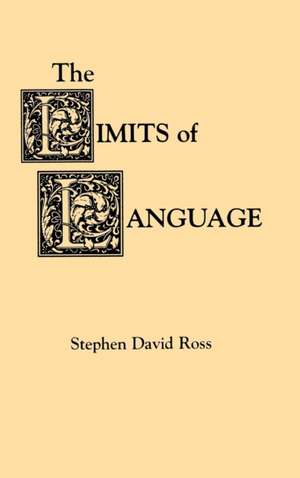
The Limits of Language
Autor Stephen David Rossen Limba Engleză Hardback – 1993
Preț: 420.32 lei
Puncte Express: 630
Carte tipărită la comandă
Livrare economică 23 noiembrie-07 decembrie
Livrare prin curier în România Termenul estimat este afișat lângă disponibilitate.
Transport gratuit pentru acest produs Plată online sau ramburs, în funcție de opțiunile comenzii.
Retur gratuit în 14 zile Comandă securizată și suport în română.
Specificații
ISBN-13: 9780823215188
ISBN-10: 0823215180
Pagini: 314
Dimensiuni: 157 x 235 x 23 mm
Greutate: 0.66 kg
Ediția:New.
Editura: Fordham University Press
ISBN-10: 0823215180
Pagini: 314
Dimensiuni: 157 x 235 x 23 mm
Greutate: 0.66 kg
Ediția:New.
Editura: Fordham University Press
V-ar putea interesa
-
 NatureRalph Waldo EmersonPreț: 55.77 lei
 -
 Being For: Evaluating the Semantic Program of ExpressivismMark Schroeder-12%Preț: 371.97 lei421.44 lei
 -
 LOT 2: The Language of Thought RevisitedJerry A. Fodor-18%Preț: 210.82 lei256.42 lei
 -
 -25%Preț: 376.78 lei501.07 lei
 -
 Malignant: Medical Ethicists Confront CancerRebecca Dresser-22%Preț: 236.63 lei302.92 lei
 -
 Truth by Analysis: Games, Names, and PhilosophyColin McGinn-31%Preț: 625.23 lei908.56 lei
 -
 Action, Perception and the BrainJ. SchulkinPreț: 391.45 lei
 -
 Memory, History, Justice in HegelAngelica NuzzoPreț: 395.55 lei
 -
 The Ego Tunnel: The Science of the Mind and the Myth of the SelfThomas Metzinger-15%Preț: 135.06 lei158.05 lei
 -
 The Ultimate Harry Potter and PhilosophyWilliam IrwinPreț: 136.66 lei
 -
 Mad Men and PhilosophyWilliam IrwinPreț: 135.70 lei
 -
 Philosophy For Dummies UK EditionMartin CohenPreț: 137.14 lei
 -
 Badiou and Deleuze Read LiteratureJean-Jacques Lecercle-14%Preț: 207.74 lei240.83 lei
 -
 Sovereignties in QuestionJacques DerridaPreț: 299.67 lei
 -
 Sounding/SilenceDavid Nowell SmithPreț: 489.99 lei
 -
 Environmental AestheticsMartin DrenthenPreț: 236.63 lei
Textul de pe ultima copertă
The Limits of Language concerns itself with the nature and limits of language at a time when our understanding of the world and of ourselves is intimately related to what we understand of language. It offers a detailed examination of different approaches to, and claims about, language drawn from the variety of orientations taken toward it, primarily in the twentieth century. What makes the author's approach unique is its concern with the ways in which we may understand language and its relation to the world and ourselves as a question of limits, drawing upon contemporary continental and English-language views of language, philosophical and linguistic, from American pragmatists such as Peirce and Dewey, and from important contemporary sources such as feminist theory. The book bridges English-language and continental discussions of language partly by recognizing their contrasts but systematically developing an overarching view of language out of their interaction. The focus of the book on the limits of language leads from questions concerning a science of language, and how such a science may attempt to demarcate its limits, as in Saussure and Chomsky, to a view of grammar and structure, of rules, in language, again issues of whether there are permanent and far-reaching limits to language and to human linguistic capabilities. In addition, the limits of language mark the limits of humanity and our understanding of the world, as expressed in Wittgenstein and Heidegger, for example, so that exploration of language limits lead to the very limits of nature and experience, of individual and social life. These, as many contemporary writers argue, including Levinas, Lyotard, and Irigaray, are notontological, but are fundamentally ethical and political. In other words, far-reaching explorations in the possibilities of another ethics and politics emerge from the examination of language.