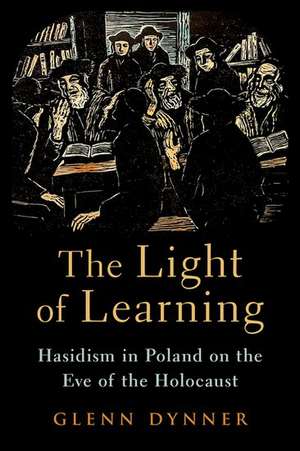
The Light of Learning: Hasidism in Poland on the Eve of the Holocaust
Autor Glenn Dynneren Limba Engleză Hardback – 20 noi 2024
Preț: 212.43 lei
Preț vechi: 282.66 lei
-25%
Puncte Express: 319
Carte disponibilă
Livrare economică 29 octombrie-04 noiembrie
Livrare express 14-20 octombrie pentru 106.04 lei
Livrare prin curier în România Termenul estimat este afișat lângă disponibilitate.
Transport gratuit de la 400.00 lei Plată online sau ramburs, în funcție de opțiunile comenzii.
Retur gratuit în 14 zile Comandă securizată și suport în română.
Specificații
ISBN-13: 9780197670637
ISBN-10: 0197670636
Pagini: 320
Ilustrații: 35 b/w photos; 1 map
Dimensiuni: 163 x 243 x 19 mm
Greutate: 0.6 kg
Editura: Oxford University Press
Colecția OUP USA
Locul publicării:New York, United States
ISBN-10: 0197670636
Pagini: 320
Ilustrații: 35 b/w photos; 1 map
Dimensiuni: 163 x 243 x 19 mm
Greutate: 0.6 kg
Editura: Oxford University Press
Colecția OUP USA
Locul publicării:New York, United States
Recenzii
Glenn Dynner's book is an eye-opening account of Hasidic life in Poland immediately before World War II. It expertly challenges regnant theories of Hasidic isolationism and exhibits the extent to which Hasidic circles and leaders were deeply engaged in educational reform, including women's education, as well as politics and the collapsing world around them. Drawing from published works, archival materials, and memoirs in numerous languages, Dynner changes the way we will look at Hasidic life in interwar Poland. A must-read for those interested in Eastern European Jewry's engagement with modernity.
The great eighteenth-century pietist movement of Hasidism infused Jews with a passion for God, prayer, and the integrity of the individual. Historian Glenn Dynner demonstrates Hasidism's ability to cope with modernity's radical changes, political and cultural, without losing its religious integrity. In his new book, he shows us the vitality of Hasidism in interwar Poland, despite physical and spiritual pogroms, and how Hasidic teachings brought spiritual strength to Jews during the horrors of the Holocaust."
A paradigm shift in the study of Hasidism, Polish Jewry, and gender. Dynner offers a gracious and nuanced reading of modern Hasidic revival and resistance, one that humanizes the movement and deepens our understanding of Jewish modernity. This is a masterpiece of historical writing."
Dynner's book shows that there is ample reason to appreciate the distinctively vibrant forms of Hasidic Judaism that flourished in interwar Poland.
Dynner's volume, which I wholeheartedly recommend, serves as an important model for the type of balanced, scholarly corrective we require in order to properly study and understand Hasidism, and will hopefully serve as a model for future historians to create their own synthesis between the two methodological approaches that we have discussed.
Dynner's excellent, insightful, enjoyable book is a most positive contribution to collections on Hasidism, drawing on primary archival sources such as diaries, letters, Hasidic discourses, business documents, photos, and secondary sources.
The book's meticulous research makes it a valuable resource for scholars and students across various fields, including Jewish studies, Hasidic studies,eastern European history, and gender studies. Beyond Jewish studies, the book's interdisciplinary approach and exploration of broader themes, such as the interplay between religion, education, and politics, make it relevant to scholars in fields such as religious studies, education, and social history. Its accessible writing style and comprehensive coverage, alongside eye-catching photos, also make it appealingto a broader readership interested in learning about the complexities of Jewish life in interwar Poland.
In addition to presenting a careful study of a significant portion of Polish Jewish society, this work should be of interest to historians of East Central Europe and scholars of Hasidism. Dynner's work importantly presents an argument for the central role of religion in this drama otherwise staged as one of political nationalism and modern, secular culture. For scholars of Hasidism, this work provides an example of how to integrate sources by and about women. This book also offers something of interest to that elusive general, educated reader: a case study of how a society values education.
The Light of Learning deserves to be read not only as a contribution to Hasidic studies but as a model of how to combine archival depth, theoretical insight, andnarrative clarity. It is, quite fittingly, a work that lives up to its title, sheddingenduring light on modern Jewish history.
The great eighteenth-century pietist movement of Hasidism infused Jews with a passion for God, prayer, and the integrity of the individual. Historian Glenn Dynner demonstrates Hasidism's ability to cope with modernity's radical changes, political and cultural, without losing its religious integrity. In his new book, he shows us the vitality of Hasidism in interwar Poland, despite physical and spiritual pogroms, and how Hasidic teachings brought spiritual strength to Jews during the horrors of the Holocaust."
A paradigm shift in the study of Hasidism, Polish Jewry, and gender. Dynner offers a gracious and nuanced reading of modern Hasidic revival and resistance, one that humanizes the movement and deepens our understanding of Jewish modernity. This is a masterpiece of historical writing."
Dynner's book shows that there is ample reason to appreciate the distinctively vibrant forms of Hasidic Judaism that flourished in interwar Poland.
Dynner's volume, which I wholeheartedly recommend, serves as an important model for the type of balanced, scholarly corrective we require in order to properly study and understand Hasidism, and will hopefully serve as a model for future historians to create their own synthesis between the two methodological approaches that we have discussed.
Dynner's excellent, insightful, enjoyable book is a most positive contribution to collections on Hasidism, drawing on primary archival sources such as diaries, letters, Hasidic discourses, business documents, photos, and secondary sources.
The book's meticulous research makes it a valuable resource for scholars and students across various fields, including Jewish studies, Hasidic studies,eastern European history, and gender studies. Beyond Jewish studies, the book's interdisciplinary approach and exploration of broader themes, such as the interplay between religion, education, and politics, make it relevant to scholars in fields such as religious studies, education, and social history. Its accessible writing style and comprehensive coverage, alongside eye-catching photos, also make it appealingto a broader readership interested in learning about the complexities of Jewish life in interwar Poland.
In addition to presenting a careful study of a significant portion of Polish Jewish society, this work should be of interest to historians of East Central Europe and scholars of Hasidism. Dynner's work importantly presents an argument for the central role of religion in this drama otherwise staged as one of political nationalism and modern, secular culture. For scholars of Hasidism, this work provides an example of how to integrate sources by and about women. This book also offers something of interest to that elusive general, educated reader: a case study of how a society values education.
The Light of Learning deserves to be read not only as a contribution to Hasidic studies but as a model of how to combine archival depth, theoretical insight, andnarrative clarity. It is, quite fittingly, a work that lives up to its title, sheddingenduring light on modern Jewish history.
Notă biografică
Glenn Dynner is the Carl and Dorothy Bennett Professor of Judaic Studies at Fairfield University, editor of the journal Shofar: An Interdisciplinary Journal of Jewish Studies, and a recent Guggenheim Fellow. He is author of Men of Silk: The Hasidic Conquest of Polish Jewish Society (OUP, 2006), and Yankel's Tavern: Jews, Liquor, and Life in the Kingdom of Poland (OUP, 2013).