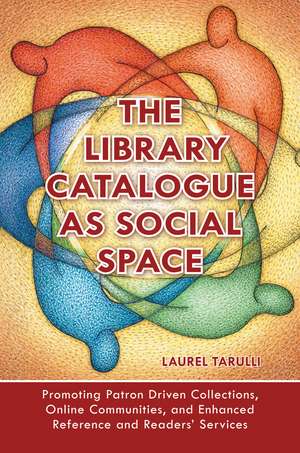
The Library Catalogue as Social Space: Promoting Patron Driven Collections, Online Communities, and Enhanced Reference and Readers' Services
Autor Laurel Tarullien Limba Engleză Paperback – 16 ian 2012
This book is a guide to the library catalogue that all public library professionals will find enlightening and useful. Its technical services perspective provides a different point of view as compared to traditional public library literature, which is often written by frontline professionals. For example, it poses and examines this thought-provoking question: should library catalogues be considered the primary gateway to the library's information, rather than the library website?
Author and collection access librarian Laurel Tarulli examines next-generation or "social" catalogues, discussing the theories and concepts behind them, their impact on core library services, and their potential in shaping future libraries and library services. Geared toward frontline and backroom staff, this book helps readers understand next-generation catalogues and see the collaborative opportunities that are possible between the frontline and backroom. Written to be much more than a "one-time" read, this resource book provides practical ideas for beneficial collaboration and implementation of social features in library catalogues.
Preț: 282.40 lei
Preț vechi: 418.56 lei
-33%
Puncte Express: 424
Carte tipărită la comandă
Livrare economică 05-19 decembrie
Livrare prin curier în România Termenul estimat este afișat lângă disponibilitate.
Transport gratuit de la 400.00 lei Plată online sau ramburs, în funcție de opțiunile comenzii.
Retur gratuit în 14 zile Comandă securizată și suport în română.
Specificații
ISBN-13: 9781598846294
ISBN-10: 1598846299
Pagini: 144
Dimensiuni: 156 x 235 x 15 mm
Greutate: 0.23 kg
Ediția:New.
Editura: Bloomsbury Publishing
Colecția Libraries Unlimited
Locul publicării:New York, United States
ISBN-10: 1598846299
Pagini: 144
Dimensiuni: 156 x 235 x 15 mm
Greutate: 0.23 kg
Ediția:New.
Editura: Bloomsbury Publishing
Colecția Libraries Unlimited
Locul publicării:New York, United States
V-ar putea interesa
-
 Information Technology in Educational Research and StatisticsD Lamont Johnson-15%Preț: 601.60 lei707.76 lei
-
 Information DesignGraziella Tonfoni-15%Preț: 523.58 lei615.97 lei
-
 -30%Preț: 449.81 lei641.54 lei
-
 -35%Preț: 376.66 lei577.07 lei
-
 History of Libraries of the Western WorldMichael H. Harris-33%Preț: 388.60 lei579.46 lei
-
 -33%Preț: 450.34 lei672.82 lei
-
 Systems Librarian: Designing Roles, Defining SkillsAmerican Library AssociationPreț: 281.21 lei
-
 -24%Preț: 282.64 lei372.03 lei
-
 Paper to Digital: Documents in the Information AgeZiming Liu Ph.D.-22%Preț: 363.81 lei468.91 lei
-
 Government Secrecy: Classic and Contemporary ReadingsJan Goldman Ph.D.-28%Preț: 457.93 lei637.61 lei
-
 Mysteries in the ClassroomNancy J. Polette-21%Preț: 277.27 lei350.69 lei
-
 -31%Preț: 320.52 lei461.45 lei
-
 Only ConnectTrevor Haywood-23%Preț: 888.47 lei1153.86 lei
-
 Library Preservation and Conservation in the '90sJohn Havermans-23%Preț: 879.94 lei1142.78 lei
-
 Intelligent Library BuildingsMarc Chauveinc-23%Preț: 762.14 lei989.79 lei
-
 -23%Preț: 875.27 lei1136.71 lei
-
 International Directory of Libraries for the BlindMisako Nomura-23%Preț: 884.00 lei1148.06 lei
-
 A Reader in Preservation and ConservationRalph W. Manning-23%Preț: 878.76 lei1141.25 lei
Cuprins
Foreword by Barbara B. Tillett
Introduction
1. The Library Catalogue as a Social Space
2. Exploring Next Generation Catalogues
3. Controversies and Concerns Surrounding Next Generation Catalogues
4. Readers' Services and the Catalogue
5. The Impact of Social Catalogues on Traditional Library Services
6. Social Features without Social Catalogues: Enhancing Your Public Library Catalogue Is Possible Even with Limitations and Resistance
7. Future Directions of the Library Catalogue
Bibliography
Index
Recenzii
What a fascinating book and a must-read for all librarians! . . . The book is very well researched and well written, and the discussion is supported by examples of next-generation catalogues in use today. . . . This really is an excellent book that comprehensively discusses the current and future possibilities of library catalogues. It is recommended for anyone interested in learning about the capabilities and exciting potential of next-generation catalogues.
The book provides some thought-provoking questions, while at the same time introduces social technology. Several practical suggestions for implementing free social features in library catalogs are provided.
If you are thinking about what to do with your catalog to make it more interactive and relevant, this book is for you. Recommended.
With the growing use of Web 2.0 by library patrons, integrating this technology into the catalog is the best way to reach patrons, and Tarulli helps both novice and seasoned librarians to achieve success in any library setting.