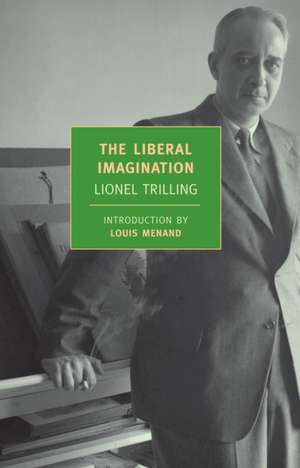
The Liberal Imagination
Autor Lionel Trillingen Limba Engleză Paperback – 23 sep 2008
Observăm în ultimele decenii o evoluție a criticii literare de la o disciplină pur estetică spre un instrument riguros de analiză a structurilor sociale și politice, o transformare pe care The Liberal Imagination a anticipat-o și a definit-o încă de la jumătatea secolului trecut. Publicată într-un moment de maximă tensiune ideologică, în 1950, această lucrare a lui Lionel Trilling nu este doar un volum de eseuri, ci un manifest pentru o gândire critică nuanțată. Remarcăm modul în care autorul respinge soluțiile simpliste ale științelor sociale și „panaceele” economice, insistând asupra faptului că doar imaginația literară poate surprinde motivațiile umane ireductibile și inevitabilitatea tragicului. Textul extinde cadrul propus de The Moral Obligation to Be Intelligent prin aplicarea metodei dialectice asupra unor teme culturale vaste, de la Huckleberry Finn la analiza Raportului Kinsey. În timp ce alte lucrări din epocă se limitau la comentariul textual, Lionel Trilling poziționează criticul ca fiind simultan un produs al societății sale și un apărător al vieții reflexive din afara ei. Această abordare completează perspectiva oferită de American Fiction in the Cold War de Thomas H. Schaub, oferind date esențiale despre modul în care intelectualii americani au reformat liberalismul „vechi”, optimist, într-unul sceptic și conștient de fragilitatea rațiunii. În contextul operei sale, The Liberal Imagination reprezintă fundamentul teoretic pentru temele explorate narativ în singurul său roman, The Middle of the Journey. Dacă în ficțiune Trilling urmărea trădările ideologice ale intelectualilor, aici el demonstrează de ce literatura rămâne singurul teren capabil să susțină un liberalism reflexiv, opus dogmatismului. Ritmul eseistic este dens, dar argumentația rămâne extrem de actuală pentru curriculumul de istorie a ideilor și critică literară.
Preț: 106.78 lei
Carte disponibilă
Livrare economică 11-25 mai
Livrare express 24-30 aprilie pentru 42.33 lei
Specificații
ISBN-10: 1590172833
Pagini: 303
Dimensiuni: 132 x 203 x 18 mm
Greutate: 0.35 kg
Editura: NEW YORK REVIEW OF BOOKS
V-ar putea interesa
-
 Discovering Modernism: T. S. Eliot and His ContextLouis Menand-18%Preț: 163.59 lei199.19 lei
 -
 Preț: 139.70 lei
 -
 The Future of Academic FreedomLouis MenandPreț: 226.54 lei
 -
 American StudiesLouis MenandPreț: 126.20 lei
 -
 The Marketplace of IdeasLouis MenandPreț: 102.16 lei
 -
 Preț: 410.64 lei
 -
 H. Theories of NarrativeTerrence Hawkes-18%Preț: 2190.06 lei2670.80 lei
 -
 New Accents: New AccentsTerence Hawkes-18%Preț: 22566.95 lei27520.67 lei
 -
 Body and StoryRichard TerdimanPreț: 240.86 lei
 -
 The Moral Obligation to Be Intelligent: Selected EssaysLionel TrillingPreț: 169.31 lei
 -
 Ngaio Marsh: The Woman and Her WorkB. J. Rahn-33%Preț: 329.37 lei490.91 lei
 -
 IntriguesGabriel Riera-19%Preț: 431.78 lei533.07 lei
 -
 Preț: 439.75 lei
 -
 Matthew ArnoldLionel TrillingPreț: 271.67 lei
 -
 The Semiotics of Beckett's TheatreKhaled BesbesPreț: 188.77 lei
 -
 Criticism and IdeologyTerry EagletonPreț: 132.84 lei
De ce să citești această carte
Această ediție publicată de NEW YORK REVIEW OF BOOKS este esențială pentru cei care doresc să înțeleagă rădăcinile intelectuale ale liberalismului modern. Cititorul câștigă o perspectivă critică asupra modului în care literatura de calitate poate tempera fanatismul politic și dogmatismul, oferind instrumente de analiză pentru complexitatea societății contemporane. Este o lectură fundamentală pentru studenții la litere, istorie sau științe politice.
Despre autor
Lionel Trilling (1905–1975) a fost unul dintre cei mai influenți critici literari și eseiști americani ai secolului XX. Profesor la Universitatea Columbia și membru marcant al grupului „New York Intellectuals”, a contribuit constant la publicația Partisan Review. Opera sa este marcată de analiza implicațiilor culturale, sociale și politice ale literaturii, fiind cunoscut pentru finețea cu care a explorat intersecția dintre mintea individuală și structurile puterii. Alături de eseistică, a lăsat în urmă lucrarea critică E.M. Forster și romanul politic The Middle of the Journey.
Notă biografică
Louis Menand is the Anne T. and Robert M. Bass Professor of English at Harvard University, and a staff writer at The New Yorker. He is the author of Discovering Modernism, The Metaphysical Club and American Studies.
Descriere scurtă
Writing with acute intelligence about classics like Huckleberry Finn and the novels of Henry James and F. Scott Fitzgerald, but also on such varied matters as the Kinsey Report and money in the American imagination, Trilling presents a model of the critic as both part of and apart from his society, a defender of the reflective life that, in our ever more rationalized world, seems ever more necessary—and ever more remote.
Recenzii
“Trilling’s best and most influential collection of essays shows how criticism, written with grace, style, and a self-questioning cast of mind, can itself become a form of literature, as well as a valuable contribution to how we think about society.” –Morris Dickstein
“A literary critic of major stature.” –The Times (London)
“The essays in [The Liberal Imagination] are remarkable for persuasiveness with which they draw attention to the importance for much, if not all great literature, of the tragic, the ironic, and the basically unjust elements in life.” –The Times (London)
"The Liberal Imagination, [is] a book that sold more than seventy thousand copies in hardcover and more than a hundred thousand in paperback, and that made Trilling a figure, a model of the intellectual in Cold War America... The argument of The Liberal Imagination is that literature teaches that life is not so simple for unfairness, snobbery, resentment, prejudice, neurosis, and tragedy happen to be literature's particular subject matter." --Lewis Menand, The New Yorker
“Lionel Trilling...is undergoing a slow but effective resurgence...everything suggest that both his persona and oeuvre are attracting a young generation of scholars eager to understand his echoes, present and future.” –Forward
“One felt that the essays of The Liberal Imagination were helping to generate a new kind of discourse; in them the traditional disparities between English and American ways of discussing both literature and society were being transcended. The specific means of this transcendence had largely to do with the intensity and luminosity of Trilling’s mind...” –The New York Times Book Review
The author "shows that literature is relevant to politics not because it affirms any political doctrine but because it provides a corrective to any political ideology whatsoever." –Intercollegiate Studies Institute (ISI)
“Lionel Trilling was so compelling that he mesmerized many of his Columbia students for life, away from what he regarded as the illusions about progress fostered by the liberal imagination.” –Los Angeles Times
“One of the most important literary critics of mid-20th century America.” –The Wall Street Journal
“This liberal critic of liberalism was revered for his reasonableness, the elegance of his dialectical style, the refinement of his ideas.” –The New York Times
“After his death, Lionel Trilling still exerts great influence on the landscape of American culture.” –The New York Times
“‘The Function of the Little Magazine’ is as enchanting as when it first appeared in 1946 and remains a superior lesson on the juxtaposition of the highbrow intellectual elite and a democratic mass audience.” –Foreword
“The dialectical method at its peak, honed to revelatory art.” –Sam Tanenhaus