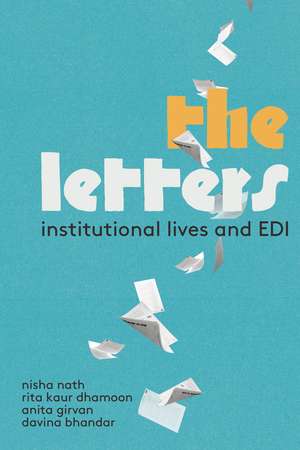
The Letters: Institutional Lives and EDI
Autor Nisha Nath, Rita Kaur Dhamoon, Anita Girvan, Davina Bhandaren Limba Engleză Paperback – 28 apr 2026
Intimate and moving, this erudite collaboration among four publicly engaged scholars traces power as it weaves through institutional correspondence. In grappling with official claims of inclusion, the authors examine how EDI-related letters are used by the university to claim a mythical identity — of being equitable, inclusive, diverse, and decolonizing —while simultaneously warding off criticism. Focused on recuperating the labour and forms of life-writing that members of subordinated groups undertake in institutions, The Letters amplifies structurally marginalized voices to diagnose why and how EDI adversely impacts certain people and poignantly identifies creative ways to intervene against the neoliberal university.
Preț: 117.84 lei
Puncte Express: 177
Carte disponibilă
Livrare economică 07-21 noiembrie
Livrare prin curier în România Termenul estimat este afișat lângă disponibilitate.
Transport gratuit de la 400.00 lei Plată online sau ramburs, în funcție de opțiunile comenzii.
Retur gratuit în 14 zile Comandă securizată și suport în română.
Specificații
ISBN-13: 9781773638102
ISBN-10: 1773638106
Pagini: 180
Dimensiuni: 152 x 229 x 6 mm
Greutate: 0.22 kg
Editura: Fernwood Publishing
Colecția Fernwood Publishing
Locul publicării:Canada
ISBN-10: 1773638106
Pagini: 180
Dimensiuni: 152 x 229 x 6 mm
Greutate: 0.22 kg
Editura: Fernwood Publishing
Colecția Fernwood Publishing
Locul publicării:Canada
Cuprins
- Chapter 1:: ‘The Letters’: Writing Lives Through and Against the EDI University
- Chapter 2:: The Invitation: ‘The Letters’: EDI and Tracing Work in the Academy
- Chapter 3:: Swallowing EDI and Complaint Procedures: Writing Lives of Magnificent, Subversive, and Rebellious Communities
- Chapter 4:: Riffing with Aunt Jemima: Rhythms of Call-and-Response within Nested Letters
- Chapter 5:: Up for Grabs: Public University, Where Are We Now?
- Chapter 6:: The Letters’: Collective Tracing
Recenzii
“The Letters diagnoses and intervenes in the state of institutional life in the university, while also insisting on letters that teach us about labour, care, and collectivity. It is incisive and nourishing. Read it.”
“Opening with the call, “DIE EDI,” this work arrives amidst a bitter irony, having been written precisely in anticipation of the death of EDI. Yet, much more importantly, this intimate critique raises the problem of what “we” will have rebuilt in EDI’s wake, if not simply another turn back to the good ol’ days. In the latter sense, the collective’s offering in, through, and as “the letters” not only validates the daily struggles of Black, Indigenous, queer, and women of color scholars; in doing so, this work also honors the intellectual lineages and visions that guide our work and have always found expression: both exceeding their forms of appearance and resounding in and across different scales.”
“Breathtaking, brilliant, creative, enraging, heartfelt, joyful, powerful, and wise, The Letters is testament to the importance of ‘writing our lives’ and ‘right-ing our lives’ within and against the neoliberal, EDI’ university. The authors unflinchingly demonstrate the corrosive damages that universities inflict while also capturing the subversive power of collective witnessing, dissident friendships, and doing otherwise in these spaces. It is a work of profound theoretical heft that I also see as a love letter to its readers: not only does it give us a way to process, metabolize and understand painful encounters in our academic lives that have harmed us, it is also a reminder that amid the many instances of institutional cruelty that we might have witnessed and lived through, other worlds remain possible.”
“Raising critical questions about the university as a public institution, The Letters provides penetrating observations and brilliant analysis of the distortions, contradictions, hypocrisies and omissions of the EDI university. Articulating a powerful alternative to both liberal visions and far-right critiques of EDI, it is an original and very timely contribution to discussions on and strategies for equity and decolonization in the academe and beyond.”
“Opening with the call, “DIE EDI,” this work arrives amidst a bitter irony, having been written precisely in anticipation of the death of EDI. Yet, much more importantly, this intimate critique raises the problem of what “we” will have rebuilt in EDI’s wake, if not simply another turn back to the good ol’ days. In the latter sense, the collective’s offering in, through, and as “the letters” not only validates the daily struggles of Black, Indigenous, queer, and women of color scholars; in doing so, this work also honors the intellectual lineages and visions that guide our work and have always found expression: both exceeding their forms of appearance and resounding in and across different scales.”
“Breathtaking, brilliant, creative, enraging, heartfelt, joyful, powerful, and wise, The Letters is testament to the importance of ‘writing our lives’ and ‘right-ing our lives’ within and against the neoliberal, EDI’ university. The authors unflinchingly demonstrate the corrosive damages that universities inflict while also capturing the subversive power of collective witnessing, dissident friendships, and doing otherwise in these spaces. It is a work of profound theoretical heft that I also see as a love letter to its readers: not only does it give us a way to process, metabolize and understand painful encounters in our academic lives that have harmed us, it is also a reminder that amid the many instances of institutional cruelty that we might have witnessed and lived through, other worlds remain possible.”
“Raising critical questions about the university as a public institution, The Letters provides penetrating observations and brilliant analysis of the distortions, contradictions, hypocrisies and omissions of the EDI university. Articulating a powerful alternative to both liberal visions and far-right critiques of EDI, it is an original and very timely contribution to discussions on and strategies for equity and decolonization in the academe and beyond.”