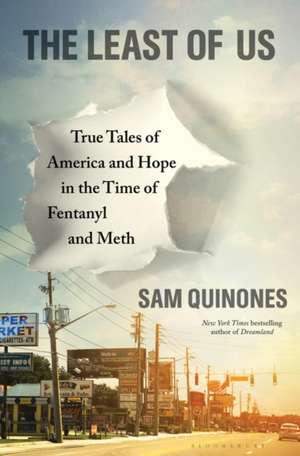
The Least of Us
Autor Sam Quinonesen Limba Engleză Hardback – 2 noi 2021
Evoluția crizei opioidelor a intrat într-o fază nouă, mult mai letală, marcată de trecerea de la derivatele din plante la substanțe sintetice produse în laboratoare clandestine. În The Least of Us, remarcăm modul în care Sam Quinones documentează această transformare radicală, unde fentanilul și metamfetamina au devenit motoarele unei crize de sănătate publică fără precedent. Autorul subliniază o realitate sumbră: în timp ce traficanții adoptă eficiența corporatistă, marile corporații folosesc tehnici de marketing care exacerbează vulnerabilitatea umană și dependența.
Descoperim aici o analiză sociologică profundă care depășește simpla statistică a deceselor. Sam Quinones face legătura între puritatea extremă a noilor droguri sintetice și valul de boli mintale și lipsă de adăpost care mătură Statele Unite. Spre deosebire de Dreamland, unde accentul cădea pe rețelele de distribuție a heroinei, acest volum investighează modul în care structura socială este atacată la nivel fundamental. Cititorii familiarizați cu American Overdose de Chris McGreal vor aprecia aici perspectiva lui Quinones, care nu se limitează la critica sistemului medical sau a corupției, ci caută soluții în poveștile de recuperare ale comunităților mici, adesea ignorate.
Structura narativă îmbină reportajul de teren de la granița cu Mexicul cu portrete emoționante ale unor oameni obișnuiți care încearcă să reconstruiască țesutul social. Această lucrare completează temele explorate anterior în Dreamland (YA Edition), oferind o viziune matură și urgentă asupra modului în care empatia și solidaritatea locală reprezintă singura barieră eficientă în fața unui mecanism de profit care nu ține cont de viața umană.
Preț: 105.11 lei
Preț vechi: 140.60 lei
-25%
Carte disponibilă
Livrare economică 18 mai-01 iunie
Specificații
ISBN-10: 1635574358
Pagini: 432
Dimensiuni: 164 x 238 x 38 mm
Greutate: 0.68 kg
Editura: Bloomsbury USA
Locul publicării:New York, United States
V-ar putea interesa
-
 Preț: 216.79 lei
 -
 Preț: 196.65 lei
 -
 Locke, Science and PoliticsSteven Forde-14%Preț: 681.98 lei793.01 lei
 -
 Tell Your True TaleSam QuinonesPreț: 35.83 lei
 -
 Tell Your True Tale: Sunkist/La PuenteJian HuangPreț: 40.98 lei
 -
 Dreamland (YA Edition)Sam QuinonesPreț: 105.37 lei
 -
 -26%Preț: 67.58 lei90.93 lei
 -
 The Narcotic FarmNancy D Campbell-5%Preț: 152.64 lei160.67 lei
 -
 Preț: 206.36 lei
 -
 La Fortification de Campagne Appliquée, Ou Guide Pratique Pour Les Travaux DéfensifsHenri-Charles-Érasme GirardPreț: 199.77 lei
 -
 Japan: From Surrender to PeaceE.J. Lewe van Aduard-15%Preț: 619.75 lei729.11 lei
 -
 The Research System in TransitionSusan E Cozzens-18%Preț: 1181.44 lei1440.78 lei
 -
 The Development of American FederalismWilliam H. Riker-18%Preț: 905.87 lei1104.72 lei
 -
 Burma's ConstitutionMaung MaungPreț: 381.55 lei
 -
 Legal Effect of World War II on Treaties of the United StatesStuart Hull MacintyrePreț: 381.87 lei
 -
 La conspiración de los 12 golpesThays PeñalverPreț: 108.65 lei
De ce să citești această carte
Această carte este esențială pentru cei care doresc să înțeleagă noua față a dependenței în secolul XXI. Sam Quinones oferă nu doar o cronică a distrugerii provocate de fentanil, ci și un manifest pentru reconstrucție socială. Cititorul câștigă o perspectivă clară asupra mecanismelor economice din spatele traficului de droguri sintetice și, mai important, descoperă puterea comunității ca antidot la alienare și consumism.
Despre autor
Sam Quinones este un jurnalist de investigație și narator american, recunoscut pentru capacitatea sa de a descifra fenomene sociale complexe prin intermediul poveștilor umane. Fost reporter la LA Times, el este autorul volumului Dreamland, câștigător al premiului National Book Critics Circle. Lucrările sale anterioare, precum True Tales from Another Mexico sau Antonio's Gun and Delfino's Dream, l-au consacrat drept unul dintre cei mai fini observatori ai dinamicii de la granița dintre SUA și Mexic. Prin proiecte precum Tell Your True Tale, Quinones continuă să promoveze puterea jurnalismului narativ în documentarea realităților marginale.
Descriere
Apple Best Books of 2021
From the New York Times bestselling author of Dreamland, a searing follow-up that explores the terrifying next stages of the opioid epidemic and the quiet yet ardent stories of community repair.
Sam Quinones traveled from Mexico to main streets across the U.S. to create Dreamland, a groundbreaking portrait of the opioid epidemic that awakened the nation. As the nation struggled to put back the pieces, Quinones was among the first to see the dangers that lay ahead: synthetic drugs and a new generation of kingpins whose product could be made in Magic Bullet blenders. In fentanyl, traffickers landed a painkiller a hundred times more powerful than morphine. They laced it into cocaine, meth, and counterfeit pills to cause tens of thousands of deaths-at the same time as Mexican traffickers made methamphetamine cheaper and more potent than ever, creating, Sam argues, swaths of mental illness and a surge in homelessness across the United States.
Quinones hit the road to investigate these new threats, discovering how addiction is exacerbated by consumer-product corporations. "In a time when drug traffickers act like corporations and corporations like traffickers," he writes, "our best defense, perhaps our only defense, lies in bolstering community." Amid a landscape of despair, Quinones found hope in those embracing the forgotten and ignored, illuminating the striking truth that we are only as strong as our most vulnerable.
Weaving analysis of the drug trade into stories of humble communities, The Least of Us delivers an unexpected and awe-inspiring response to the call that shocked the nation in Sam Quinones's award-winning Dreamland.
Recenzii
American pain. This is the territory of Sam Quinones, a masterly reporter and vivid, lyrical writer, whose last book, Dreamland won a National Book Critics Circle Award and awakened readers to the problem of opiate addiction in the United States. . . . In The Least of Us, Quinones applies a similarly kaleidoscopic approach to 'designer drugs' like fentanyl and methamphetamine.
Jam-packed with amazing facts and, like all of Quinones' work, reads like a thriller. You may think you know this story. Trust me, you don't. I normally don't write book reviews, but Quinones' book is well worth your time.
Together with his earlier Dreamland, The Least of Us confirms his place as a leading chronicler of an American nightmare.
Chronicles how meth-ravaged communities have broken the cycle of drug abuse, violence and despair.
Sam Quinones is the indispensable ground-level guide to the epidemics of addiction that plague so many Americans. In The Least of Us, the tales of despair are brightened by seeing communities beginning to adapt and regrow to fight the horror that besets them. Everyone should read this.
This well-researched follow-up traces the next stage of the epidemic, with synthetic drugs and the next generation of kingpins. There is plenty of heartache, yes, but there is also hope in its exploration of communities trying to repair themselves.
When I was chairman of the Senate health committee in 2018 and we were focused on developing legislation to address the nation's opioid crisis, I held a hearing where Sam Quinones was the only witness. Such is Quinones' command of the issue and the usefulness of his insights for our nation. In The Least of Us, Quinones has continued his meticulous reporting to capture a full picture of how America's communities are working to resist the damage caused by illegal synthetic drugs - and also to fight the epidemic of isolation by repairing the threads of connection that have so badly frayed.
With deep compassion and piercing insight, Sam Quinones beautifully captures the pain of America's opioid addiction and the gaping holes in society that allowed the tragedy to fester. He then not only offers condemnation of how we got here but true hope of how we can get out.
With The Least of Us, Sam Quinones continues to be the preeminent chronicler of the national opioid epidemic. By combining rigorous research, keen insight and listening to people's stories across the country, Sam has once again captured not only the pain and sadness but the resiliency and optimism that have come to be the hallmark of this epidemic.
Journalist Quinones follows Dreamland with a sweeping portrait of the destruction wrought by pharmaceutical companies, Mexican cartels, and other drug profiteers, and an inspirational call for a renewed sense of community to combat the isolation of addiction . . . This is a richly rewarding report from the front lines of an ongoing emergency.
Readers looking for the latest take on the drug trade and recovery as well as those who flock to well written journalism will dig into this.
In a follow-up to his widely acclaimed Dreamland, Quinones explores the fentanyl and meth crisis sweeping the U.S. while at the same time spotlighting the moments of hope and community that keep us going. From the wreckage of ruined lives come stories of faith, trust and belief in our fellow humans.
"Outstanding ... elegantly written . Quinones has perfected his method of merging big-picture cause-and-effect analyses of the economics and neuroscience of drugs with illustrative human-interest stories of Americans swept up in this national catastrophe."
A painful sequel [to Dreamland] because it's an admission that we haven't beaten the national opioid addiction. Far from it. Quinones makes the convincing case that the problem has simply moved underground, changing locations from the doctor's office to back alleys, or to the internet, where users purchase drugs from shady Mexican or Chinese chemical providers.
A heartrending depiction of the current phase of the quixotic drug war. Sam Quinones covers the human drama with an admirable empathy . The stories offered will remain ingrained in the reader's mind because they're so powerful.
Over the last 15 years, he has filed the best dispatches about Mexican migration and its effects on the United States and Mexico, bar none.
[A] compelling examination . . . a driven and important narrative.
Quinones' research ensures that there is something legitimately interesting (and frequently horrifying) on every page.
Dreamland is at once a heartbreaking narrative about the individuals in the grips of addiction, and a thorough history of how that addiction was made possible by a variety of key players . . . a must-read for anyone grappling with the story of heroin addiction in the United States.
Quinones recounts individual tales - from junkies in Portland, Ore., to pill mills in Appalachia to entrepreneurial heroin traffickers from small-town Mexico - to describe a "catastrophic synergy" in which over-prescription of opioid painkillers begets addicts, many of whom then turn to heroin, which is cheaper and just as ubiquitous.
You won't find this story told better anywhere else, from the economic hollowing-out of the middle class to the greedy and reckless marketing of pharmaceutical opiates to the remarkable entrepreneurial industry of the residents of the obscure Mexican state of Nayarit . . . Dreamland--true crime, sociology, and exposé--illuminates a catastrophe unfolding all around us, right now.
The most original writer on Mexico and the border out there.