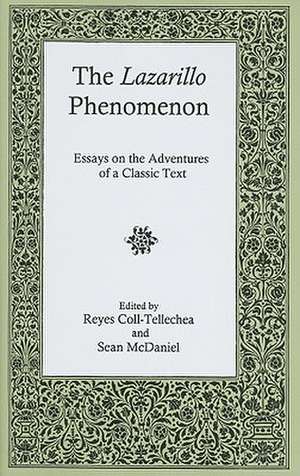
The Lazarillo Phenomenon: Essays on the Adventures of a Classic Text
Editat de Reyes Coll-Tellechea, Sean McDanielen Limba Engleză Hardback – iun 2010
The Lazarillo Phenomenon directs the reader's attention away from traditional concerns and toward different areas such as the complexities surrounding the production, transmission, and reception of the novel across time, and the wide-ranging social, historical, political, literary, economic, and religious circumstances in which it was written, banned, censured, and finally re-circulated. Contributors include Reyes Coll-Tellechea, María V. Jordán Arroyo, Ismene Kansí, Sean McDaniel, Joseph V. Ricapito, Theresa Ann Sears, Benjamín Torrico, Anthony Zahareas, and Oscar Pereira Zazo.
Preț: 499.76 lei
Preț vechi: 753.87 lei
-34%
Puncte Express: 750
Preț estimativ în valută:
88.38€ • 103.71$ • 76.66£
88.38€ • 103.71$ • 76.66£
Carte tipărită la comandă
Livrare economică 10-24 martie
Specificații
ISBN-13: 9781611483482
ISBN-10: 1611483484
Pagini: 202
Dimensiuni: 168 x 243 x 17 mm
Greutate: 0.44 kg
Editura: Bloomsbury Publishing
Colecția Bucknell University Press
Locul publicării:New York, United States
ISBN-10: 1611483484
Pagini: 202
Dimensiuni: 168 x 243 x 17 mm
Greutate: 0.44 kg
Editura: Bloomsbury Publishing
Colecția Bucknell University Press
Locul publicării:New York, United States
V-ar putea interesa
-
 -15%Preț: 454.21 lei534.37 lei
 -
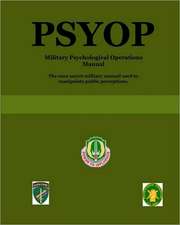 Psyop: Military Psychological Operations ManualArmy U. S. ArmyPreț: 146.99 lei
 -
 Big Man on Campus: A University President Speaks Out on Higher EducationStephen Joel TrachtenbergPreț: 103.80 lei
 -
 Preț: 94.45 lei
 -
 Preț: 48.17 lei
 -
 Preț: 148.58 lei
 -
 Preț: 83.69 lei
 -
 Preț: 76.65 lei
 -
 Preț: 116.34 lei
 -
 Preț: 116.13 lei
 -
 A Guide to Library Research in MusicPauline Shaw Bayne-18%Preț: 332.73 lei406.55 lei
 -
 The Greatest Cult Television Shows of All TimeChristopher J. Olson-17%Preț: 315.95 lei382.86 lei
 -
 -22%Preț: 250.29 lei319.78 lei
 -
 Historical Dictionary of JazzJohn S. Davis-33%Preț: 835.53 lei1256.34 lei
 -
 Historical Dictionary of Middle Eastern CinemaTerri Ginsberg-34%Preț: 976.49 lei1469.06 lei
 -
 That's Not in My Geography BookKate KellyPreț: 83.76 lei
 -
 Contemporary Athletics Compendium: Volume 2James H. Humphrey-30%Preț: 872.60 lei1249.36 lei
 -
 AzorenfloraAndreas StieglitzPreț: 151.68 lei
 -
 Harmonisierung mit Klang und FarbeMarion SigmundPreț: 112.57 lei
 -
 WC-GästebuchManfred HilbergerPreț: 70.41 lei
 -
 Lernvorschläge für die Sachkundeprüfung im Bewachungsgewerbe gem. §34a GewO XII - LexikonKim Marc Alexander WeßelingPreț: 180.16 lei
 -
 Lernvorschläge für die Sachkundeprüfung im Bewachungsgewerbe gem. §34a GewO X - PraxishilfenKim Marc Alexander WeßelingPreț: 199.49 lei
Recenzii
These nine intelligent, well-argued essays on Lazarillo de Tormes (1554)-an anonymously written work generally acknowledged as the first picaresque narrative and posited by some scholars as the first modern novel-focus on subjects ranging from the internal structure of the text to its representation of the politics of social status to the implications of its early circulation....A welcome addition....Recommended.
Scholars of Spanish literature offer new perspectives on the anonymous picaresque novel , first published in 1555 and considered one of the literary treasures of Spain's Golden Age. They discuss reframing studies; publicity and fictionality; the importance of post-publication history; the Spanish Inquisition and the battle for ; the alimentary code in the novel; the secret library of Barcarrota; the women; the odyssey of and the secular state of mind; and style, diction, and content. Quotations are in Spanish followed by English translation.
I find Pereira's elaborations refreshing as he brings to bear the distinctness of public, private, and particular and their respective roles in Spanish culture of the wider period.
Scholars of Spanish literature offer new perspectives on the anonymous picaresque novel , first published in 1555 and considered one of the literary treasures of Spain's Golden Age. They discuss reframing studies; publicity and fictionality; the importance of post-publication history; the Spanish Inquisition and the battle for ; the alimentary code in the novel; the secret library of Barcarrota; the women; the odyssey of and the secular state of mind; and style, diction, and content. Quotations are in Spanish followed by English translation.
I find Pereira's elaborations refreshing as he brings to bear the distinctness of public, private, and particular and their respective roles in Spanish culture of the wider period.