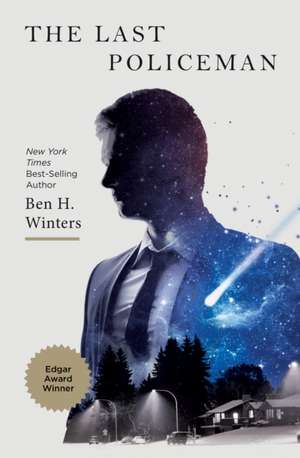
The Last Policeman: A Novel: Last Policeman, cartea 01
Autor Ben H. Wintersen Limba Engleză Paperback – 13 mai 2013
“A genre-defying blend of crime writing and science fiction.” –Alexandra Alter, The New York Times
Winner of the 2013 Edgar® Award for Best Paperback Original!
An asteroid is on a direct collision course with Earth, and everyone knows there is no escape. The economy spirals downward while crops rot in the fields. Churches and synagogues are packed. People all over the world are walking off the job—but Detective Hank Palace refuses to surrender to despair. When a man is found dead in an apparent suicide, Hank sees evidence everyone else ignores—and becomes the only person willing to investigate.
As his investigation unfolds against the backdrop of an increasingly unstable society, Hank uncovers secrets that challenge not only the case itself but the very foundations of justice, morality, and purpose. With every passing day bringing the asteroid closer, he must decide whether truth still matters when the future has already been erased.
Winner of the Edgar Award for Best Paperback Original, The Last Policeman is a brilliantly original blend of detective fiction, speculative science fiction, and philosophical suspense. Launching Ben H. Winters' acclaimed trilogy, it delivers an unforgettable mystery while asking one of fiction's most compelling questions: What gives life meaning when time is running out?
Preț: 102.41 lei
Puncte Express: 154
Carte disponibilă
Livrare economică 02-16 noiembrie
Livrare prin curier în România Termenul estimat este afișat lângă disponibilitate.
Transport gratuit de la 400.00 lei Plată online sau ramburs, în funcție de opțiunile comenzii.
Retur gratuit în 14 zile Comandă securizată și suport în română.
Specificații
ISBN-13: 9781594746741
ISBN-10: 1594746745
Pagini: 336
Dimensiuni: 134 x 202 x 23 mm
Greutate: 0.3 kg
Editura: QUIRK BOOKS
Colecția Quirk Books
Seria Last Policeman
ISBN-10: 1594746745
Pagini: 336
Dimensiuni: 134 x 202 x 23 mm
Greutate: 0.3 kg
Editura: QUIRK BOOKS
Colecția Quirk Books
Seria Last Policeman
V-ar putea interesa
-
 Preț: 140.96 lei
 -
 End GameJeffrey ArcherPreț: 123.70 lei
 -
 The LastHanna Jameson-18%Preț: 59.77 lei72.84 lei
 -
 ExtremityNicholas BingePreț: 119.28 lei
 -
 -23%Preț: 800.35 lei1039.43 lei
 -
 The Survivor Wants to Die at the EndAdam SilveraPreț: 92.92 lei
 -
 Preț: 163.07 lei
 -
 Every Last SuspectNicola Moriarty-18%Preț: 58.97 lei71.78 lei
 -
 Famous Last WordsGillian McAllisterPreț: 71.78 lei
 -
 The Last Murder at the End of the WorldStuart Turton-26%Preț: 52.98 lei71.36 lei
 -
 Simul: Momenticon, Book 2Andrew Caldecott-26%Preț: 58.09 lei78.53 lei
 -
 Countdown City: The Last Policeman Book IIBen H. WintersPreț: 87.63 lei
 -
 World of Trouble: The Last Policeman Book IIIBen H. WintersPreț: 89.63 lei
 -
 Last SeenJ. T. EllisonPreț: 66.49 lei
 -
 8 Months LeftJames PattersonPreț: 71.78 lei
 -
 At the End of the World, Turn LeftZhanna SlorPreț: 72.07 lei
 -
 Preț: 57.65 leiRecomandat
 -
 -19%Preț: 58.40 lei71.88 leiRecomandat
Notă biografică
Ben H. Winters is the New York Times best-selling, Edgar Award–winning, and Philip K. Dick Award–winning author of The Quiet Boy, Golden State, Underground Airlines, the Last Policeman trilogy, and the mash-up novel Sense and Sensibility and Sea Monsters. Ben has also worked extensively in television; he was a writer on the FX cult hit Legion as well as Manhunt on Apple TV+, and he is the creator of the CBS drama Tracker. He lives in Los Angeles with his wife, three kids, and one large dog.
Extras
I’m staring at the insurance man and he’s staring at me, two cold gray eyes behind old-fashioned tortoiseshell frames, and I’m having this awful and inspiring feeling, like holy moly this is real, and I don’t know if I’m ready, I really don’t.
I narrow my eyes and I steady myself and I take him in again, shift on my haunches to get a closer look. The eyes and the glasses, the weak chin and the receding hairline, the thin black belt tied and tightened beneath the chin.
This is real. Is it? I don’t know.
I take a deep breath, demanding of myself that I focus, block out everything but the corpse, block out the grimy floors and the tinny rock-and-roll Muzak from the cheap speakers in the ceiling.
The smell is killing me, a pervasive and deeply unpleasant odor, like a horse barn that’s been splashed with French-fry grease. There are any number of jobs in this world still being efficiently and diligently accomplished, but the late-night cleaning of twentypoliceman four-hour fast-food-restaurant bathrooms is not among them. Case in point: the insurance man had been slumped over in here, lodged between the toilet and the dull green wall of the stall, for several hours before Officer Michelson happened to come in, needing to use the john, and discovered him.
Michelson called it in as a 10-54S, of course, which is what it looks like. One thing I’ve learned in the last few months, one thing we’ve all learned, is that suicides-by-hanging rarely end up dangling from a light fixture or a roof beam, like in the movies. If they’re serious, and nowadays everybody is serious, would-be suicides fasten themselves to a doorknob, or to a coat hook, or, as the insurance man appears to have done, to a horizontal rail, like the grab bar in a handicapped stall. And then they just lean forward, let their weight do the work, tighten the knot, seal the airway.
I angle farther forward, readjust my crouch, trying to find a way to share space comfortably with the insurance man without falling or getting my fingerprints all over the scene. I’ve had nine of these in the three and a half months since I became a detective, and still I can’t get used to it, to what death by asphyxiation does to a person’s face: the eyes staring forward as if in horror, laced with thin red spiderwebs of blood; the tongue, rolled out and over to one side; the lips, inflated and purplish at the edges. I close my eyes, rub them with my knuckles, and look again, try to get a sense of what the insurance man’s appearance had been in life. He wasn’t handsome, that you can see right away. The face is doughy and the proportions are all just a little off: chin too small, nose too big, the eyes almost beady behind the thick lenses.
What it looks like is that the insurance man killed himself with a long black belt. He fastened one end to the grab bar and worked the other end into the hangman’s knot that now digs brutally upward into his Adam’s apple.
“Hey, kid. Who’s your friend?”
“Peter Anthony Zell,” I answer quietly, looking up over my shoulder at Dotseth, who has opened the door of the stall and stands grinning down at me in a jaunty plaid scarf, clutching a steaming cup of McDonald’s coffee.
“Caucasian male. Thirty-eight years old. He worked in insurance.”
“And let me guess,” says Dotseth. “He was eaten by a shark. Oh, wait, no: suicide. Is it suicide?”
“It appears that way.”
“Shocked, I am! Shocked!” Denny Dotseth is an assistant attorney general, a warhorse with silver hair and a broad, cheerful face. “Oh, geez, I’m sorry, Hank. Did you want a cup of coffee?”
“No, thank you, sir.”
I give Dotseth a report on what I’ve learned from the black faux-leather wallet in the victim’s back pocket. Zell was employed at a company called Merrimack Life and Fire, with offices in the Water West Building, off Eagle Square. A little collection of movie stubs, all dating from the last three months, speaks to a taste for adolescent adventure: the Lord of the Rings revival; two installments of the sci-fi serial Distant Pale Glimmers; the DC-versus-Marvel thing at the IMAX in Hooksett. No trace of a family, no photographs in the wallet at all. Eighty-five dollars in fives and tens. And a driver’s license, with an address here in town: 14 Matthew Street Extension, South Concord.
“Oh, sure. I know that area. Some nice little town houses down that way. Rolly Lewis has a place over there.”
“And he got beat up.”
“Rolly?”
“The victim. Look.” I turn back to the insurance man’s distorted face and point to a cluster of yellowing bruises, high on the right cheek. “Someone banged him one, hard.”
“Oh, yeah. He sure did.”
Dotseth yawns and sips his coffee. New Hampshire statute has long required that someone from the office of the attorney general be called whenever a dead body is discovered, so that if a murder case is to be built, the prosecuting authority has a hand in from Go. In mid-January this requirement was overturned by the state legislature as being unduly onerous, given the present unusual circumstances—Dotseth and his colleagues hauling themselves all over the state just to stand around like crows at murder scenes that aren’t murder scenes at all. Now, it’s up to the discretion of the investigating officer whether to call an AAG to a 10-54S. I usually go ahead and call mine in.
“So what else is new, young man?” says Dotseth. “You still
playing a little racquetball?”
“I don’t play racquetball, sir,” I say, half listening, eyes locked on the dead man.
“You don’t? Who am I thinking of?”
I’m tapping a finger on my chin. Zell was short, five foot six maybe; stubby, thick around the middle. Holy moly, I’m still thinking, because something is off about this body, this corpse, this particular presumptive suicide, and I’m trying to figure out what it is.
“No phone,” I murmur.
“What?”
“His wallet is here, and his keys, but there’s no cell phone.”
Dotseth shrugs. “Betcha he junked it. Beth just junked hers. Service is starting to get so dicey, she figured she might as well get rid of the darn thing now.“
I nod, murmur “sure, sure,” still staring at Zell.
“Also, no note.”
“What?”
“There’s no suicide note.”
“Oh, yeah?” he says, shrugs again. “Probably a friend will find it. Boss, maybe.” He smiles, drains the coffee. “They all leave notes, these folks. Although, you have to say, explanation not really necessary at this point, right?”
“Yes, sir,” I say, running a hand over my mustache. “Yes, indeed.”
Last week in Kathmandu, a thousand pilgrims from all over southeast Asia walked into a massive pyre, monks chanting in a circle around them before marching into the blaze themselves. In central Europe, old folks are trading how-to DVDs: How toWeigh Your Pockets with Stones, How to Mix a Barbiturate Cocktail in the Sink. In the American Midwest—Kansas City, St. Louis, Des Moines—the trend is firearms, a solid majority employing a shotgun blast to the brain.
Here in Concord, New Hampshire, for whatever reason, it’s hanger town. Bodies slumped in closets, in sheds, in unfinished basements. A week ago Friday, a furniture-store owner in East Concord tried to do it the Hollywood way, hoisted himself from an overhanging length of gutter with the sash of his bathrobe, but the gutter pipe snapped, sent him tumbling down onto the patio, alive but with four broken limbs.
“Anyhow, it’s a tragedy,” Dotseth concludes blandly. “Every one of them a tragedy.”
He shoots a quick look at his watch; he’s ready to boogie. But I’m still down in a squat, still running my narrowed eyes over the body of the insurance man. For his last day on earth, Peter Zell chose a rumpled tan suit and a pale blue button-down dress shirt. His socks almost but don’t quite match, both of them brown, one dark and one merely darkish, both loose in their elastic, slipping down his calves. The belt around his neck, what Dr. Fenton will call the ligature, is a thing of beauty: shiny black leather, the letters B&R etched into the gold buckle.
“Detective? Hello?” Dotseth says, and I look up at him and I blink. “Anything else you’d like to share?”
“No, sir. Thank you.”
“No sweat. Pleasure as always, young man.”
“Except, wait.”
“Sorry?”
I stand up straight and turn and face him. “So. I’m going to murder somebody.” A pause. Dotseth waiting, amused, exaggerated patience. “All righty.”
“And I live in a time and a town where people are killing themselves all over the place. Right and left. It’s hanger town.”
“Okay.”
“Wouldn’t my move be, kill my victim and then arrange it to appear as a suicide?”
“Maybe.”
“Maybe, right?”
“Yeah. Maybe. But that right there?” Dotseth jabs a cheerful thumb toward the slumped corpse. “That’s a suicide.”
He winks, pushes open the door of the men’s room, and leaves me alone with Peter Zell.
I narrow my eyes and I steady myself and I take him in again, shift on my haunches to get a closer look. The eyes and the glasses, the weak chin and the receding hairline, the thin black belt tied and tightened beneath the chin.
This is real. Is it? I don’t know.
I take a deep breath, demanding of myself that I focus, block out everything but the corpse, block out the grimy floors and the tinny rock-and-roll Muzak from the cheap speakers in the ceiling.
The smell is killing me, a pervasive and deeply unpleasant odor, like a horse barn that’s been splashed with French-fry grease. There are any number of jobs in this world still being efficiently and diligently accomplished, but the late-night cleaning of twentypoliceman four-hour fast-food-restaurant bathrooms is not among them. Case in point: the insurance man had been slumped over in here, lodged between the toilet and the dull green wall of the stall, for several hours before Officer Michelson happened to come in, needing to use the john, and discovered him.
Michelson called it in as a 10-54S, of course, which is what it looks like. One thing I’ve learned in the last few months, one thing we’ve all learned, is that suicides-by-hanging rarely end up dangling from a light fixture or a roof beam, like in the movies. If they’re serious, and nowadays everybody is serious, would-be suicides fasten themselves to a doorknob, or to a coat hook, or, as the insurance man appears to have done, to a horizontal rail, like the grab bar in a handicapped stall. And then they just lean forward, let their weight do the work, tighten the knot, seal the airway.
I angle farther forward, readjust my crouch, trying to find a way to share space comfortably with the insurance man without falling or getting my fingerprints all over the scene. I’ve had nine of these in the three and a half months since I became a detective, and still I can’t get used to it, to what death by asphyxiation does to a person’s face: the eyes staring forward as if in horror, laced with thin red spiderwebs of blood; the tongue, rolled out and over to one side; the lips, inflated and purplish at the edges. I close my eyes, rub them with my knuckles, and look again, try to get a sense of what the insurance man’s appearance had been in life. He wasn’t handsome, that you can see right away. The face is doughy and the proportions are all just a little off: chin too small, nose too big, the eyes almost beady behind the thick lenses.
What it looks like is that the insurance man killed himself with a long black belt. He fastened one end to the grab bar and worked the other end into the hangman’s knot that now digs brutally upward into his Adam’s apple.
“Hey, kid. Who’s your friend?”
“Peter Anthony Zell,” I answer quietly, looking up over my shoulder at Dotseth, who has opened the door of the stall and stands grinning down at me in a jaunty plaid scarf, clutching a steaming cup of McDonald’s coffee.
“Caucasian male. Thirty-eight years old. He worked in insurance.”
“And let me guess,” says Dotseth. “He was eaten by a shark. Oh, wait, no: suicide. Is it suicide?”
“It appears that way.”
“Shocked, I am! Shocked!” Denny Dotseth is an assistant attorney general, a warhorse with silver hair and a broad, cheerful face. “Oh, geez, I’m sorry, Hank. Did you want a cup of coffee?”
“No, thank you, sir.”
I give Dotseth a report on what I’ve learned from the black faux-leather wallet in the victim’s back pocket. Zell was employed at a company called Merrimack Life and Fire, with offices in the Water West Building, off Eagle Square. A little collection of movie stubs, all dating from the last three months, speaks to a taste for adolescent adventure: the Lord of the Rings revival; two installments of the sci-fi serial Distant Pale Glimmers; the DC-versus-Marvel thing at the IMAX in Hooksett. No trace of a family, no photographs in the wallet at all. Eighty-five dollars in fives and tens. And a driver’s license, with an address here in town: 14 Matthew Street Extension, South Concord.
“Oh, sure. I know that area. Some nice little town houses down that way. Rolly Lewis has a place over there.”
“And he got beat up.”
“Rolly?”
“The victim. Look.” I turn back to the insurance man’s distorted face and point to a cluster of yellowing bruises, high on the right cheek. “Someone banged him one, hard.”
“Oh, yeah. He sure did.”
Dotseth yawns and sips his coffee. New Hampshire statute has long required that someone from the office of the attorney general be called whenever a dead body is discovered, so that if a murder case is to be built, the prosecuting authority has a hand in from Go. In mid-January this requirement was overturned by the state legislature as being unduly onerous, given the present unusual circumstances—Dotseth and his colleagues hauling themselves all over the state just to stand around like crows at murder scenes that aren’t murder scenes at all. Now, it’s up to the discretion of the investigating officer whether to call an AAG to a 10-54S. I usually go ahead and call mine in.
“So what else is new, young man?” says Dotseth. “You still
playing a little racquetball?”
“I don’t play racquetball, sir,” I say, half listening, eyes locked on the dead man.
“You don’t? Who am I thinking of?”
I’m tapping a finger on my chin. Zell was short, five foot six maybe; stubby, thick around the middle. Holy moly, I’m still thinking, because something is off about this body, this corpse, this particular presumptive suicide, and I’m trying to figure out what it is.
“No phone,” I murmur.
“What?”
“His wallet is here, and his keys, but there’s no cell phone.”
Dotseth shrugs. “Betcha he junked it. Beth just junked hers. Service is starting to get so dicey, she figured she might as well get rid of the darn thing now.“
I nod, murmur “sure, sure,” still staring at Zell.
“Also, no note.”
“What?”
“There’s no suicide note.”
“Oh, yeah?” he says, shrugs again. “Probably a friend will find it. Boss, maybe.” He smiles, drains the coffee. “They all leave notes, these folks. Although, you have to say, explanation not really necessary at this point, right?”
“Yes, sir,” I say, running a hand over my mustache. “Yes, indeed.”
Last week in Kathmandu, a thousand pilgrims from all over southeast Asia walked into a massive pyre, monks chanting in a circle around them before marching into the blaze themselves. In central Europe, old folks are trading how-to DVDs: How toWeigh Your Pockets with Stones, How to Mix a Barbiturate Cocktail in the Sink. In the American Midwest—Kansas City, St. Louis, Des Moines—the trend is firearms, a solid majority employing a shotgun blast to the brain.
Here in Concord, New Hampshire, for whatever reason, it’s hanger town. Bodies slumped in closets, in sheds, in unfinished basements. A week ago Friday, a furniture-store owner in East Concord tried to do it the Hollywood way, hoisted himself from an overhanging length of gutter with the sash of his bathrobe, but the gutter pipe snapped, sent him tumbling down onto the patio, alive but with four broken limbs.
“Anyhow, it’s a tragedy,” Dotseth concludes blandly. “Every one of them a tragedy.”
He shoots a quick look at his watch; he’s ready to boogie. But I’m still down in a squat, still running my narrowed eyes over the body of the insurance man. For his last day on earth, Peter Zell chose a rumpled tan suit and a pale blue button-down dress shirt. His socks almost but don’t quite match, both of them brown, one dark and one merely darkish, both loose in their elastic, slipping down his calves. The belt around his neck, what Dr. Fenton will call the ligature, is a thing of beauty: shiny black leather, the letters B&R etched into the gold buckle.
“Detective? Hello?” Dotseth says, and I look up at him and I blink. “Anything else you’d like to share?”
“No, sir. Thank you.”
“No sweat. Pleasure as always, young man.”
“Except, wait.”
“Sorry?”
I stand up straight and turn and face him. “So. I’m going to murder somebody.” A pause. Dotseth waiting, amused, exaggerated patience. “All righty.”
“And I live in a time and a town where people are killing themselves all over the place. Right and left. It’s hanger town.”
“Okay.”
“Wouldn’t my move be, kill my victim and then arrange it to appear as a suicide?”
“Maybe.”
“Maybe, right?”
“Yeah. Maybe. But that right there?” Dotseth jabs a cheerful thumb toward the slumped corpse. “That’s a suicide.”
He winks, pushes open the door of the men’s room, and leaves me alone with Peter Zell.
Recenzii
Winner of the 2013 Edgar® Award for Best Paperback Original
One of Slate’s Best Books of 2012
A July 2012 Indie Next List Pick
“It’s funny, it’s thrilling, it’s crazy, it’s interesting.”—Jenna Bush Hager, TODAY with Hoda & Jenna
“Winters’s apocalyptic detective story contains an earth-shattering element of science fiction that lifts it beyond a typical procedural.”—New York Times Book Review
“An appealing hybrid of the best of science fiction and crime fiction.”—The Washington Post
"[The] weird, beautiful, unapologetically apocalyptic Last Policeman trilogy is one of my favorite mystery series."—John Green, author of The Fault in Our Stars and Paper Towns
“In his acclaimed Last Policeman trilogy, Winters showed off his mastery of edgy, sardonic wit — there’s nothing like an asteroid speeding toward Earth to bring out the black humor in people.”—Newsday
“Sharp, funny, and deeply wise.”—Slate.com
“Darkly intriguing.”—Discover
“I’m in the middle of it and can’t put the dang thing down.”—USA Today’s Pop Candy
“Exhilarating.”—E! Online
“Ben Winters makes noir mystery even darker: his latest novel sets a despondent detective on a suspicious suicide case—while an asteroid hurtles toward earth.”—Wired.com
“Winters’s writing is funny, surprisingly tender, and thoroughly human.”—Ellery Queen Mystery Magazine
“A sturdy, functional, entertaining page-turner.”—Greg Cook, WBUR.org
“I’m eager to read the other books, and expect that they’ll keep me as enthralled as the first one did.”—Mark Frauenfedler, Boing Boing
“The Last Policeman is extraordinary—as well as brilliant, surprising, and, considering the circumstances, oddly uplifting.”—Mystery Scene
“Full of compelling twists, likable characters, and a sad beauty, The Last Policeman is a gem.”—San Francisco Book Review
“This is a book that asks big questions about civilization, community, desperation and hope.”—io9
“In his Last Policeman trilogy, for which he won both the Edgar Award and the Philip K. Dick Award, Winters took a standard science fiction trope — the final months before an asteroid slams into Earth — and mixed it with some of the conventions of the detective novel, imbuing his apocalyptic scenario with an extra measure of urgency and poignancy.”—The San Francisco Chronicle
“The Last Policeman succeeds both as a mystery, with a quirky detective and an intriguing whodunit, and as a piece of apocalyptic speculative fiction.”—Sacramento News & Review
“Resonant and powerful.”—Locus
“A promising kickoff to a planned trilogy. For Winters, the beauty is in the details rather than the plot’s grim main thrust.”—Kirkus Reviews, starred review
One of Slate’s Best Books of 2012
A July 2012 Indie Next List Pick
“It’s funny, it’s thrilling, it’s crazy, it’s interesting.”—Jenna Bush Hager, TODAY with Hoda & Jenna
“Winters’s apocalyptic detective story contains an earth-shattering element of science fiction that lifts it beyond a typical procedural.”—New York Times Book Review
“An appealing hybrid of the best of science fiction and crime fiction.”—The Washington Post
"[The] weird, beautiful, unapologetically apocalyptic Last Policeman trilogy is one of my favorite mystery series."—John Green, author of The Fault in Our Stars and Paper Towns
“In his acclaimed Last Policeman trilogy, Winters showed off his mastery of edgy, sardonic wit — there’s nothing like an asteroid speeding toward Earth to bring out the black humor in people.”—Newsday
“Sharp, funny, and deeply wise.”—Slate.com
“Darkly intriguing.”—Discover
“I’m in the middle of it and can’t put the dang thing down.”—USA Today’s Pop Candy
“Exhilarating.”—E! Online
“Ben Winters makes noir mystery even darker: his latest novel sets a despondent detective on a suspicious suicide case—while an asteroid hurtles toward earth.”—Wired.com
“Winters’s writing is funny, surprisingly tender, and thoroughly human.”—Ellery Queen Mystery Magazine
“A sturdy, functional, entertaining page-turner.”—Greg Cook, WBUR.org
“I’m eager to read the other books, and expect that they’ll keep me as enthralled as the first one did.”—Mark Frauenfedler, Boing Boing
“The Last Policeman is extraordinary—as well as brilliant, surprising, and, considering the circumstances, oddly uplifting.”—Mystery Scene
“Full of compelling twists, likable characters, and a sad beauty, The Last Policeman is a gem.”—San Francisco Book Review
“This is a book that asks big questions about civilization, community, desperation and hope.”—io9
“In his Last Policeman trilogy, for which he won both the Edgar Award and the Philip K. Dick Award, Winters took a standard science fiction trope — the final months before an asteroid slams into Earth — and mixed it with some of the conventions of the detective novel, imbuing his apocalyptic scenario with an extra measure of urgency and poignancy.”—The San Francisco Chronicle
“The Last Policeman succeeds both as a mystery, with a quirky detective and an intriguing whodunit, and as a piece of apocalyptic speculative fiction.”—Sacramento News & Review
“Resonant and powerful.”—Locus
“A promising kickoff to a planned trilogy. For Winters, the beauty is in the details rather than the plot’s grim main thrust.”—Kirkus Reviews, starred review
Descriere
An Edgar Award–winning science fiction mystery where one determined detective investigates a possible murder as humanity counts down its final six months before an asteroid destroys the Earth.
“A genre-defying blend of crime writing and science fiction.” –Alexandra Alter, The New York Times
Winner of the 2013 Edgar® Award for Best Paperback Original!
“A genre-defying blend of crime writing and science fiction.” –Alexandra Alter, The New York Times
Winner of the 2013 Edgar® Award for Best Paperback Original!