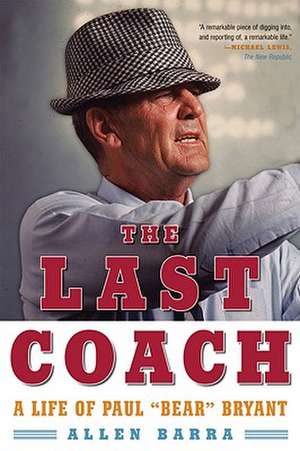
The Last Coach
Autor Allen Barraen Limba Engleză Paperback – sep 2006
Descoperim în The Last Coach nu doar cronica unei cariere sportive prodigioase, ci portretul unei figuri monumentale care a definit valorile sudului american prin disciplină, loialitate și o etică a muncii neînduplecată. Cititorul va înțelege rapid de ce moartea lui Paul „Bear” Bryant a fost tratată cu reverența rezervată șefilor de stat, fiind martorul transformării unui copil dintr-o familie de fermieri săraci în cel mai influent antrenor din istoria fotbalului american. Notăm cu interes modul în care Allen Barra refuză hagiografia simplistă, alegând în schimb să exploreze nuanțele unui om care, deși prieten public cu segregaționistul George Wallace, a acționat discret pentru integrarea rasială a echipei sale, forțând schimbări sociale profunde prin intermediul sportului. Abordarea amintește de Coach de Keith Dunnavant prin dorința de a oferi un portret definitiv al succesului la Alabama Crimson Tide, dar Allen Barra adaugă o profunzime jurnalistică superioară, analizând controversele—de la brutalitatea antrenamentelor „Junction Boys” la procesele de defăimare care au zguduit presa vremii. Remarcăm ritmul narativ dens, susținut de cele peste 600 de pagini, care reușește să mențină tensiunea unei finale de campionat. În contextul operei sale, această biografie consolidează expertiza lui Barra în analiza miturilor sportive, fiind o continuare firească a cercetărilor sale din Clearing the Bases, unde chestiona fundamentele succesului în sport, sau din Mickey and Willie, unde explora dualitatea figurilor legendare. Este o lucrare despre putere, autoritate și moștenirea durabilă a unui om care a fost, pentru milioane de oameni, pur și simplu „Antrenorul”.
Preț: 225.15 lei
Carte disponibilă
Livrare economică 07-21 noiembrie
Livrare express 24-30 octombrie pentru 98.04 lei
Specificații
ISBN-10: 039332897X
Pagini: 610
Dimensiuni: 140 x 210 x 33 mm
Greutate: 0.74 kg
Editura: W. W. Norton & Company
V-ar putea interesa
-
 Manchester City Ruined My LifeColin Shindler-27%Preț: 68.34 lei93.13 lei
 -
 Kiss or KillMark TwightPreț: 113.15 lei
 -
 Lost Lanes Southern EnglandJack ThurstonPreț: 110.33 lei
 -
 ScarpNick Papadimitriou-27%Preț: 66.98 lei91.64 lei
 -
 Seven Deadly Sins: My Pursuit of Lance ArmstrongDavid Walsh-31%Preț: 56.03 lei80.62 lei
 -
 Tarka Line WalksPeter CraskePreț: 73.16 lei
 -
 Eric Tabarly: Memories of the Open SeaEric TabarlyPreț: 83.75 lei
De ce să citești această carte
Această carte este esențială pentru oricine dorește să înțeleagă psihologia leadershipului sub presiune extremă. Dincolo de tacticile de fotbal american, cititorul câștigă o perspectivă rară asupra modului în care un singur om poate influența cultura unei întregi regiuni. Este o recomandare certă pentru pasionații de biografii istorice și pentru cei care caută să descopere cum sportul poate deveni un motor al schimbării sociale și al integrității personale.
Despre autor
Allen Barra este un reputat jurnalist sportiv și autor, cunoscut pentru rubrica sa din „Wall Street Journal” și contribuțiile constante în „New York Times” și „Salon.com”. Expertiza sa în istoria sportului american este vastă, publicând lucrări de referință precum Mickey and Willie și Clearing the Bases. Stilul său se caracterizează printr-o documentare riguroasă și o capacitate de a contextualiza performanța sportivă în mediul social și politic al epocii. În The Last Coach, Barra își folosește experiența de analist pentru a demonta miturile și a prezenta realitatea complexă a celei mai mari legende din fotbalul universitar.
Descriere scurtă
President Reagan and the three former American presidents sent flowers, as did people as diverse as Bob Hope, ABC's Roone Arledge, advice columnist Ann Landers and the Reverend Billy Graham. Scores of Bryant's former players, including Joe Namath, Lee Roy Jordan, Ken Stabler and Ozzie Newsome, were in attendance. So were Bryant's most distinguished colleagues, the greatest living football coaches, including Southern Cal's John McKay, who said, It was like a presidential funeral procession. No coach in America could have gotten that. No coach but him. But then, he wasn't just a coach. He was the coach.
Bryant's passing was noted with the kind of reverence our country reserved for statesmen or military leaders, though Paul Bear Bryant had insisted for much of his life that he was just a football coach. For millions he was much more, he was the greatest coach the game ever saw, the heir to the tradition established by Knute Rockne. He took his Alabama Crimson Tide teams to an unmatched six national championships. But to the players, journalists and fans whose lives he touched in his more than half a century as a player and coach, he was the last symbol of values that transcended football--courage, discipline, loyalty, and hard work.
To his critics, Bryant represented the dark side of big-time college football--brutality, fanaticism and blind adherence to authority. The real Bear Bryant was far more complex than either his admirers or detractors knew. While maintaining a public friendship with Alabama governor George Wallace, he continually sought ways to undermine the governor's segregationist policies, finally forcing a legendary football game in Birmingham with the University of Southern California that opened the floodgates to the integration of football at the University of Alabama, including its coaching staff. Old fashioned in his politics, he was nonetheless an admirer of Robert Kennedy, whom he planning to vote for in 1968.
Allen Barra's The Last Coach traces Paul Bryant's rise from a family of truck farmers to recognition as the most successful and influential coach in the game's history. The eleventh of thirteen children, Bryant was born in tiny Moro Bottom, Arkansas in 1913 and grew up in nearby Fordyce--where his legend was born when he wrestled a live bear on the stage of a local theater. Paul was raised by his mother, who barely managed to keep him out of trouble and on the Fordyce High School Redbugs long enough to get a football scholarship at Alabama, where he would meet and marry the love of his life, campus beauty queen Mary Harmon Black.
At the height of the Depression, football took Bryant to the Rose Bowl with Alabama's 1934 national champions and on to a career as an assistant and, finally, a head football coach, where he matched wit and grit with the greatest coaches of two generations, men like Tennessee's General Robert Neyland, Oklahoma's Bud Wilkinson, Notre Dame's Ara Parseghian, Ohio State's Woody Hayes, and Penn State's Joe Paterno. Along the way, he stirred controversy with his infamous Junction Boys training camp in 1954, during which almost two-thirds of the Texas A&M football team quit; his legal battle with The Saturday Evening Post over the accusation that he had conspired to fix a college football game, a trial which rocked the sports world; and his pursuit of Amos Alonzo Stagg's all-time record for college coaching victories.
Through it all, Bryant's influence has not only endured but prevailed as his former players and assistants continue to define the best in not only college but professional football. A USA Today and Washington Post Best Sports Book.