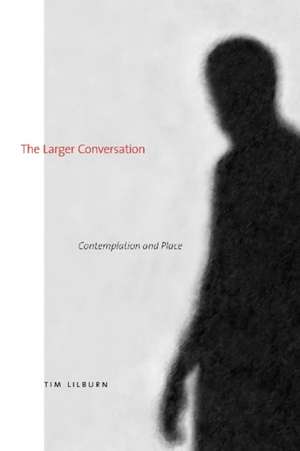
The Larger Conversation: Contemplation and Place
Autor Tim Lilburnen Limba Engleză Paperback – 9 noi 2017
Preț: 204.57 lei
Puncte Express: 307
Carte disponibilă
Livrare economică 09-23 noiembrie
Livrare prin curier în România Termenul estimat este afișat lângă disponibilitate.
Transport gratuit de la 400.00 lei Plată online sau ramburs, în funcție de opțiunile comenzii.
Retur gratuit în 14 zile Comandă securizată și suport în română.
Specificații
ISBN-13: 9781772122992
ISBN-10: 1772122998
Pagini: 296
Dimensiuni: 152 x 229 x 18 mm
Greutate: 0.43 kg
Editura: University of Alberta Press
Colecția University of Alberta Press
Locul publicării:Edmonton, Canada
ISBN-10: 1772122998
Pagini: 296
Dimensiuni: 152 x 229 x 18 mm
Greutate: 0.43 kg
Editura: University of Alberta Press
Colecția University of Alberta Press
Locul publicării:Edmonton, Canada
V-ar putea interesa
-
 DisagreementRichard Feldman-12%Preț: 267.69 lei305.73 lei
 -
 Epistemic ValueAdrian Haddock-31%Preț: 776.61 lei1125.26 lei
 -
 Williamson on KnowledgePatrick Greenough-22%Preț: 378.68 lei485.25 lei
 -
 -31%Preț: 746.12 lei1079.62 lei
 -
 The Nature of NormativityRalph Wedgwood-21%Preț: 425.64 lei541.16 lei
 -
 Learning from Words: Testimony as a Source of KnowledgeJennifer Lackey-12%Preț: 267.97 lei305.88 lei
 -
 The Metaphysics of KnowledgeKeith Hossack-12%Preț: 368.64 lei416.67 lei
 -
 -11%Preț: 331.92 lei373.04 lei
 -
 -34%Preț: 665.26 lei1009.02 lei
 -
 Testimony, Trust, and AuthorityBenjamin McMyler-31%Preț: 675.86 lei976.60 lei
 -
 Naturalizing EpistemologyF. D'AgostinoPreț: 401.31 lei
 -
 On Race and Racism in AmericaRoy MartinezPreț: 263.55 lei
 -
 Heroes and PhilosophyWilliam IrwinPreț: 138.56 lei
 -
 EpistemologyRobert M. MartinPreț: 64.78 lei
Cuprins
IntroductionI1 The Ethical Significance of the Human Relationship to Place2 The Start of Real Thinking3 On Scholem, Ruusbroec and Exegesis4 Imagination, Psychagogy and Ontology5 Mostly on Prayer6 Seeing into Things: Suhrawardi and MandelstamII7 A Mandelstamian Generation in China8 Poetry as Pneumatic Force9 Fresh Coherence10 Turning the Soul Around: The Ascetical Practice of Philosophy in the Republic11 Negative Theological Meditations: Apophasis and Its Politics12 Thinking the Rule of Benedict within Modernity13 Thomas Merton’s Novitiate Talks on Cistercian Usages and Richard Kearney’s TheandrismIII14 A Poetics of Decolonization15 Contemplative Experience; Autochthonous Practice16 Faith and Land17 NothingnessEpilogue: At the Foot of WMIEŦENDramatis PersonaeGlossaryAcknowledgementsReadingPermissionsIndex
Recenzii
"It takes a poet to see the extraordinary in the mundane.... This is reading for the joy of it." [Full review at https://www.blacklocks.ca/book-review-going-home]
"In a series of essays, lectures, confessions, and interviews, all based on years of reading and research, Lilburn shares not new but old, reclaimed ways of thinking—long-ignored riches from the Christian, Judaic and Islamic contemplative wisdom traditions.... In order to undo the Western extractive, colonial approach to land—one that uses, warehouses, and dominates—we have to return to our former strengths, what Lilburn calls 'cognitive rebar.' What justice asks of us is that we do the work to prepare for conversation." [Full article at http://www.focusonvictoria.ca/novdec2017/the-larger-conversation-contemplation-and-place-r5/]
"This book is exactly what I think is required in the emerging scholarly and literary work on decolonization in Canada. This isn't a dry and heavy academic text marking up conceptual territory: territorializing knowledge with confusing title and jargon... This book is much more in the traditions of mystical contemplative philosophy."
"This collection of essays is the third in a series of books in which Lilburn reflects on his own sense of rootlessness, often as a cultural phenomenon. The current book's emphasis on the colonial condition is new...[The] construal at the heart of the book is individual and specific: North Americans of European descent suffer from a colonial malaise consisting significantly of a malformed relation to place."
"[Lilburn] feels that beneath 'the smoothness, the relative fine running of late capitalism,' there’s a disturbing hunger... And why? Because, argues Lilburn, through chapters on philosophical inquiry, spiritual struggle, deep ecological concern, and unsparing self-confession, we have not truly learned how to live on this land so relatively new to us, a land acquired in many ways through violence and dishonesty... What Lilburn attempts in this larger conversation is to find a way back, through earnest inquiry with philosophers, mystics, poets, and saints stretching back thousands of years, to the 'essence of nature'..." [Full review at https://thestarphoenix.com/entertainment/books/book-reviews-lilburn-searches-for-meaning-peeteetuce-creates-scathing-depiction-of-phoniness]
"In 1999, writer and poet Tim Lilburn published the non-fiction work Living in the World as if It Were Home, a meditation on humanity's relationship with the natural environment that has become a classic and was the first book in a loose trilogy examining the connections between politics, environmentalism, philosophy, and modernity. Eighteen years later, the final part of the trilogy, a volume of contemplative essays, is available from UAP."
"The Larger Conversation is a beautiful, patient, and persistent philosophical work.... Lilburn suggests that in entering a relationship with place, with any specific place that we care about, we can be seen by place and thus be given our identity—indeed our Being—through a kind of grace. I love this argument and line of thought for its beauty and practicality. It offers a true way to move forward from the colonial past by first making changes to how we perceive reality—a reality that we constantly misunderstand—about how and why and who we are in place." [Full review at http://canlit.ca/article/being-seen-by-place/]
"One of Lilburn’s primary interests has always been the relationship – the dialogue – between poetry and philosophy, including their common roots and common objectives.... At the same time, some of this writing is deeply personal, even confessional; here, the writer is more candid than usual about his own life, including childhood memories, illness and aging, faith and doubt." Kelly Shepherd, UTP Quarterly 2017 [Full review at DOI 10.3138/utq.88.3.hr79]
"In a series of essays, lectures, confessions, and interviews, all based on years of reading and research, Lilburn shares not new but old, reclaimed ways of thinking—long-ignored riches from the Christian, Judaic and Islamic contemplative wisdom traditions.... In order to undo the Western extractive, colonial approach to land—one that uses, warehouses, and dominates—we have to return to our former strengths, what Lilburn calls 'cognitive rebar.' What justice asks of us is that we do the work to prepare for conversation." [Full article at http://www.focusonvictoria.ca/novdec2017/the-larger-conversation-contemplation-and-place-r5/]
"This book is exactly what I think is required in the emerging scholarly and literary work on decolonization in Canada. This isn't a dry and heavy academic text marking up conceptual territory: territorializing knowledge with confusing title and jargon... This book is much more in the traditions of mystical contemplative philosophy."
"This collection of essays is the third in a series of books in which Lilburn reflects on his own sense of rootlessness, often as a cultural phenomenon. The current book's emphasis on the colonial condition is new...[The] construal at the heart of the book is individual and specific: North Americans of European descent suffer from a colonial malaise consisting significantly of a malformed relation to place."
"[Lilburn] feels that beneath 'the smoothness, the relative fine running of late capitalism,' there’s a disturbing hunger... And why? Because, argues Lilburn, through chapters on philosophical inquiry, spiritual struggle, deep ecological concern, and unsparing self-confession, we have not truly learned how to live on this land so relatively new to us, a land acquired in many ways through violence and dishonesty... What Lilburn attempts in this larger conversation is to find a way back, through earnest inquiry with philosophers, mystics, poets, and saints stretching back thousands of years, to the 'essence of nature'..." [Full review at https://thestarphoenix.com/entertainment/books/book-reviews-lilburn-searches-for-meaning-peeteetuce-creates-scathing-depiction-of-phoniness]
"In 1999, writer and poet Tim Lilburn published the non-fiction work Living in the World as if It Were Home, a meditation on humanity's relationship with the natural environment that has become a classic and was the first book in a loose trilogy examining the connections between politics, environmentalism, philosophy, and modernity. Eighteen years later, the final part of the trilogy, a volume of contemplative essays, is available from UAP."
"The Larger Conversation is a beautiful, patient, and persistent philosophical work.... Lilburn suggests that in entering a relationship with place, with any specific place that we care about, we can be seen by place and thus be given our identity—indeed our Being—through a kind of grace. I love this argument and line of thought for its beauty and practicality. It offers a true way to move forward from the colonial past by first making changes to how we perceive reality—a reality that we constantly misunderstand—about how and why and who we are in place." [Full review at http://canlit.ca/article/being-seen-by-place/]
"One of Lilburn’s primary interests has always been the relationship – the dialogue – between poetry and philosophy, including their common roots and common objectives.... At the same time, some of this writing is deeply personal, even confessional; here, the writer is more candid than usual about his own life, including childhood memories, illness and aging, faith and doubt." Kelly Shepherd, UTP Quarterly 2017 [Full review at DOI 10.3138/utq.88.3.hr79]