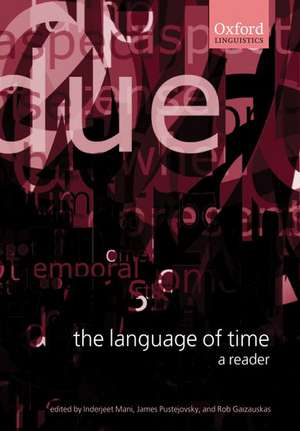
The Language of Time: A Reader
Editat de Inderjeet Mani, James Pustejovsky, Robert Gaizauskasen Limba Engleză Paperback – 26 mai 2005
Preț: 501.74 lei
Preț vechi: 626.48 lei
-20%
Puncte Express: 753
Carte tipărită la comandă
Livrare economică 26 noiembrie-01 decembrie
Livrare prin curier în România Termenul estimat este afișat lângă disponibilitate.
Transport gratuit pentru acest produs Plată online sau ramburs, în funcție de opțiunile comenzii.
Retur gratuit în 14 zile Comandă securizată și suport în română.
Specificații
ISBN-13: 9780199268542
ISBN-10: 0199268541
Pagini: 604
Ilustrații: numerous line figures
Dimensiuni: 171 x 245 x 34 mm
Greutate: 1.05 kg
Editura: Oxford University Press
Colecția OUP Oxford
Locul publicării:Oxford, United Kingdom
ISBN-10: 0199268541
Pagini: 604
Ilustrații: numerous line figures
Dimensiuni: 171 x 245 x 34 mm
Greutate: 1.05 kg
Editura: Oxford University Press
Colecția OUP Oxford
Locul publicării:Oxford, United Kingdom
V-ar putea interesa
-
 Lexical Semantics: The Problem of PolysemyJames Pustejovsky-19%Preț: 365.50 lei453.89 lei
 -
 -31%Preț: 976.08 lei1422.75 lei
 -
 Tentacles!Shirley Raye Redmond-30%Preț: 28.65 lei40.86 lei
 -
 First French ReaderStanley Appelbaum-19%Preț: 63.39 lei78.35 lei
 -
 A Second Spanish ReaderStanley Appelbaum-17%Preț: 46.09 lei55.36 lei
 -
 Great French Short StoriesStanley Appelbaum-19%Preț: 100.04 lei122.83 lei
 -
 -18%Preț: 74.61 lei90.76 lei
 -
 Semantics and the LexiconJames Pustejovsky-15%Preț: 673.63 lei792.50 lei
 -
 The Pilgrim and the BeeMatthew P Brown-11%Preț: 504.87 lei567.28 lei
 -
 -23%Preț: 868.11 lei1127.42 lei
 -
 LesenUte Schneider-23%Preț: 1739.81 lei2259.49 lei
 -
 Die Ilse ist wegChristine NöstlingerPreț: 66.21 lei
 -
 Preț: 169.24 lei
 -
 Die Judenbuche. Text und KommentarAnnette von Droste-HülshoffPreț: 56.34 lei
 -
 Lexical Semantics and Knowledge RepresentationJames Pustejovsky-20%Preț: 340.35 lei425.44 lei
 -
 Annotating, Extracting and Reasoning about Time and EventsFrank Schilder-20%Preț: 314.60 lei393.24 lei
 -
 Puzzles in Logic, Languages and ComputationDragomir Radev-20%Preț: 366.08 lei457.60 lei
 -
 Advances in Generative Lexicon TheoryJames Pustejovsky-20%Preț: 1001.86 lei1252.34 lei
 -
 Handbook of Linguistic AnnotationNancy Ide-20%Preț: 3069.59 lei3836.99 lei
Recenzii
This book brings together a variety of approaches, theoretical as well practical, for dealing with time in natural language. The papers are among the most relevant. They have been arranged in an order which makes sense. The introductions are excellent.... Compulsory reading for people working in the relevant disciplines.
Notă biografică
Inderjeet Mani is Associate Professor of Linguistics at Georgetown University, where he chairs the program in Computational Linguistics. He works on the computer understanding of temporal narrative and on ontologies for natural language processing. His work on automatic summarization has included new summarization methods as well as evaluation techniques, while his research on temporal information extraction has led to the development of taggers for temporal expressions in various languages. He has served on the Editorial Board of the journal Computational Linguistics (2002-4), and has published more than fifty scientific papers and two books: Automatic Summarization (2001) and the co-edited volume Advances in Automatic Text Summarization (1999).James Pustejovsky is Professor of Computer Science and Director of the Laboratory for Linguistics and Computation at Brandeis University. His research focuses on the areas of computational and theoretical models of lexical semantics, temporal reasoning, knowledge representation, and information extraction and retrieval in bioinformatics. His books include The Generative Lexicon (1995), Meaning in Context (2005), and the edited volumes Lexical Semantics and Knowledge Representation (1992 with Sabine Bergler), Semantics and the Lexicon (1993); Lexical Semantics and the Problem of Polysemy (1997 with Bran Boguraev), and Events as Grammatical Objects (2000 with Carol Tenny).Robert Gaizauskas is Professor of Computer Science at the University of Sheffield. His research interests lie in applied natural language processing, especially information extraction and retrieval, both from newswire text and from scientific writing, particularly medical and biological text. He also works on automatic question answering and summarization, on the extraction of temporal information from texts and has an on-going interest in evaluation of language technology. He has published over 80 papers in peer-reviewed journals and conference proceedings.
Cuprins
- Part 1: Tense, Aspect, and Event Structure
- 1: Z. Vendler: Verbs and Times
- 2: James Pustejovsky: The Syntax of Event Structure
- 3: Emmon Bach: The Algebra of Events
- 4: Hans Reichenbach: The Tense of Verbs
- 5: A.N. Prior: Tense Logic and the Logic of Earlier and Later
- 6: Marc Moens and Mark Steedman: Temporal Ontology and Temporal Reference
- 7: Bonnie J. Door and Mari Broman Olsen: Deriving Verbal and Compositional Lexical Aspect for NLP Applications
- 8: Rebecca J. Passonneau: A Computational Model of the Semantics of Tense and Aspect
- Part II: Temporal Reasoning
- 9: Drew McDermot: A Temporal Logic for Reasoning About Processes and Plans
- 10: Robert Kowalski and Marek Sergot: A Logic-Based Calculus of Events
- 11: Luca Chittaro and Carlo Combi: Extending the Event Calculus with Temporal Granularity and Indeterminacy
- 12: James F. Allen: Towards a General Theory of Action and Time
- 13: Antony Galton: A Critical Examination of Allen's Theory of Action and Time
- 14: Jerry Hobbs and James Pustejovsky: Annotating and Reasoning About Time and Events
- Part III: Temporal Structure of Discourse
- 15: David R. Dowty: The Effects of Aspectual Class on the Temporal Structure of Discourse: Semantics or Pragmatics?
- 16: Alex Lascarides and Nicholas Asher: Temporal Relations, Discourse Structure, and Commonsense Entailment
- 17: Allan Bell: News Stories as Narratives
- 18: Bonnie Lynn Webber: Tense as Discourse Anaphor
- 19: Fei Song and Robin Cohen: Tense Interpretation in the Context of Narrative
- 20: Janyce Wiebe, Tom O'Hara, Thorsten Ohrstrom-Sandgren, and K. J. McKeever: An Empirical Approach to Temporal Reference Resolution
- 21: Chung Hee Hwang and Lenhart K. Schubert: Tense Trees as the Fine Structure of Discourse
- 22: Janet Hitzeman, Marc Moens, and Claire Grover: Algorithms for Analyzing the Temporal Structure of Discourse
- Part IV: Temporal Annotation
- 23: George Wilson, Inderjeet Mani, Beth Sundheim, and Lisa Ferro: A Multilingual Approach to Annotating and Extracting Temporal Information
- 24: Graham Katz and Fabrizio Arosio: The Annotation of Temporal Information in Natural Language Sentences
- 25: Elena Filatove and Eduard Hovy: Assigning Time-Stamps to Event-Clauses
- 26: Franck Schilder and Christopher Habel: From Temporal Expressions to Temporal Information: Semantic Tagging of News Messages
- 27: James Pustejovsky, Robert Ingria, Roser Sauri, Jose Castano, Jessica Littman, Robert Gaizauskas, Andrea Setzer, Graham Katz, and Inderjeet Mani: The Specification Language TimeML
- 28: Wenjie Li, Kam-Fai Wong, and Chunfa Yuan: A Model for Processing Temporal References in Chinese
- 29: Andrea Setzer, Robert Gaizauskas, and Mark Hepple: Using Semantic Inference for Temporal Annotation Comparison
- Index