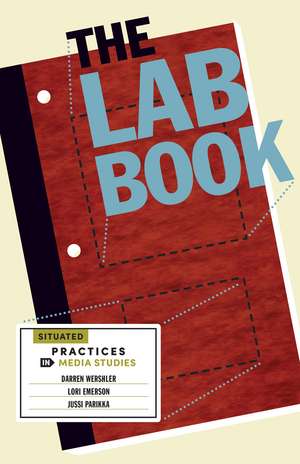
The Lab Book: Situated Practices in Media Studies
Autor Darren Wershler, Lori Emerson, Jussi Parikkaen Limba Engleză Paperback – 19 apr 2022
Autorii acestui volum, Darren Wershler, Lori Emerson și Jussi Parikka, sunt figuri centrale în studiile media contemporane, aducând o expertiză vastă din zonele arheologiei media și ale practicilor digitale situate. The Lab Book reprezintă rezultatul unei cercetări riguroase asupra proliferării spațiilor de experimentare, propunând o metodologie practică pentru a înțelege cum se produce cunoașterea în medii hibride, de la laboratoarele universitare până la makerspaces.
Descoperim aici o structură organizată tematic, care depășește simpla descriere a echipamentelor. Cartea este segmentată în capitole care analizează „Aparatura”, „Infrastructura” și „Oamenii”, fiecare fiind susținut de studii de caz concrete, precum MIT Media Lab sau Bell Labs. Comparabil cu Digital Humanities and Laboratories de Urszula Pawlicka-Deger în rigurozitatea cu care tratează spațiile de cercetare, volumul de față se distinge prin extinderea analizei către „imaginarele” laboratorului, explorând chiar și zone neconvenționale precum camerele de ședințe de spiritism sau vagoanele agricole Jesup.
Considerăm că relevanța lucrării rezidă în capacitatea de a oferi un glosar de tehnici și o perspectivă critică asupra modului în care aceste instituții s-au integrat în structura universității. Față de The Big Humanities de Richard Lane, care se concentrează pe tehnologiile specifice, The Lab Book pune accent pe practicile situate, demonstrând că laboratorul nu este doar o imitație a științelor exacte, ci o formă culturală distinctă. Ilustrațiile incluse sprijină vizual argumentele despre evoluția acestor comunități creative.
Preț: 199.07 lei
Carte disponibilă
Livrare economică 05-19 noiembrie
Livrare express 22-28 octombrie pentru 25.65 lei
Specificații
ISBN-10: 1517902185
Pagini: 328
Ilustrații: 41 black & whilte illustrations
Dimensiuni: 140 x 216 x 25 mm
Greutate: 0.34 kg
Editura: University of Minnesota Press
Colecția Univ Of Minnesota Press
De ce să citești această carte
Recomandăm această lucrare profesioniștilor și cercetătorilor din studiile media și umanioarele digitale. Cititorul câștigă un instrumentar teoretic și practic pentru a analiza și gestiona spațiile de cercetare contemporane. Este o resursă esențială pentru a înțelege cum infrastructura și tehnica modelează inovația, oferind o perspectivă istorică rară asupra laboratorului ca motor cultural și academic.
Despre autor
Darren Wershler deține catedra de cercetare a Universității Concordia în Media și Literatură Contemporană din Montreal. Activitatea sa este marcată de o abordare interdisciplinară, fiind recunoscut atât ca academician, cât și ca poet publicat. În lucrări anterioare, precum Counterblasting Canada, a explorat influența tehnologiei și a comunicării asupra modernismului canadian, teme care se regăsesc și în analiza practicilor de laborator. Alături de Lori Emerson și Jussi Parikka, Wershler contribuie la definirea noilor direcții în media archaeology, integrând critica literară cu analiza infrastructurilor tehnologice.
Descriere scurtă
From the “Big Science” of Bell Laboratories to the esoteric world of séance chambers to university media labs to neighborhood makerspaces, places we call “labs” are everywhere—but how exactly do we account for the wide variety of ways that they produce knowledge? More than imitations of science and engineering labs, many contemporary labs are hybrid forms that require a new methodological and theoretical toolkit to describe. The Lab Book investigates these vital, creative spaces, presenting readers with the concept of the “hybrid lab” and offering an extended—and rare—critical investigation of how labs have proliferated throughout culture.
Organized by interpretive categories such as space, infrastructure, and imaginaries, The Lab Book uses both historical and contemporary examples to show how laboratories have become fundamentally connected to changes in the contemporary university. Its wide reach includes institutions like the MIT Media Lab, the Tuskegee Institute’s Jesup Wagon, ACTLab, and the Media Archaeological Fundus. The authors cover topics such as the evolution and delineation of lab-based communities, how labs’ tools and technologies contribute to defining their space, and a glossary of key hybrid lab techniques.
Providing rich historical breadth and depth, The Lab Book brings into focus a critical, but often misunderstood, aspect of the contemporary arts and humanities.
Notă biografică
Lori Emerson is associate professor in the Department of English and director of the Intermedia Arts, Writing, and Performance Program at the University of Colorado at Boulder. She is founding director of the Media Archaeology Lab and author of Reading Writing Interfaces: From the Digital to the Bookbound (Minnesota, 2014).
Jussi Parikka is professor of technological culture and aesthetics at the Winchester School of Art (University of Southampton) and founding codirector of the Archaeologies of Media and Technology research unit. He is visiting professor at the Academy of Performing Arts, Prague, as research leader for the project Operational Images. He is author of A Geology of Media; Insect Media: An Archaeology of Animals and Technology; and The Anthrobscene; coauthor of Remain; and editor of Digital Memory and the Archive, all from Minnesota.
Cuprins
Acknowledgments
Introduction: Everything Is a Lab
Case Study: The French Language Lab (Middlebury College, U.S.)
1. Lab Space
Case Study: Menlo Park Laboratory (Menlo Park, U.S.)
Case Study: MIT Media Lab, Part 1 (MIT, U.S.)
Case Study: Media Archaeological Fundus (Humboldt University, Germany)
2. Lab Apparatus
Case Study: The Signal Laboratory (Humboldt University, Germany)
Case Study: The Media Archaeology Lab (University of Colorado Boulder, U.S.)
3. Lab Infrastructure
Case Study: Home Economics Labs and Extension on the Canadian Prairies (Manitoba, Canada)
Case Study: Black Laboratories and Agricultural Extension
4. Lab People
Case Study: MIT Media Lab, Part 2 (MIT, U.S.)
Case Study: ActLab (University of Texas Austin, U.S.)
5. Lab Imaginaries
Case Study: Hybrid Spaces of Experimentation and Parapsychology
Case Study: Bell Labs, A Factory for Ideas
6. Lab Techniques
Conclusion
Notes
Bibliography
Index
Recenzii
"The Lab Book is a crucial intervention into humanities labs and their precarious institutional environments. Situated between science and technology studies (STS) and media archaeology, Wershler, Emerson, and Parikka’s book develops a heuristic for analyzing these hybrid spaces, producing a valuable tool for understanding the assemblages of space, apparatus, infrastructure, people, and imaginaries supporting their existence."—Theory, Culture Society
"Richly illustrated and well argued, these chapters convincingly showcase the benefits of adopting the extended laboratory model to enhance the study of past and present laboratories."—Isis: A Journal of the History of Science Society
"The Lab Book very successfully makes a complex and compelling case for a new understanding and appreciation of labs, as well as their value in media studies and beyond."—Information Culture