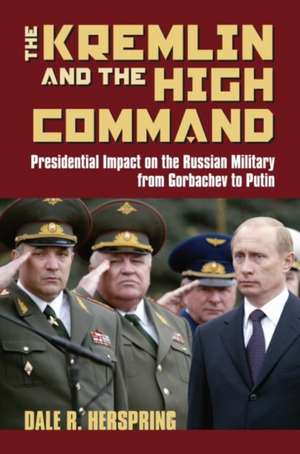
The Kremlin & the High Command
Autor Dale R Herspringen Limba Engleză Hardback – 11 oct 2006
În cadrul programelor de studii de securitate și relații internaționale, evoluția aparatului militar rus de la prăbușirea URSS până în prezent constituie un studiu de caz fundamental pentru înțelegerea dinamicii puterii în statele aflate în tranziție. Observăm cum The Kremlin & the High Command reușește să umple un gol analitic, fiind prima lucrare care evaluează sistematic interacțiunea dintre liderii politici de la Kremlin și corpul ofițerilor superiori pe parcursul a trei mandate prezidențiale distincte: Gorbaciov, Elțîn și Putin. Autorul Dale R Herspring propune o teză provocatoare: în ciuda inerției birocratice specifice mediului militar, personalitatea președintelui a devenit factorul determinant pentru viabilitatea și modernizarea forțelor armate. Remarcăm analiza detaliată a modului în care neglijarea instituțională din epoca Gorbaciov și promisiunile neonorate ale lui Elțîn au condus la demoralizare și corupție, culminând cu eșecurile din Afganistan și Cecenia. Lucrarea extinde cadrul propus de Democratic Breakdown and the Decline of the Russian Military de Zoltan Barany cu date noi din perioada consolidării puterii lui Vladimir Putin, oferind o perspectivă nuanțată asupra modului în care controlul politic strict poate afecta capacitatea de luptă. Spre deosebire de The Soldier in Russian Politics, 1985-96 de Robert Barylski, care se concentrează pe deceniul de tranziție, volumul de față urmărește traiectoria lungă a transformării, de la o forță ghidată de ideologia comunistă la una aflată sub autoritatea unui singur om. Stilul este riguros, specific cercetării academice publicate de University Press of Kansas, oferind o radiografie a haosului instituțional și a eforturilor de redresare care au marcat ultimii 25 de ani ai Federației Ruse.
Preț: 289.08 lei
Carte disponibilă
Livrare economică 16-30 noiembrie
Specificații
ISBN-10: 0700614672
Pagini: 256
Dimensiuni: 161 x 237 x 23 mm
Greutate: 0.54 kg
Ediția:1
Editura: University Press of Kansas
V-ar putea interesa
-
 The Shadow WorldAndrew Feinstein-17%Preț: 103.34 lei124.56 lei
 -
 Preț: 356.91 lei
 -
 -30%Preț: 473.16 lei674.78 lei
 -
 Gunboat DiplomacyJ. Cable-18%Preț: 922.91 lei1125.50 lei
 -
 Star Wars 501stKaren TravissPreț: 59.91 lei
 -
 Order 66: And Other StoriesKaren TravissPreț: 51.84 lei
 -
 Military PowerStephen BiddlePreț: 285.06 lei
 -
 Preț: 310.32 lei
 -
 Preț: 217.01 lei
 -
 Army DiplomacyWalter M HudsonPreț: 367.71 lei
 -
 New Weapons, Old PoliticsThomas L. McNaugherPreț: 201.58 lei
 -
 Preț: 422.48 lei
 -
 -23%Preț: 641.98 lei833.74 lei
 -
 Red Star Over the Pacific, Second EditionToshi YoshiharaPreț: 240.95 lei
 -
 Fleet Tactics and Naval Operations, Third EditionWayne P HughesPreț: 477.93 lei
 -
 On Tactics: A Theory of Victory in BattleB.A. FriedmanPreț: 153.15 lei
 -
 On OperationsBrett A. FriedmanPreț: 206.05 lei
 -
 -16%Preț: 96.19 lei114.46 lei
 -
 -23%Preț: 845.22 lei1097.69 lei
 -
 The Economics of ArmsKeith HartleyPreț: 280.93 lei
De ce să citești această carte
Această carte este esențială pentru cei care doresc să înțeleagă rădăcinile politice ale comportamentului militar actual al Rusiei. Cititorul câștigă o perspectivă clară asupra modului în care deciziile de la vârful statului influențează direct disciplina și dotarea trupelor. Este o resursă valoroasă pentru analiștii geopolitici, oferind argumente solide despre rolul central al președintelui în definirea puterii militare a unei națiuni.