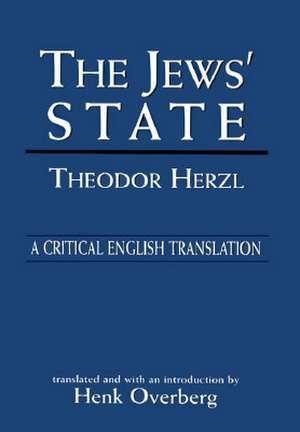
The Jews' State: A Critical English Translation
Autor Theodor Herzl Traducere de Henk Overbergen Limba Engleză Hardback – aug 1997
Preț: 523.99 lei
Preț vechi: 733.33 lei
-29%
Puncte Express: 786
Carte tipărită la comandă
Livrare economică 07-21 decembrie
Livrare prin curier în România Termenul estimat este afișat lângă disponibilitate.
Transport gratuit pentru acest produs Plată online sau ramburs, în funcție de opțiunile comenzii.
Retur gratuit în 14 zile Comandă securizată și suport în română.
Specificații
ISBN-13: 9780765759733
ISBN-10: 076575973X
Pagini: 271
Dimensiuni: 156 x 214 x 25 mm
Greutate: 0.46 kg
Editura: Bloomsbury Publishing
Colecția Jason Aronson Inc
Locul publicării:New York, United States
ISBN-10: 076575973X
Pagini: 271
Dimensiuni: 156 x 214 x 25 mm
Greutate: 0.46 kg
Editura: Bloomsbury Publishing
Colecția Jason Aronson Inc
Locul publicării:New York, United States
V-ar putea interesa
-
 Nationalism and Ethnic Conflict: Threats to European SecurityStephen Iwan Griffiths-23%Preț: 173.98 lei226.30 lei
 -
 -18%Preț: 367.42 lei445.52 lei
 -
 Nationalism and the Moral Psychology of CommunityBernard YackPreț: 321.01 lei
 -
 Resolving the Cyprus ConflictM. MichaelPreț: 373.74 lei
 -
 Comparing State Polities: A Framework for Analyzing 100 GovernmentsMichael J. Sullivan-31%Preț: 472.08 lei688.49 lei
 -
 The Prospects of Industrial CivilizationBertrand RussellPreț: 245.85 lei
 -
 Ethno-symbolism and Nationalism: A Cultural ApproachAnthony D. SmithPreț: 456.05 lei
 -
 Public Relations and Nation Building: Influencing IsraelMargalit Toledano-18%Preț: 1350.97 lei1647.52 lei
 -
 NationalismAnthony D. SmithPreț: 149.75 lei
 -
 The Nation and Nationalism in EuropeIreneusz Paweł Karolewski-16%Preț: 205.01 lei243.40 lei
 -
 Nationalism, Ethnicity and the StateJohn Coakley-18%Preț: 689.72 lei841.12 lei
 -
 -23%Preț: 240.77 lei313.06 lei
 -
 European NationsMiroslav HrochPreț: 222.49 lei
 -
 ShowtimePat LeahyPreț: 116.75 lei
 -
 Introducing MarxismRupert WoodfinPreț: 64.47 lei
 -
 -38%Preț: 848.21 lei1358.45 lei
Descriere
The translator writes:
"The Jews' State" is over one hundred years old. The work is both catalyst and prophecy. Catalyst: Speaking both to Jews and to the international community, it virtually launched the modern debate about a modern state for Jews. Prophecy: it foretold the entire scope of this debate, its timing, its spread, its nature, its parameters. It is all there in embryo for us to read and ponder. This little book continues to inform conceptions and arguments about the position on Jews in their state and in the world, and about the relationship between Jews and their fellow human beings. In a very real sense, it still deeply guides how we view the contemporary Middle East.
Translated and retranslated countless times and into many languages since it was published, this present translation is one of only three English versions that have been attempted in the century since its first publication, the first in English in twenty-five years. Its concerns are both text and context. Though the text has been with us ever since is publication, it is the context that needs recreating. Among the factors that have created distance between us and the world in which The Jews' State was created include: The experience of the world and the Jewish community during the last century, the salience of anti-Semitism, the Holocaust, the formations and development of the state of Israel, the troubled existence of the Jewish state ever since its inception, the continuing Jewish diaspora and its relationship with the state and world. The common understandings which Theodore Herzl assumed in his readers have dissipated and vanished, and with them a sense of his book's import and impact. These understandings need to be retrieved and recreated.
The present edition is therefore an attempt both at presentation and retrieval: Presentation of the text in the language of today: retrieval of the context which gave rise to it. This dual function informs the three main parts of this edition. Its first part is an account of the ideological and social worlds in which Herzl worked and wrote, the Jewish world and the mainstream world, and it argues that Herzl's interaction with both these worlds rests on some complex attitudes on his part in which approval, compliance, critique, and rejection all played a role. There follows a section on The Jews' State itself, which picks up on the main themes that occupied Herzl, and discusses their scope and treatment. This first part finishes with a description of the initial impact of The Jews' State on Herzl's world.
The second part of this edition offers a presentation of the text itself, in the form of a translation, which attempts to recreate in a modern idiom the content of the work as well as some of the peculiarities of Herzl's style. The third part of this edition consists of a critical glossary, dealing with some salient issues in translation as well as the explanation of a number of terms and allusions in the text, whose meaning is not immediately obvious to modern readers. The edition closes with a bibliography."
"The Jews' State" is over one hundred years old. The work is both catalyst and prophecy. Catalyst: Speaking both to Jews and to the international community, it virtually launched the modern debate about a modern state for Jews. Prophecy: it foretold the entire scope of this debate, its timing, its spread, its nature, its parameters. It is all there in embryo for us to read and ponder. This little book continues to inform conceptions and arguments about the position on Jews in their state and in the world, and about the relationship between Jews and their fellow human beings. In a very real sense, it still deeply guides how we view the contemporary Middle East.
Translated and retranslated countless times and into many languages since it was published, this present translation is one of only three English versions that have been attempted in the century since its first publication, the first in English in twenty-five years. Its concerns are both text and context. Though the text has been with us ever since is publication, it is the context that needs recreating. Among the factors that have created distance between us and the world in which The Jews' State was created include: The experience of the world and the Jewish community during the last century, the salience of anti-Semitism, the Holocaust, the formations and development of the state of Israel, the troubled existence of the Jewish state ever since its inception, the continuing Jewish diaspora and its relationship with the state and world. The common understandings which Theodore Herzl assumed in his readers have dissipated and vanished, and with them a sense of his book's import and impact. These understandings need to be retrieved and recreated.
The present edition is therefore an attempt both at presentation and retrieval: Presentation of the text in the language of today: retrieval of the context which gave rise to it. This dual function informs the three main parts of this edition. Its first part is an account of the ideological and social worlds in which Herzl worked and wrote, the Jewish world and the mainstream world, and it argues that Herzl's interaction with both these worlds rests on some complex attitudes on his part in which approval, compliance, critique, and rejection all played a role. There follows a section on The Jews' State itself, which picks up on the main themes that occupied Herzl, and discusses their scope and treatment. This first part finishes with a description of the initial impact of The Jews' State on Herzl's world.
The second part of this edition offers a presentation of the text itself, in the form of a translation, which attempts to recreate in a modern idiom the content of the work as well as some of the peculiarities of Herzl's style. The third part of this edition consists of a critical glossary, dealing with some salient issues in translation as well as the explanation of a number of terms and allusions in the text, whose meaning is not immediately obvious to modern readers. The edition closes with a bibliography."
Cuprins
A Note from the Translator
Preface
Theodor Herzl: The Jews' State-An Introduction
Title and Genesis
The Jewish Context
The European Context
The Work
Reception and Impact
The Jews' State: An Attempt at a Modern Solution to the Issue of the Jews by Theodor Herzl
Preamble
Introduction
General Part
The Jewish Company
Local Branches
Society of Jews and the Jews' State
Conclusion
Glossary
Bibliography
Works and Translations of Theodor Herzl
Reference Guides
Newspapers and Journals
Books and Articles
Index
Preface
Theodor Herzl: The Jews' State-An Introduction
Title and Genesis
The Jewish Context
The European Context
The Work
Reception and Impact
The Jews' State: An Attempt at a Modern Solution to the Issue of the Jews by Theodor Herzl
Preamble
Introduction
General Part
The Jewish Company
Local Branches
Society of Jews and the Jews' State
Conclusion
Glossary
Bibliography
Works and Translations of Theodor Herzl
Reference Guides
Newspapers and Journals
Books and Articles
Index
Notă biografică
Theodor Herzl (2 May 1860 - 3 July 1904) was an Austro-Hungarian Jewish journalist and political activist who was the father of modern political Zionism. Herzl formed the Zionist Organization and promoted Jewish immigration to Palestine in an effort to form a Jewish state.Herzl was born in Pest, Kingdom of Hungary to a prosperous Neolog Jewish family. After a brief legal career in Vienna, he became the Paris correspondent for the Viennese newspaper Neue Freie Presse. Confronted with antisemitic events in Vienna, he reached the conclusion that anti-Jewish sentiment would make Jewish assimilation impossible, and that the only solution for Jews was the establishment of a Jewish state. In 1896, Herzl published the pamphlet Der Judenstaat, in which he elaborated his visions of a Jewish homeland. His ideas attracted international attention and rapidly established Herzl as a major figure in the Jewish world.In 1897, Herzl convened the First Zionist Congress in Basel, Switzerland, and was elected president of the Zionist Organization. He began a series of diplomatic initiatives to build support for a Jewish state, appealing unsuccessfully to German emperor Wilhelm II and Ottoman sultan Abdul Hamid II. At the Sixth Zionist Congress in 1903, Herzl presented the Uganda Scheme, endorsed by Colonial Secretary Joseph Chamberlain on behalf of the British government. The proposal, which sought to create a temporary refuge for the Jews in British East Africa following the Kishinev pogrom, was met with strong opposition and ultimately rejected. Herzl died of a heart ailment in 1904 at the age of 44, and was buried in Vienna. In 1949, his remains were brought to Israel and reinterred on Mount Herzl.