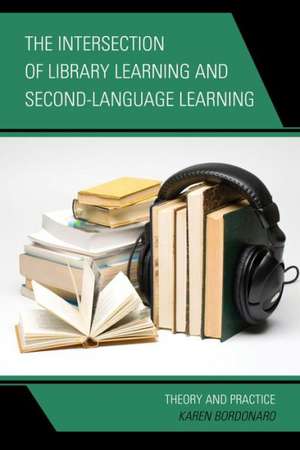
The Intersection of Library Learning and Second-Language Learning: Theory and Practice
Autor Karen Bordonaroen Limba Engleză Paperback – dec 2013
The Intersection of Library Learning and Second-Language Learning: Theory and Practice is aimed at practitioners, both librarians and language instructors, and describes everyday scenarios which will resonate with academic librarians and language instructors. It presents practical experiences and accompanies them with a consideration of the literature of both librarianship and language education. It reviews and evaluates professional practices employed by working librarians and language instructors in their dealings with international students.
Considerations of the intersections between language learning and library learning are placed within a theoretical framework of learner autonomy. This framework offers librarians and language instructors methods and practices that enable students to take control of their learning in the areas of both language learning and library learning. A concluding chapter offers ways to connect the framework of learner autonomy to settings outside that of a university context.
Preț: 376.07 lei
Preț vechi: 549.57 lei
-32%
Puncte Express: 564
Preț estimativ în valută:
66.56€ • 77.78$ • 57.78£
66.56€ • 77.78$ • 57.78£
Carte tipărită la comandă
Livrare economică 20 februarie-06 martie
Preluare comenzi: 021 569.72.76
Specificații
ISBN-13: 9781442227033
ISBN-10: 1442227036
Pagini: 135
Dimensiuni: 148 x 228 x 14 mm
Greutate: 0.26 kg
Editura: Bloomsbury Publishing
Colecția Rowman & Littlefield Publishers
Locul publicării:New York, United States
ISBN-10: 1442227036
Pagini: 135
Dimensiuni: 148 x 228 x 14 mm
Greutate: 0.26 kg
Editura: Bloomsbury Publishing
Colecția Rowman & Littlefield Publishers
Locul publicării:New York, United States
Cuprins
Preface
Chapter 1: Introduction
Chapter 2: What is Library Learning?
Chapter 3: What is Language Learning?
Chapter 4: Intersections: People and Times
Chapter 5: Intersections: Places and Materials
Chapter 6: Intersections: Teaching and Learning Perspectives
Chapter 7: Intersections: Learner Autonomy as Theoretical Framework
Chapter 8: Intersections in the University: Self-Access Centers
Chapter 9: Intersections in the Community: Lifelong Learning
Selected Bibliography
Chapter 1: Introduction
Chapter 2: What is Library Learning?
Chapter 3: What is Language Learning?
Chapter 4: Intersections: People and Times
Chapter 5: Intersections: Places and Materials
Chapter 6: Intersections: Teaching and Learning Perspectives
Chapter 7: Intersections: Learner Autonomy as Theoretical Framework
Chapter 8: Intersections in the University: Self-Access Centers
Chapter 9: Intersections in the Community: Lifelong Learning
Selected Bibliography
Recenzii
Karen Bordonaro brings together her extensive experience as a learner, teacher, librarian, and researcher to examine the intersections between second-language learning and libraries. Drawing on both theory and practice, this book is a thorough and nuanced examination of second-language learning and librarianship and will be a vital contribution to the field.
While much has been written about library services for international students, this book draws needed attention to information literacy development with language learning in mind. Bordonaro's broad perspective as an expert in both library science and second language learning helps to demystify some of the language-related challenges that together with differences in academic culture and experience, limit the effective use of libraries by many international students. . . .Especially notable is Bordonaro's advocacy for non-native English speakers' library learning while they are still learning the language. One of this book's fundamental points is that language learners should not be regarded as a problem to the library but rather as legitimate users with different needs, which libraries should work together with language programs to meet. ESL students need comprehensive, systematic curriculum-driven practice with library use, not just an add-on to upper-level writing classes. ESL students will benefit from the experiential content-based language learning approach that Bordonaro describes, and so will students who are beginning academic studies while they continue to need some language support. . . .Language instructors, program administrators, and librarians working in a university setting will find this book worthwhile as a resource for planning library instruction for ESL students and other language learners. Making the book available in university libraries for practitioners to read, discuss, and act upon will certainly benefit English language learners pursuing higher education in North America.
While much has been written about library services for international students, this book draws needed attention to information literacy development with language learning in mind. Bordonaro's broad perspective as an expert in both library science and second language learning helps to demystify some of the language-related challenges that together with differences in academic culture and experience, limit the effective use of libraries by many international students. . . .Especially notable is Bordonaro's advocacy for non-native English speakers' library learning while they are still learning the language. One of this book's fundamental points is that language learners should not be regarded as a problem to the library but rather as legitimate users with different needs, which libraries should work together with language programs to meet. ESL students need comprehensive, systematic curriculum-driven practice with library use, not just an add-on to upper-level writing classes. ESL students will benefit from the experiential content-based language learning approach that Bordonaro describes, and so will students who are beginning academic studies while they continue to need some language support. . . .Language instructors, program administrators, and librarians working in a university setting will find this book worthwhile as a resource for planning library instruction for ESL students and other language learners. Making the book available in university libraries for practitioners to read, discuss, and act upon will certainly benefit English language learners pursuing higher education in North America.