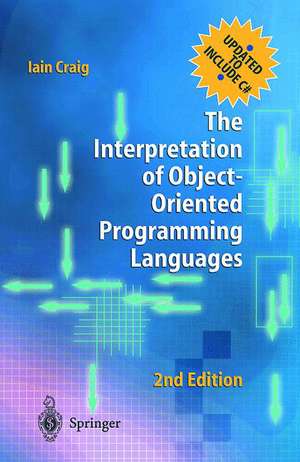
The Interpretation of Object-Oriented Programming Languages
Autor Iain Craigen Limba Engleză Paperback – 10 oct 2001
Preț: 322.59 lei
Preț vechi: 403.23 lei
-20%
Puncte Express: 484
Carte tipărită la comandă
Livrare economică 30 noiembrie-14 decembrie
Livrare prin curier în România Termenul estimat este afișat lângă disponibilitate.
Transport gratuit de la 400.00 lei Plată online sau ramburs, în funcție de opțiunile comenzii.
Retur gratuit în 14 zile Comandă securizată și suport în română.
Specificații
ISBN-13: 9781852335472
ISBN-10: 1852335475
Pagini: 308
Ilustrații: XIV, 290 p.
Dimensiuni: 155 x 235 x 17 mm
Greutate: 0.47 kg
Ediția:Second Edition 2002
Editura: Springer
Locul publicării:London, United Kingdom
ISBN-10: 1852335475
Pagini: 308
Ilustrații: XIV, 290 p.
Dimensiuni: 155 x 235 x 17 mm
Greutate: 0.47 kg
Ediția:Second Edition 2002
Editura: Springer
Locul publicării:London, United Kingdom
V-ar putea interesa
-
 Head First HTML and CSS 2eElisabeth Robson-20%Preț: 299.12 lei373.90 lei
 -
 -20%Preț: 664.21 lei830.27 lei
 -
 Loop Transformations for Restructuring CompilersUtpal Banerjee-20%Preț: 1025.57 lei1281.96 lei
 -
 -20%Preț: 671.69 lei839.62 lei
 -
 Dependence AnalysisUtpal Banerjee-20%Preț: 1020.61 lei1275.77 lei
 -
 Retargetable Compilers for Embedded Core ProcessorsClifford Liem-20%Preț: 668.73 lei835.92 lei
 -
 KanbanDavid J. Anderson-20%Preț: 264.20 lei330.25 lei
 -
 Preț: 299.96 lei
 -
 Mastering ServiceNow - Second EditionMartin Wood-20%Preț: 368.74 lei460.93 lei
 -
 C2 Compiler ConceptsBernd Teufel-20%Preț: 318.35 lei397.94 lei
 -
 Constraint DatabasesGabriel Kuper-20%Preț: 958.63 lei1198.29 lei
 -
 -20%Preț: 635.40 lei794.25 lei
 -
 Compiler DesignReinhard Wilhelm-20%Preț: 553.55 lei691.93 lei
Public țintă
ResearchCuprins
1. Introduction.- 1.1 Introduction.- 1.2 Essential Properties of Objects.- 1.3 Objects and Messages.- 1.4 Pure and Impure Languages.- 1.5 Mixed-Paradigm Languages.- 1.6 Organization of this Book.- 2. Class Fundamentals.- 2.1 Introduction.- 2.2 Classes.- 2.3 Instances.- 2.4 Slots and Methods.- 2.5 Slot Access.- 2.6 Visibility and Accessibility.- 2.7 Instance Creation.- 2.8 Inheritance.- 2.9 Abstract Classes.- 2.10 Iterators.- 2.11 Part Objects.- 3. Prototype and Actor Languages.- 3.1 Introduction.- 3.2 Prototype Languages.- 3.3 Methods in Prototype Languages.- 3.4 Actor Languages.- 4. Inheritance and Delegation.- 4.1 Introduction.- 4.2 Interpretations of Inheritance.- 4.3 Inheritance as Subtyping.- 4.4 Inheritance as Code Sharing.- 4.5 Single Inheritance.- 4.6 Calling More Abstract Methods.- 4.7 Multiple Inheritance.- 4.8 Multiple Inheritance Graph Shape.- 4.9 Approaches to Multiple Inheritance.- 4.10 Implemented Multiple Inheritance Techniques.- 4.11 Mixin Classes.- 4.12 Alternatives to Multiple Inheritance.- 4.13 Delegation and Prototypes.- 4.14 Aggregation.- 5. Methods.- 5.1 Introduction.- 5.2 Methods and Objects.- 5.3 Object Constructors and Methods.- 5.4 Environments and Closures.- 5.5 Methods and Inheritance.- 5.6 Static and Dynamic Binding.- 6. Types I: Types and Objects.- 6.1 Introduction.- 6.2 Inheritance and Types.- 6.3 Polymorphism.- 6.4 Genericity.- 6.5 Overloading and Overriding.- 6.6 Languages with Root Classes.- 6.7 Polyadicity and Default Parameters.- 6.8 Downcasting and Subtypes.- 6.9 Review.- 7. Types II: Types and Objects—Alternatives.- 7.1 Introduction.- 7.2 Types and Implementations.- 7.3 Hiding Implementation Details.- 7.4 Classes and Type Operations.- 7.5 Containers and Objects.- 8. Reflection.- 8.1 Introduction.- 8.2 Class and Meta Class.- 8.3Meta Class and Reflection.- 8.4 Meta-Object Protocols.- 8.5 Self Representation, Abstract Syntax and Abstract Classes...- 8.6 Reflection in Java.- 8.7 Reflection in Prototype-based Languages.- 8.8 Prospects for the Future.- 9. C#.- 9.1 Introduction.- 9.2 Classes and Instances.- 9.3 Inheritance.- 9.4 Methods and Operators.- 9.5 Polymorphism and Types.- 9.6 Base Class Library.- A. BeCecil.- A.1 Programming Standard 00 Mechanisms.- A.2 Syntactic Sugar.- A.3 A Small Example.- A.4 Concluding Remarks.- B. Mixed-Paradigm Languages.- B.1 Introduction.- B.2 Functional Programming: An Overview.- B.2.1 Control Structures and Semantics.- B.2.2 Evaluation Strategies.- B.2.3 Higher-Order Functions.- B.2.4 Hindley-Milner Type Inference.- B.2.5 Syntactic Sugar.- B.3 An Impure Language.- B.3.1 The Object-Oriented Component.- B.3.2 The Functional Component.- B.4 Review.- References.
Caracteristici
Compares a wide range of o-o languages, and their underlying concepts