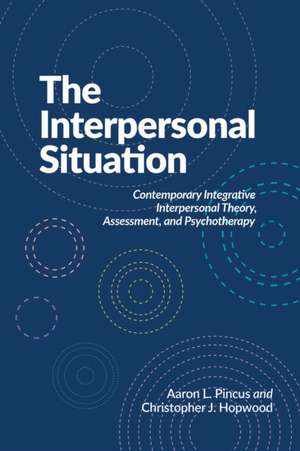
The Interpersonal Situation
Autor Aaron L. Pincus, Christopher J Hopwooden Limba Engleză Paperback – 19 aug 2025
Notăm cu interes apariția lucrării The Interpersonal Situation, un manual care propune un algoritm clinic riguros pentru cartografierea interacțiunilor umane în context terapeutic. Subliniem faptul că autorii Aaron L. Pincus și Christopher J Hopwood nu introduc o nouă formă izolată de terapie, ci un cadru euristic numit Teoria Interpersonală Integrativă Contemporană (CIIT). Acest protocol permite clinicianului să translateze simptomatologia abstractă în date concrete de interacțiune, oferind pași preciși pentru evaluarea modului în care gândurile și sentimentele pacientului se manifestă în relația cu terapeutul. Reținem capacitatea acestui volum de a unifica diverse orientări teoretice sub o umbrelă comună, ecumenică. Structura cărții facilitează o tranziție fluidă de la teoria psihopatologiei la implementarea tehnicilor de intervenție, oferind ghidaj detaliat pentru diagnosticul interpersonal. Este un manual de referință comparabil cu Contempory Interpersonal Theory & Research – Personality, Psychopathology & Psychotherapy de DJ Kiesler, dar actualizat conform ghidurilor clinice recente și axat pe o aplicabilitate practică imediată. Spre deosebire de alte abordări rigide, cadrul CIIT este flexibil, permițând adaptarea la o cazuistică diversă. Analizăm în special capitolele dedicate intervențiilor clinice, unde procesul de tratament este segmentat în etape monitorizabile. Această ediție publicată de APA; se distinge prin rigoarea științifică specifică publicațiilor academice, fiind esențială pentru cei care doresc să integreze dinamica interpersonală în practica lor curentă, indiferent dacă baza lor este cognitiv-comportamentală sau psihodinamică.
Preț: 482.31 lei
Preț vechi: 524.24 lei
-8%
Carte disponibilă
Livrare economică 11-25 noiembrie
Livrare express 27-31 octombrie pentru 30.60 lei
Specificații
ISBN-10: 1433843471
Pagini: 265
Dimensiuni: 150 x 226 x 16 mm
Greutate: 0.39 kg
Editura: American Psychological Association
V-ar putea interesa
-
 -31%Preț: 1142.41 lei1667.23 lei
-
 The Guide to Interpersonal Psychotherapy: Updated and Expanded EditionMyrna M. Weissman-21%Preț: 463.39 lei586.54 lei
-
 Interpersonal Psychotherapy: A Global ReachMyrna Weissman-21%Preț: 304.66 lei385.43 lei
-
 Being a Brain-Wise TherapistBonnie Badenoch-5%Preț: 267.01 lei281.06 lei
-
 -5%Preț: 261.97 lei275.76 lei
-
 -5%Preț: 248.85 lei261.95 lei
-
 -5%Preț: 377.32 lei397.18 lei
-
 -8%Preț: 603.53 lei655.80 lei
-
 Personality and Wholeness in TherapyDaniel J. Siegel-5%Preț: 297.66 lei313.32 lei
-
 The Handbook of Person-Centred Psychotherapy and CounsellingDr. Gina Di Malta-22%Preț: 293.51 lei376.01 lei
-
 Preț: 409.53 lei
-
 Integrative Person-Centred CounsellingRick Murphy-5%Preț: 352.18 lei370.72 lei
-
 Structural Analysis of Social Behavior (SASB)Kenneth L. Critchfield-5%Preț: 422.60 lei444.84 lei
-
 Essential Psychotherapies, Fourth Edition: Theory and PracticeStanley B. Messer-5%Preț: 462.68 lei487.03 lei
-
 -5%Preț: 420.20 lei442.31 lei
-
 New Approaches to Integration in PsychotherapyEleanor O'Leary-5%Preț: 213.03 lei224.24 lei
-
 -5%Preț: 385.54 lei405.83 lei
-
 -5%Preț: 295.33 lei310.87 lei
-
 Psychology of Interpersonal Perception & RelationshipsAndrea Rennolds-27%Preț: 1271.26 lei1734.42 lei
-
 The Fundamentals of Psychoanalytic TechniqueR. Horacio Etchegoyen-5%Preț: 590.56 lei621.64 lei
De ce să citești această carte
Recomandăm această lucrare profesioniștilor din psihologia clinică și psihiatrie care caută un instrument de diagnostic mai profund decât simpla clasificare a simptomelor. Cititorul câștigă un model euristic validat (CIIT) care transformă relația terapeut-pacient într-o sursă activă de date clinice. Este o resursă indispensabilă pentru a înțelege mecanismele interpersonale ale psihopatologiei și pentru a structura intervenții personalizate, bazate pe dovezi, într-un format compact și aplicat.
Descriere
Notă biografică
Christopher J. Hopwood is a professor of personality psychology at the University of Zurich. He has published hundreds of research articles, edited books, and chapters on personality assessment, personality disorders, and interpersonal processes. He is the former president of the Society for Interpersonal Theory and Research and board member and fellow of the Society for Personality Assessment. He has been associate editor at Assessment, Journal of Personality Assessment, Journal of Personality Disorders, Journal of Personality and Social Psychology, and Journal of Psychopathology and Clinical Science. He has won numerous awards, including the American Psychological Association Theodore Millon Award for contributions to Personality Psychology and the Society for Personality Assessment Beck, Exner, and Mid‐Career Awards for contributions to Personality Assessment. He has more than 10 years of experience in clinical practice and supervision.
Cuprins
Chapter 1. Introduction to the Interpersonal Perspective
Chapter 2. History, Assumptions, and Principles
Chapter 3. Psychopathology
Chapter 4. Interpersonal Mapping of Common Mental Health Constructs
Part II. Implementation
Chapter 5. Assessment
Chapter 6. Intervention
Chapter 7. Clinical Integration and Transdiagnostic Utility