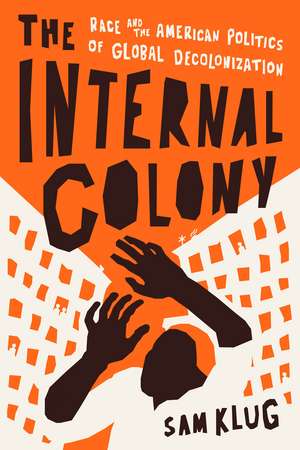
The Internal Colony: Race and the American Politics of Global Decolonization
Autor Sam Klugen Limba Engleză Hardback – 14 ian 2025
In The Internal Colony, Sam Klug reveals the central but underappreciated importance of global decolonization to the divergence between mainstream liberalism and the Black freedom movement in postwar America. Klug reconsiders what has long been seen as a matter of primarily domestic policy in light of a series of debates concerning self-determination, postcolonial economic development, and the meanings of colonialism and decolonization. These debates deeply influenced the discord between Black activists and state policymakers and formed a crucial dividing line in national politics in the 1960s and 1970s.
The result is a history that broadens our understanding of ideological formation—particularly how Americans conceptualized racial power and political economy—by revealing a much wider and more dynamic network of influences. Linking intellectual, political, and social movement history, The Internal Colony illuminates how global decolonization transformed the terms of debate over race and social class in the twentieth-century United States.
Preț: 303.81 lei
Puncte Express: 456
Carte disponibilă
Livrare economică 10-24 noiembrie
Livrare express 24-30 octombrie pentru 43.93 lei
Livrare prin curier în România Termenul estimat este afișat lângă disponibilitate.
Transport gratuit de la 400.00 lei Plată online sau ramburs, în funcție de opțiunile comenzii.
Retur gratuit în 14 zile Comandă securizată și suport în română.
Specificații
ISBN-13: 9780226820514
ISBN-10: 0226820513
Pagini: 280
Ilustrații: 1 halftones
Dimensiuni: 152 x 229 x 25 mm
Greutate: 0.52 kg
Ediția:First Edition
Editura: University of Chicago Press
Colecția University of Chicago Press
ISBN-10: 0226820513
Pagini: 280
Ilustrații: 1 halftones
Dimensiuni: 152 x 229 x 25 mm
Greutate: 0.52 kg
Ediția:First Edition
Editura: University of Chicago Press
Colecția University of Chicago Press
Notă biografică
Sam Klug is an assistant teaching professor of history at Loyola University Maryland.
Cuprins
Introduction
Chapter 1: The Crucible of Postwar Planning
Chapter 2: The Tragic Joke of Trusteeship
Chapter 3: Facing the Neocolonial Future
Chapter 4: Development Politics from Other Shores
Chapter 5: The Myth of the First New Nation
Chapter 6: The War on Poverty and the Search for Indigenous Leadership
Chapter 7: Welfare Colonialism and the Limits of Community Action
Chapter 8: The Crisis of Vocabulary in the Black Freedom Movement
Chapter 9: Pluralism and Colonialism in the Black Power Era
Chapter 10: The Challenge of Decolonization in America
Epilogue
Acknowledgments
Notes
Index
Chapter 1: The Crucible of Postwar Planning
Chapter 2: The Tragic Joke of Trusteeship
Chapter 3: Facing the Neocolonial Future
Chapter 4: Development Politics from Other Shores
Chapter 5: The Myth of the First New Nation
Chapter 6: The War on Poverty and the Search for Indigenous Leadership
Chapter 7: Welfare Colonialism and the Limits of Community Action
Chapter 8: The Crisis of Vocabulary in the Black Freedom Movement
Chapter 9: Pluralism and Colonialism in the Black Power Era
Chapter 10: The Challenge of Decolonization in America
Epilogue
Acknowledgments
Notes
Index
Recenzii
"The idea that African Americans constitute a nation within a nation has long been a mainstay of Black political thought and practice. In this trenchant exploration of the internal colony thesis, one iteration of this wider idea, Sam Klug demonstrates that comparison to the colonial condition produced a shared if contested vocabulary among New Deal policymakers and Black Power activists alike. With a razor-sharp delineation of the uses and meanings which accrued to the internal colony, Klug powerfully centers decolonization’s significance for American politics and documents the persistence of Black internationalism."
“Sam Klug’s The Internal Colony is a landmark book that explores how the competing definitions of colonialism and decolonization shaped US domestic and foreign policy during the twentieth century. Capacious, well-researched, and intellectually rich, the book offers a compelling analysis of the varied debates between Black activists and liberal policymakers during a critical moment in the history of Black internationalism. This is a must-read for those seeking to understand the interconnections of race, politics, and global thought in modern America.”
“This expansive and deeply researched book sheds new light on the relationship between global anticolonialism and Black political thought within the United States by tracing the history of the idea of Black Americans as an internal colony from the aftermath of World War II to the Black Power era. In this compelling work, Klug broadens our understanding of the global dimensions of U.S. race politics in the twentieth century.”
“An extraordinary work of historical research on the entanglement of worldwide decolonization and post-WWII African American history and a comprehensive inquiry into how Black intellectuals and social movements made use of colonial comparisons and analogies to understand racial domination, inequality, and possibilities of freedom ‘within’ the United States.”
"A timely intellectual history, which forces us to rethink some of the dominant narratives of US Black radicalism in this period and advocates a properly internationalist frame."
"Klug is an outstanding interlocutor of the myriad individuals and organizations that saw in the United States similarities with the colonial world. He is sympathetic to their multiplicity of worldviews, to the subtleties of their debates, to the intensity of their differences, and to the places where their views converged. His cast of characters is vast, and his ability to maneuver through the complexities of their worlds—from universities to boardrooms to myriad organizations that changed and morphed, emerged and fell apart, thrived and failed—is nothing short of remarkable. One of the underappreciated aspects of writing good history is simply gathering the facts, the who did what when, who said, wrote, and argued what, who threw a tantrum, and who seized initiatives, and Klug weaves a masterful script out of some frankly labyrinthine material."
“By tracing the long arc of the language of internal colonialism in the Black freedom movement, Klug has performed an invaluable service to scholars and activists alike.”