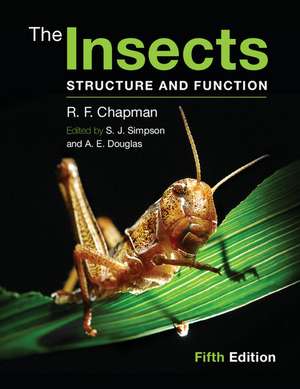
The Insects
Autor R. F. Chapman Editat de Stephen J. Simpson, Angela E. Douglasen Limba Engleză Paperback – 21 sep 2018
Ceea ce aduce nou această a cincea ediție a lucrării The Insects este o recalibrare fundamentală a textului clasic semnat de R. F. Chapman, adaptându-l riguros pentru cerințele cercetării moleculare contemporane. Notăm cu interes faptul că, deși păstrează rigoarea care a consacrat volumul ca standard academic timp de patru decenii, noii editori, Stephen J. Simpson și Angela E. Douglas, au extins analiza sistemelor fiziologice prin prisma noilor descoperiri din genetică și imunologie. Descoperim aici o abordare care prioritizează sistemele funcționale în detrimentul clasificărilor taxonomice rigide, facilitând astfel accesul studenților la mecanismele biologice complexe fără a necesita o cunoaștere exhaustivă a ordinelor de insecte. Structura cărții este segmentată logic în părți dedicate principalelor regiuni anatomice și funcțiilor vitale. De la ingestia și utilizarea hranei (Partea I), la mecanica zborului și locomoției din zona toracelui (Partea II) și până la complexitatea reproducerii și dezvoltării postembrionare (Partea III), progresia informației este susținută de aproape 600 de ilustrații tehnice și tabele sintetice. Cititorii familiarizați cu Insect Physiology and Biochemistry de James L. Nation, Sr. vor aprecia în acest volum profunzimea detaliilor anatomice și accentul pus pe modul în care fiziologia dictează comportamentul în mediul natural. Față de abordarea generalistă din Entomology de Cedric Gillott, lucrarea de față rămâne un instrument mai tehnic, axat pe mecanismele interne de funcționare. Putem afirma că acest volum reprezintă apogeul muncii lui Chapman, integrând temele explorate de acesta în lucrări precum Biology of Grasshoppers. Este o resursă esențială care face puntea între entomologia clasică și biologia moleculară modernă, fiind indispensabilă atât în laboratoarele de cercetare, cât și în studiul universitar avansat.
Preț: 522.63 lei
Preț vechi: 645.23 lei
-19%
Carte tipărită la comandă
Livrare economică 07-21 decembrie
Specificații
ISBN-10: 052111389X
Pagini: 962
Ilustrații: 597 b/w illus. 29 tables
Dimensiuni: 189 x 246 x 52 mm
Greutate: 1.66 kg
Ediția:Revizuită
Editura: Cambridge University Press
Locul publicării:Cambridge, United Kingdom
V-ar putea interesa
-
 Biology of GrasshoppersR. F. Chapman-9%Preț: 1940.30 lei2132.20 lei
 -
 Ants of Africa and Madagascar – A Guide to the GeneraBrian L. FisherPreț: 407.73 lei
 -
 Identifying British Insects and ArachnidsPeter C. BarnardPreț: 369.26 lei
 -
 Insect MigrationV. Alistair Drake-8%Preț: 424.49 lei461.39 lei
 -
 Entomology and the LawBernard Greenberg-5%Preț: 376.47 lei396.28 lei
 -
 Conservation BiologyAndrew S. Pullin-19%Preț: 506.65 lei625.49 lei
 -
 Insect Diversity ConservationMichael J. Samways-11%Preț: 599.17 lei673.23 lei
 -
 -18%Preț: 992.77 lei1210.70 lei
 -
 Preț: 359.64 lei
 -
 Typical FliesE. K. PearcePreț: 232.29 lei
 -
 -15%Preț: 612.23 lei720.27 lei
 -
 ButterfliesDick Vane-WrightPreț: 118.47 lei
 -
 Structured Deposition of Animal Remains in the Fertile Crescent during the Bronze AgeJose Luis Ramos SoldadoPreț: 171.47 lei
 -
 -23%Preț: 2264.68 lei2941.13 lei
 -
 Coleoptera, Beetles. Morphology and SystematicsRolf G. Beutel-23%Preț: 2916.07 lei3787.11 lei
 -
 -23%Preț: 1834.10 lei2381.95 lei
De ce să citești această carte
Recomandăm această ediție oricărui student sau cercetător care dorește să înțeleagă nu doar cum arată insectele, ci mai ales cum funcționează acestea la nivel fiziologic și molecular. Veți câștiga o perspectivă integrată asupra modului în care anatomia influențează supraviețuirea și reproducerea, totul într-un format structurat pe sisteme vitale, extrem de util pentru învățarea aplicată și referință rapidă în domeniu.
Despre autor
R. F. Chapman a fost o figură centrală în entomologia mondială, textul său fiind considerat „biblia” fiziologiei insectelor încă de la prima apariție. Expertiza sa vastă, reflectată și în lucrări specializate precum Perspectives in Chemoreception and Behavior, a pus bazele înțelegerii modului în care insectele interacționează cu mediul prin simțuri și mecanisme chimice. Această ediție este revizuită de Stephen J. Simpson și Angela E. Douglas, ambii experți recunoscuți în nutriția și fiziologia insectelor, care au reușit să păstreze vocea autoritară a lui Chapman, aducând în același timp datele la zi conform standardelor științifice actuale.
Descriere scurtă
Cuprins
Recenzii
'This new edition of The Insects: Structure and Function fascinates the reader with details on the morphology, processes and mechanisms which allow insects to burgeon on Earth. The tradition of excellence established by Chapman has been perpetuated. Thoroughly modernized and comprehensive, the revision captures the excitement of recent major advances in understanding.' Peter W. Price, Regents' Professor Emeritus, Northern Arizona University
'… the standard textbook in the field since the first edition … this is an essential text for students, researchers and applied entomologists alike.' Bois et forêts des tropiques