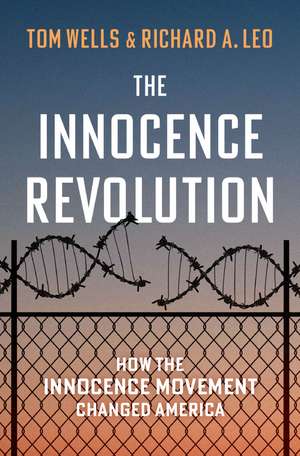
The Innocence Revolution: How the Innocence Movement Changed America
Autor Tom Wells, Richard A. Leoen Limba Engleză Hardback – 15 mar 2027
Preț: 228.08 lei
Preț vechi: 264.34 lei
-14% Precomandă
Puncte Express: 342
Carte nepublicată încă
Livrare prin curier în România Precomanda se expediază când titlul devine disponibil.
Transport gratuit de la 400.00 lei Plată online sau ramburs, în funcție de opțiunile comenzii.
Retur gratuit în 14 zile Comandă securizată și suport în română.
Doresc să fiu notificat când acest titlu va fi disponibil:
Se trimite...
Specificații
ISBN-13: 9780197871249
ISBN-10: 0197871240
Pagini: 296
Dimensiuni: 156 x 235 mm
Editura: Oxford University Press
Colecția OUP USA
Locul publicării:New York, United States
Recenzii
This is an important book chronicling the innocence movement to free the wrongfully convicted, including many who'd received the death penalty, complete with many triumphs and occasional missteps, and the sea change in public awareness of wrongful convictions the movement has produced. The criminal cases covered are often gripping. Wells and Leo have written a valuable book on a topic of enduring importance.
The definitive treatment of how erroneous convictions have become a major issue in the American criminal 'justice' system. With impeccable research, Wells and Leo introduce readers to the myriad challenges faced by the those working to free the innocent and, in many cases, expose the role of Lady Luck in securing the exonerations. Bravo!
A tour de force! In their well-written, authoritative book, Wells and Leo tell a story that needs to be told and one they are ideally suited to tell: how our conception of wrongful convictions has changed since the first DNA exoneration in 1989. They do so by drawing on the experiences of the lawyers, exonerees, scholars, and activists who spurred this change, creating a vivid account that deserves an important place within the canon of wrongful convictions scholarship. Simply put, the Innocence Revolution is a must-read for anyone interested in criminal justice.
Every year hundreds of innocent people are incarcerated for crimes they did not commit. Why do these miscarriages happen, and what can we do about it? Delving into scientific revolutions and courtroom battles, with exquisite writing, Wells and Leo masterfully show us where the justice system has gone wrong, and how reforms might lead us to a safer future.
The Innocence Revolution is a gripping account of one of the most consequential movements in modern American criminal justice. Tom Wells and Richard A. Leo skillfully trace the rise of the innocence movement from the first DNA exoneration in 1989 through more than 3,000 overall exonerations since, weaving social science data with the tragic stories of men and women who spent years, and often decades, wrongly imprisoned for crimes they did not commit. Wells and Leo have written the definitive history of the innocence movement, a tour de force of blended scholarship and critical storytelling.
Notă biografică
Tom Wells earned a Ph.D. in sociology from the University of California, Berkeley, and an M.A. in sociology from Columbia University. He is the author of The Kissinger Tapes: Inside His Secretly Recorded Phone Conversations; The War Within: America's Battle over Vietnam; Wild Man: The Life and Times of Daniel Ellsberg; and (with Richard A. Leo) The Wrong Guys: Murder, False Confessions, and the Norfolk Four. He has received fellowships and grants from the John Simon Guggenheim Memorial Foundation, the National Endowment for the Humanities, the National Science Foundation, the Open Society Institute, and other institutions.Richard A. Leo is the Hamill Family Professor of Law and Psychology at the University of San Francisco. He is an expert on police interrogation practices, psychological coercion, false confessions, and the wrongful conviction of the innocent. He has authored more than 100 articles and several books, including the multiple award-winning PoliceInterrogation and American Justice. Dr. Leo has won numerous individual and career achievement awards for research excellence and distinction, and he has received Soros and Guggenheim fellowships, as well as a Fellowship from the Center for the Advanced Study in the Behavioral Sciences at Stanford University.