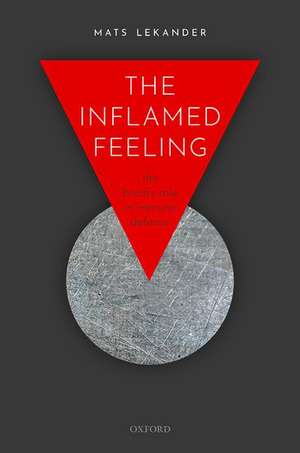
The Inflamed Feeling: The Brain's Role in Immune Defence
Autor Mats Lekanderen Limba Engleză Paperback – 25 ian 2022
Preț: 360.78 lei
Preț vechi: 429.11 lei
-16%
Puncte Express: 541
Carte disponibilă
Livrare economică 06-17 noiembrie
Livrare express 24-30 octombrie pentru 101.70 lei
Livrare prin curier în România Termenul estimat este afișat lângă disponibilitate.
Transport gratuit de la 400.00 lei Plată online sau ramburs, în funcție de opțiunile comenzii.
Retur gratuit în 14 zile Comandă securizată și suport în română.
Specificații
ISBN-13: 9780198863441
ISBN-10: 0198863446
Pagini: 264
Dimensiuni: 155 x 232 x 11 mm
Greutate: 0.41 kg
Editura: OUP OXFORD
Colecția OUP Oxford
Locul publicării:Oxford, United Kingdom
ISBN-10: 0198863446
Pagini: 264
Dimensiuni: 155 x 232 x 11 mm
Greutate: 0.41 kg
Editura: OUP OXFORD
Colecția OUP Oxford
Locul publicării:Oxford, United Kingdom
Recenzii
Join a thriller-like journey between body and brain, a constantly ongoing tourism in your innermost, in which balance and just as often unbalance is described in an accessible scientific way. Instructive and fun!
At last a book about the psychology and physiology of well-being, giving fascinating insights into questions about health which takes up so much room in contemporary society
This is a great read for those wanting a very readable insight into our inner world. Incorporating insights from psychoneuroimmunology, Mats Lekander gives us a personal tour of the way the brain experiences both our outer and inner worlds. The author includes anecdotes of his personal experiences, making the field very accessible to non-specialists as well as highly accomplished scientists
A fascinating journey drawing together cognitive psychology, anthropology, sociology and immunology to reveal how perceptions or misperceptions of our inner world (body) impact on our health and wellbeing. A must read!
Despite major advances in understanding the human immune system over the past few decades, one area that remains mysterious is the intersection between the immune system and other body systems. Among the latter, the nervous system has long been understood to have significant effects on the immune response, and puzzling out the current state of knowledge in this area is the focus of this intriguing book. Lekander (Stockholm Univ., Karolinska Institute) expertly blends current immunological and psychological research with clinical vignettes in a highly readable account.
At last a book about the psychology and physiology of well-being, giving fascinating insights into questions about health which takes up so much room in contemporary society
This is a great read for those wanting a very readable insight into our inner world. Incorporating insights from psychoneuroimmunology, Mats Lekander gives us a personal tour of the way the brain experiences both our outer and inner worlds. The author includes anecdotes of his personal experiences, making the field very accessible to non-specialists as well as highly accomplished scientists
A fascinating journey drawing together cognitive psychology, anthropology, sociology and immunology to reveal how perceptions or misperceptions of our inner world (body) impact on our health and wellbeing. A must read!
Despite major advances in understanding the human immune system over the past few decades, one area that remains mysterious is the intersection between the immune system and other body systems. Among the latter, the nervous system has long been understood to have significant effects on the immune response, and puzzling out the current state of knowledge in this area is the focus of this intriguing book. Lekander (Stockholm Univ., Karolinska Institute) expertly blends current immunological and psychological research with clinical vignettes in a highly readable account.
Notă biografică
Mats Lekander is a professor of Psychoneuroimmunology at Stockholm University and of Health Psychology at Karolinska Institutet Stockholm, Sweden. He is co-director of the Osher Center for Integrative Medicine at Karolinska Institutet, and a former director of the Stockholm Stress Center, a center of excellence for research on work, stress and health. He heads the Division of Psychoneuroimmunology at the Stress Research Institute at Stockholm University. His central line of research focuses on the relation between inflammation, brain function and behavior, especially related to the sickness response. It is also investigated how humans through perceptual means can detect when others are sick and how such detection affects behavior and attitudes. Other lines of research focus on consequences of disturbed sleep and stress, and psychological treatment of related disorders
Cuprins
- 1: What does the brain know about the outside world
- 2: What does the brain know about the body
- 3: Our inner defence systems
- 4: The sickness response
- 5: Disgust and prejudice in disease defence
- 6: How do you rate your general health
- 7: Feeling sick and other emotions
- 8: Can you affect your perceived health?
- 9: How society affects our health
- 10: Perhaps its not that bad?