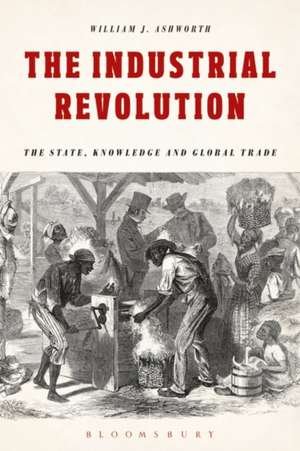
The Industrial Revolution: The State, Knowledge and Global Trade
Autor William J. Ashworthen Limba Engleză Paperback – 26 ian 2017
In this book, William J. Ashworth questions some of the orthodoxies concerning the history of the industrial revolution and offers a deep and detailed reassessment of the subject that focuses on the State and its role in the development of key British manufactures. In particular, he explores the role of State regulation and protectionism in nurturing Britain's negligible early manufacturing base. Taking a long view, from the mid 17th century through to the 19th century, the analysis weaves together a vast range of factors to provide one of the fullest analyses of the industrial revolution, and one that places it firmly within a global context, showing that the Industrial Revolution was merely a short moment within a much larger and longer global trajectory. This book is an important intervention in the debates surrounding modern industrial history will be essential reading for anyone interested in global and comparative economic history and the history of globalization.
Preț: 188.29 lei
Preț vechi: 235.64 lei
-20%
Puncte Express: 282
Carte disponibilă
Livrare economică 21 octombrie-04 noiembrie
Livrare express 07-13 octombrie pentru 83.97 lei
Livrare prin curier în România Termenul estimat este afișat lângă disponibilitate.
Transport gratuit de la 400.00 lei Plată online sau ramburs, în funcție de opțiunile comenzii.
Retur gratuit în 14 zile Comandă securizată și suport în română.
Specificații
ISBN-13: 9781474286466
ISBN-10: 1474286461
Pagini: 352
Dimensiuni: 156 x 234 x 20 mm
Greutate: 0.56 kg
Editura: Bloomsbury Publishing
Colecția Bloomsbury Academic
Locul publicării:London, United Kingdom
ISBN-10: 1474286461
Pagini: 352
Dimensiuni: 156 x 234 x 20 mm
Greutate: 0.56 kg
Editura: Bloomsbury Publishing
Colecția Bloomsbury Academic
Locul publicării:London, United Kingdom
V-ar putea interesa
-
 Lost Voices of the EdwardiansMax ArthurPreț: 118.79 lei
 -
 A New Green History Of The WorldClive Ponting-19%Preț: 75.32 lei92.51 lei
 -
 The Age Of Extremes: 1914-1991Eric Hobsbawm-26%Preț: 90.23 lei121.88 lei
 -
 WhistleblowersMyron Peretz GlazerPreț: 126.32 lei
 -
 Third World PoliticsHaynesPreț: 456.79 lei
 -
 Small Pieces Loosely Joined: A Unified Theory Of The WebDavid WeinbergerPreț: 159.48 lei
 -
 The Decline of the WestOswald SpenglerPreț: 105.41 lei
 -
 The Age of Genius: The Seventeenth Century and the Birth of the Modern MindProfessor A. C. Grayling-35%Preț: 78.22 lei120.07 lei
 -
 -28%Preț: 66.09 lei91.62 lei
 -
 The Making of India: The Untold Story of British EnterpriseKartar Lalvani-39%Preț: 146.35 lei238.96 lei
 -
 Chronologica: The Incredible Years That Defined HistoryBloomsbury Publishing-17%Preț: 108.62 lei130.43 lei
 -
 George Soros On GlobalizationGeorge SorosPreț: 142.57 lei
 -
 The OpportunityRichard HaassPreț: 157.19 lei
 -
 The Holy GrailGiles Morgan-30%Preț: 55.76 lei79.63 lei
Cuprins
Introduction
1. Trade, Finance and European War
2. "The Greatest Dominion of the World": Trade and Textiles
3. Silver and Slaves: Britain and the Atlantic World
4. South Asian "Weeds": The Balance of Trade and Textiles
5. British State Protection and Industrial Development
6. The State as Arbiter of Production
7. Balancing Tax and Industry: The Regulation and Taxing of Domestic Manufactures
8. Culture, Textile Design and Quality
9. Technological Innovation in Cotton Textiles, Metals, Energy and Steam
10. Industry and Fiscal Pressure
11. Industry and the Lived Experience: Food and Labour
12. The Rise of Political Economy during the British Industrial Revolution
Epilogue
Bibliography
1. Trade, Finance and European War
2. "The Greatest Dominion of the World": Trade and Textiles
3. Silver and Slaves: Britain and the Atlantic World
4. South Asian "Weeds": The Balance of Trade and Textiles
5. British State Protection and Industrial Development
6. The State as Arbiter of Production
7. Balancing Tax and Industry: The Regulation and Taxing of Domestic Manufactures
8. Culture, Textile Design and Quality
9. Technological Innovation in Cotton Textiles, Metals, Energy and Steam
10. Industry and Fiscal Pressure
11. Industry and the Lived Experience: Food and Labour
12. The Rise of Political Economy during the British Industrial Revolution
Epilogue
Bibliography
Recenzii
This is an excellent book, ideal for lively debates in graduate seminars. It combines impressive research with a convincing argument that expands the chronological and contextual boundaries traditionally associated with the Industrial Revolution. It is a welcome intervention in the historiography.
The author demonstrates convincingly that state policy, driven by the increasing demands for state revenue, played a critical role in determining Britain's industrial turn . Ashworth's The Industrial Revolution should be required reading for anyone who wishes to understand industrialization and the role of the state more clearly. Summing Up: Highly recommended. Upper-division undergraduates and above.
This refreshing book is a welcome antidote to those histories of the Industrial Revolution written during the Cold War ... This is a major study in a different mould, which provides a new understanding of the Industrial Revolution and the role and dynamics of the state that lay behind it.
This is a brilliant, daring, and thoroughly researched book. Its originality rests on Ashworth's remarkable capacity to link commercial and political history to the history of science in the making of the industrial revolution. Ashworth calls into question the claim that a unique scientific culture underpinned Britain's early industrial ascendancy. Moreover, he emphasizes the role of the British state and its industrial policies rather than "free markets" in providing an effective context for industrial change. In doing so, he knits together commercial expansion, the protectionist and regulatory practices of the state, and the transformation of British technology in a highly compelling manner.
Every decade or so a book comes out that forces historians to reinterpret fundamentally Britain's Industrial Revolution. This is such a book. Ashworth combines deep and even dense scholarship with fearless and sweeping interpretation, and though he is not the first to focus on the period after the Glorious Revolution, instead of prioritizing finance, commerce, or consumption, he argues that it was Britain's interventionist state and associated mercantilist controls that boosted Britain's productivity and created her manufacturing pre-eminence. It follows that, far from creating the industrial revolution, Adam Smith's market theory and free trade political economy were only possible because of it. All in all, a tour de force.
Historians have long debated the nature of the British Industrial Revolution, and their debates have invariably had profound implications for the way we view the present. Every so often, a book comes along that reframes the terms of this debate. The Industrial Revolution: The State, Knowledge and Global Trade is such a book. Ashworth's narrative combines vast synthesis with profound research. Marshaling an enormous range of secondary source material, and interrogating that historiography with his own deep archival knowledge, Ashworth succeeds in producing that rare effect: a historical gestalt shift. Those who read and digest this book will come away with a radically new perspective.
The author demonstrates convincingly that state policy, driven by the increasing demands for state revenue, played a critical role in determining Britain's industrial turn . Ashworth's The Industrial Revolution should be required reading for anyone who wishes to understand industrialization and the role of the state more clearly. Summing Up: Highly recommended. Upper-division undergraduates and above.
This refreshing book is a welcome antidote to those histories of the Industrial Revolution written during the Cold War ... This is a major study in a different mould, which provides a new understanding of the Industrial Revolution and the role and dynamics of the state that lay behind it.
This is a brilliant, daring, and thoroughly researched book. Its originality rests on Ashworth's remarkable capacity to link commercial and political history to the history of science in the making of the industrial revolution. Ashworth calls into question the claim that a unique scientific culture underpinned Britain's early industrial ascendancy. Moreover, he emphasizes the role of the British state and its industrial policies rather than "free markets" in providing an effective context for industrial change. In doing so, he knits together commercial expansion, the protectionist and regulatory practices of the state, and the transformation of British technology in a highly compelling manner.
Every decade or so a book comes out that forces historians to reinterpret fundamentally Britain's Industrial Revolution. This is such a book. Ashworth combines deep and even dense scholarship with fearless and sweeping interpretation, and though he is not the first to focus on the period after the Glorious Revolution, instead of prioritizing finance, commerce, or consumption, he argues that it was Britain's interventionist state and associated mercantilist controls that boosted Britain's productivity and created her manufacturing pre-eminence. It follows that, far from creating the industrial revolution, Adam Smith's market theory and free trade political economy were only possible because of it. All in all, a tour de force.
Historians have long debated the nature of the British Industrial Revolution, and their debates have invariably had profound implications for the way we view the present. Every so often, a book comes along that reframes the terms of this debate. The Industrial Revolution: The State, Knowledge and Global Trade is such a book. Ashworth's narrative combines vast synthesis with profound research. Marshaling an enormous range of secondary source material, and interrogating that historiography with his own deep archival knowledge, Ashworth succeeds in producing that rare effect: a historical gestalt shift. Those who read and digest this book will come away with a radically new perspective.
Notă biografică
William J. Ashworth is Senior Lecturer in History at the University of Liverpool, UK