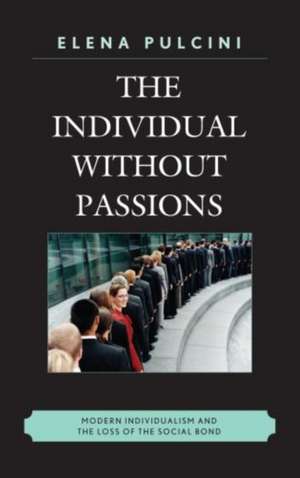
The Individual without Passions: Modern Individualism and the Loss of the Social Bond
Autor Elena Pulcini Traducere de Karen Whittleen Limba Engleză Hardback – 9 aug 2012
Elena Pulcini argues that passions are crucial not only when they are strong (homo oeconomicus), but also when absent or weak (homo democraticus), in both cases producing pathological effects on the Self and the social bond. Finally, this book underlines that the image of the modern individual does not end with the egoistical passions and that it is possible to reactivate empathetic and solidaristic passions; furthermore, it proposes the hypothesis that the solidaristic passions go to fight the egoistical passions. This hypothesis seems confirmed and is most evident in the phenomenon of the gift (as interpreted by Marcel Mauss and his contemporary heirs), the "hidden" testimony of a desire for belonging which enables us to propose a new figure of the individual-homo reciprocus.
Preț: 633.75 lei
Preț vechi: 958.73 lei
-34%
Puncte Express: 951
Carte tipărită la comandă
Livrare economică 05-19 decembrie
Livrare prin curier în România Termenul estimat este afișat lângă disponibilitate.
Transport gratuit pentru acest produs Plată online sau ramburs, în funcție de opțiunile comenzii.
Retur gratuit în 14 zile Comandă securizată și suport în română.
Specificații
ISBN-13: 9780739166574
ISBN-10: 0739166573
Pagini: 224
Dimensiuni: 157 x 234 x 23 mm
Greutate: 0.52 kg
Editura: Bloomsbury Publishing
Colecția Lexington Books
Locul publicării:New York, United States
ISBN-10: 0739166573
Pagini: 224
Dimensiuni: 157 x 234 x 23 mm
Greutate: 0.52 kg
Editura: Bloomsbury Publishing
Colecția Lexington Books
Locul publicării:New York, United States
Cuprins
Introduction: The Individual Without Passions
Chapter 1: From the Ethics of Honor to Self-Preservation
Chapter 2: Homo oeconomicus: Between Acquisitive Passion and Passion of the Self
Chapter 3: The Critique of Acquisitive Individualism and the Search for Authenticity
Chapter 4: The Disappearance of the Passions: homo democraticus
Chapter 5: Homo reciprocus: The passion of Giving and the Communitarian Individual
Chapter 1: From the Ethics of Honor to Self-Preservation
Chapter 2: Homo oeconomicus: Between Acquisitive Passion and Passion of the Self
Chapter 3: The Critique of Acquisitive Individualism and the Search for Authenticity
Chapter 4: The Disappearance of the Passions: homo democraticus
Chapter 5: Homo reciprocus: The passion of Giving and the Communitarian Individual
Recenzii
In The Individualwithout Passions, Elena Pulcini brilliantly deconstructs the presuppositions behind our possessive, narcissistic, and frequently male individualism. Above all she suggests that we should reexamine the bonds between individual and community through a new approach to democracy that revives the requirement for equality based on the gift relationship. With this book Elena Pulcini brings a major contribution to this debate that has the potential to renew political thought.
While complying scrupulously to the ordinary demands of criticism and exegesis of philosophical texts, Elena Pulcini has always taken care, in her studies relevant to the history of ideas, to focus on the particular historicity of the discursive sets examined--that is to say, on the fact of their intelligibility is conditioned on a certain type of correlation between the concepts developed by the philosophers and the way the world works--that they express in their manner while influencing the course.
The project brought by Elena Pulcini strikes immediately with its ambition. The work of Elena Pulcini has finally donned a remarkable breadth and an undeniable originality that resembles, that of Martha Nussbaum, or that of Axel Honneth and Daniel Innerarity, with whom she also engages in explicit conversation
While complying scrupulously to the ordinary demands of criticism and exegesis of philosophical texts, Elena Pulcini has always taken care, in her studies relevant to the history of ideas, to focus on the particular historicity of the discursive sets examined--that is to say, on the fact of their intelligibility is conditioned on a certain type of correlation between the concepts developed by the philosophers and the way the world works--that they express in their manner while influencing the course.
The project brought by Elena Pulcini strikes immediately with its ambition. The work of Elena Pulcini has finally donned a remarkable breadth and an undeniable originality that resembles, that of Martha Nussbaum, or that of Axel Honneth and Daniel Innerarity, with whom she also engages in explicit conversation