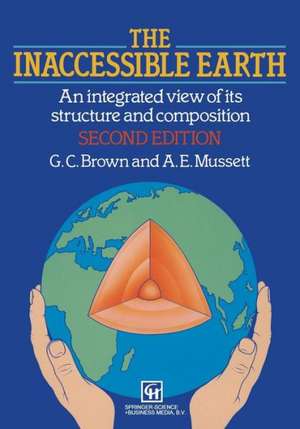
The Inaccessible Earth
Autor Geoffrey Brownen Limba Engleză Paperback – 13 noi 2013
Preț: 380.44 lei
Puncte Express: 571
Carte tipărită la comandă
Livrare economică 23 noiembrie-07 decembrie
Livrare prin curier în România Termenul estimat este afișat lângă disponibilitate.
Transport gratuit de la 400.00 lei Plată online sau ramburs, în funcție de opțiunile comenzii.
Retur gratuit în 14 zile Comandă securizată și suport în română.
Specificații
ISBN-13: 9789401046626
ISBN-10: 940104662X
Pagini: 292
Ilustrații: XI, 276 p. 121 illus.
Dimensiuni: 178 x 254 x 16 mm
Greutate: 0.55 kg
Ediția:Softcover reprint of the original 1st ed. 1993
Editura: Springer
Locul publicării:Dordrecht, Netherlands
ISBN-10: 940104662X
Pagini: 292
Ilustrații: XI, 276 p. 121 illus.
Dimensiuni: 178 x 254 x 16 mm
Greutate: 0.55 kg
Ediția:Softcover reprint of the original 1st ed. 1993
Editura: Springer
Locul publicării:Dordrecht, Netherlands
V-ar putea interesa
-
 -28%Preț: 538.87 lei744.55 lei
 -
 Non-Marine Organic GeochemistryFrederick M. SwainPreț: 458.46 lei
 -
 Geochemical and Biogeochemical Reaction ModelingCraig M. Bethke-9%Preț: 363.21 lei398.68 lei
 -
 The Evolution of MatterIgor Tolstikhin-11%Preț: 507.67 lei570.42 lei
 -
 GeochemistryFrancis Albarède-19%Preț: 501.95 lei619.69 lei
 -
 Using Geochemical Data: Evaluation, Presentation, InterpretationHugh R. Rollinson-15%Preț: 625.22 lei735.55 lei
 -
 Chemistry and the EnvironmentSven E. Harnung-19%Preț: 523.41 lei646.19 lei
 -
 Introduction to GeochemistryKula C. Misra-19%Preț: 419.79 lei518.26 lei
 -
 Marine GeochemistryRoy Chester-19%Preț: 416.37 lei514.04 lei
 -
 Analyzing Compositional Data with RK. Gerald van den Boogaart-15%Preț: 472.79 lei556.22 lei
Public țintă
ResearchCuprins
1 Introduction.- 1.1 Aims and objectives.- 1.2 ‘The Inaccessible Earth’: an outline.- 1.3 History of ideas about the Earth.- Further reading.- 2 The contribution of seismology.- 2.1 Seismic waves.- 2.2 Deduction of P- and S-wave velocities at depth.- 2.3 Seismic velocities and the structure of the Earth.- 2.4 Surface waves.- 2.5 Free oscillations of the Earth.- Summary.- Further reading.- 3 The density within the Earth.- 3.1 Introduction.- 3.2 The mass of the Earth.- 3.3 The moment of inertia of the Earth.- 3.4 The simple self-compression model: the Adams—Williamson equation.- 3.5 Defects of the self-compression model.- 3.6 More sophisticated models and a contemporary result for the Earth’s density variation.- Summary.- Further reading.- 4 The formation of the Solar System and the abundances of the elements.- 4.1 Why it is necessary to look outside the Earth.- 4.2 Introducing the Solar System and the Galaxy.- 4.3 Formation of the Solar System.- 4.4 Abundances of the elements.- 4.5 Meteorites and asteroids.- Summary.- Further reading.- 5 The accretion and layering of the terrestrial planets.- 5.1 The first 100 million years.- 5.2 Pre-planetary chemical processes.- 5.3 Post-accretional chemical processes.- 5.4 The Earth—Moon system: a special relationship.- 5.5 Mars, Venus and Mercury: a postscript.- Summary.- Further reading.- 6 The Earth’s core.- 6.1 Problems posed by the core.- 6.2 The Earth’s magnetic field and the problem of energy.- 6.3 Energy sources for the dynamo: (a) thermal convection.- 6.4 Compositions of the inner and outer cores.- 6.5 Energy sources for the dynamo: (b) compositional convection.- 6.6 Temperature in the core.- Summary.- Further reading.- 7 The mantle and oceanic crust.- 7.1 Introduction.- 7.2 The upper mantle: mineralogical andchemical relationships.- 7.3 Experimental petrology and the upper mantle.- 7.4 Structure and evolution of spreading ridges.- 7.5 The transition zone.- 7.6 The lower mantle.- Summary.- Further reading.- 8 The dynamic mantle.- 8.1 Introduction.- 8.2 Rheology of the mantle.- 8.3 The thermal balance sheet: heat sources and sinks.- 8.4 Convection in the mantle.- 8.5 Temperature within the mantle.- 8.6 The Earth as a heat engine.- Summary.- Further reading.- 9 Evolution of the mantle.- 9.1 Introduction.- 9.2 Does convection cross the 660-km discontinuity?.- 9.3 Geochemical heterogeneity in the mantle.- 9.4 Synthesis.- Summary.- Further reading.- 10 The continental crust.- 10.1 The nature of the Earth’s continental crust.- 10.2 Crustal structure, composition and rheology.- 10.3 Processes in zones of lithospheric convergence.- 10.4 Processes in zones of lithospheric extension.- Summary.- Further reading.- 11 Evolution of the Earth’s continental crust.- 11.1 The framework of crustal evolution.- 11.2 Archaean and pre-Archaean Earth history.- 11.3 The Proterozoic.- 11.4 The Phanerozoic.- 11.5 Isotopes and crustal evolution.- 11.6 A history of the Earth and a final summary.- Further reading.- Postscript: the new state of ignorance.- Notes.- 1 Moment of inertia, angular momentum, etc..- 3 Electromagnetic stiffening, and heating.- 4 Radiometric dating.- 5 The atom and the nucleus.- 6 Electronegativity and the electronic structure of atoms.- 7 Earthquake fault-plane solutions.- 8 Gravity and the geoid.- References.