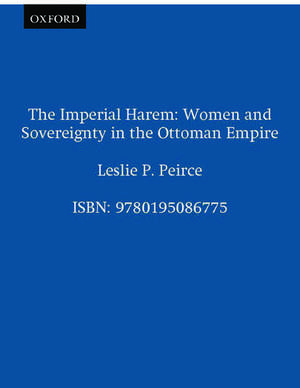
The Imperial Harem: Women and Sovereignty in the Ottoman Empire: Studies in Middle Eastern History
Leslie P. Peirceen Limba Engleză Paperback – 28 iul 1994
Din seria Studies in Middle Eastern History
- 32%
 Preț: 1118.30 lei
 -
 Preț: 140.13 lei
 - 31%
 Preț: 1124.21 lei
 - 31%
 Preț: 1121.84 lei
 - 28%
 Preț: 348.26 lei
 - 32%
 Preț: 859.38 lei
 - 20%
 Preț: 255.46 lei
 - 31%
 Preț: 650.37 lei
 - 24%
 Preț: 632.99 lei
 - 32%
 Preț: 642.28 lei
 - 33%
 Preț: 968.75 lei
 - 31%
 Preț: 1053.32 lei
 - 31%
 Preț: 1025.20 lei
 - 31%
 Preț: 742.87 lei
 - 31%
 Preț: 644.44 lei
 - 31%
 Preț: 1089.64 lei
 - 22%
 Preț: 448.93 lei
 - 31%
 Preț: 1038.68 lei
 - 29%
 Preț: 393.69 lei
 - 19%
 Preț: 327.08 lei
Preț: 466.89 lei
Preț vechi: 650.94 lei
-28%
Puncte Express: 700
Carte tipărită la comandă
Livrare economică 27 noiembrie-08 decembrie
Livrare prin curier în România Termenul estimat este afișat lângă disponibilitate.
Transport gratuit pentru acest produs Plată online sau ramburs, în funcție de opțiunile comenzii.
Retur gratuit în 14 zile Comandă securizată și suport în română.
Specificații
ISBN-13: 9780195086775
ISBN-10: 0195086775
Pagini: 400
Ilustrații: halftones, maps
Dimensiuni: 156 x 234 x 18 mm
Greutate: 0.55 kg
Ediția:Revised
Editura: Oxford University Press
Colecția OUP USA
Seria Studies in Middle Eastern History
Locul publicării:New York, United States
ISBN-10: 0195086775
Pagini: 400
Ilustrații: halftones, maps
Dimensiuni: 156 x 234 x 18 mm
Greutate: 0.55 kg
Ediția:Revised
Editura: Oxford University Press
Colecția OUP USA
Seria Studies in Middle Eastern History
Locul publicării:New York, United States
V-ar putea interesa
-
 -23%Preț: 165.15 lei215.66 lei
 -
 Heartthrobs: A History of Women and DesireCarol Dyhouse-19%Preț: 141.21 lei174.89 lei
 -
 Magic Mineral to Killer Dust: Turner & Newall and the Asbestos HazardGeoffrey Tweedale-28%Preț: 524.72 lei733.71 lei
 -
 -23%Preț: 412.99 lei533.23 lei
 -
 The Oxford Handbook of the New Cultural History of MusicJane F. Fulcher-29%Preț: 389.80 lei546.95 lei
 -
 Sport: A Very Short IntroductionMike Cronin-20%Preț: 56.77 lei70.88 lei
 -
 The Oxford Handbook of the History of ConsumptionFrank Trentmann-19%Preț: 368.64 lei454.35 lei
 -
 Trick or Treat: A History of HalloweenLisa MortonPreț: 188.53 lei
 -
 Noise: A Human History of Sound and ListeningDavid Hendy-19%Preț: 76.10 lei93.65 lei
Recenzii
It is a well-informed, scholarly study which owes little to the contemporary Ottoman political theory which normally dominates the historiography of this period, and a good deal to sociological insight. Although much of Peirce's material and many of her individual points are not in themselves new, her overall approach is. The book is striking and refreshing for its consistent and detailed re-interpretation of a very large subject, examining the nature of Ottoman sovereignty in terms of the dynastic family as a whole rather than merely of the sultan who was its figurehead.