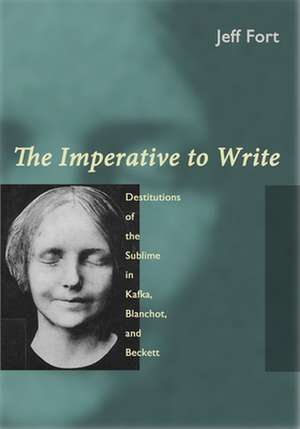
The Imperative to Write
Autor Jeff Forten Limba Engleză Hardback – 3 mar 2014
Notăm cu interes apariția volumului The Imperative to Write, o lucrare ce propune o reevaluare critică a intersecției dintre filozofia kantiană și literatura modernistă. Spre deosebire de studiile care tratează sublimul ca pe o formă de elevație spirituală, Jeff Fort analizează modul în care Franz Kafka, Maurice Blanchot și Samuel Beckett recuperează acest concept pentru a-l supune unei degradări sistematice. Autorul demonstrează cum estetica sublimului, așa cum a fost ea cristalizată de Kant, devine în mâinile acestor scriitori un instrument de explorare a limitelor limbajului și a „torturii” inerente actului de a scrie. Descoperim aici o structură riguroasă, împărțită în trei secțiuni majore. Prima parte este dedicată lui Kafka, investigând „ecstazul judecății” și violența din Colonia penitenciară. A doua parte se concentrează pe Blanchot, explorând imaginea cadavrului și „privirea moartă” a ficțiunii, în timp ce segmentul final îl abordează pe Beckett prin prisma paradoxului expresiei și a vocilor dezîntrupate. Cititorii familiarizați cu The Sublime in Kant and Beckett de Bjørn K. Myskja vor aprecia aici extinderea cadrului comparativ către spațiul francez reprezentat de Blanchot, oferind o perspectivă mult mai vastă asupra modului în care nihilismul și sublimul coexistă. Remarcăm continuitatea preocupărilor lui Jeff Fort față de corporalitate și limitele prezenței, teme prezente și în traducerile sale sau în prezentarea lucrării Corpus III. Volumul de față reușește să sintetizeze teoria literară cu rigoarea filozofică, oferind o hartă a modului în care literatura de după 1945 a transformat „chemarea conștiinței” într-o interogație radicală asupra posibilității de a mai comunica sensul.
Preț: 335.24 lei
Carte disponibilă
Livrare economică 11-25 noiembrie
Livrare express 28 octombrie-03 noiembrie pentru 52.92 lei
Specificații
ISBN-10: 0823254690
Pagini: 440
Dimensiuni: 240 x 164 x 38 mm
Greutate: 0.75 kg
Editura: Fordham University Press
V-ar putea interesa
-
 -18%Preț: 1716.03 lei2092.72 lei
 -
 The Declared Enemy: Texts and InterviewsJean GenetPreț: 250.50 lei
 -
 For What Tomorrow . . .: A DialogueJacques DerridaPreț: 160.18 lei
 -
 Copy, Archive, Signature: A Conversation on PhotographyJacques DerridaPreț: 119.38 lei
 -
 The Ground of the ImageJean-Luc NancyPreț: 295.13 lei
 -
 Heidegger, Philosophy, and PoliticsJacques DerridaPreț: 189.52 lei
 -
 Poetics of HistoryPhilippe Lacoue-LabarthePreț: 526.85 lei
 -
 E. M. Forster as CriticRukun Advani-18%Preț: 716.16 lei873.37 lei
 -
 The Ecstasies of Roland BarthesMary Bittner Wiseman-18%Preț: 1111.68 lei1355.70 lei
 -
 The Reader's Construction of NarrativeHorst Ruthrof-18%Preț: 715.36 lei872.39 lei
 -
 -18%Preț: 1256.11 lei1531.84 lei
 -
 -18%Preț: 901.18 lei1098.99 lei
 -
 The Future of Literary TheoryRalph Cohen-18%Preț: 1423.90 lei1736.46 lei
 -
 -18%Preț: 713.80 lei870.48 lei
 -
 -18%Preț: 722.41 lei880.98 lei
 -
 -30%Preț: 505.39 lei723.18 lei
 -
 -31%Preț: 530.79 lei768.74 lei
 -
 The Divided CityCorinne PachePreț: 208.32 lei
 -
 Myth and Thought Among the GreeksJean-Pierre VernantPreț: 224.28 lei
De ce să citești această carte
Această lucrare este esențială pentru cercetătorii în teorie literară și filozofie continentală. Cititorul câștigă o înțelegere profundă a modului în care marii autori ai secolului XX au deconstruit estetica clasică. Este un motiv concret de lectură pentru oricine dorește să exploreze legătura dintre suferință, lege și limbaj în operele lui Kafka sau Beckett, beneficiind de expertiza unui specialist în traducerile lui Blanchot și Derrida.
Despre autor
Jeff Fort este un distins universitar și traducător, ocupând în prezent poziția de lector în cadrul Departamentului de Literatură Comparată la University of California, Berkeley. Expertiza sa în gândirea franceză contemporană este confirmată de traducerile sale din autori fundamentali precum Jean Genet, Maurice Blanchot și Jacques Derrida. Această experiență de traducător îi oferă o sensibilitate aparte față de nuanțele limbajului, pe care o aplică în The Imperative to Write pentru a analiza mecanismele interne ale textelor literare complexe.