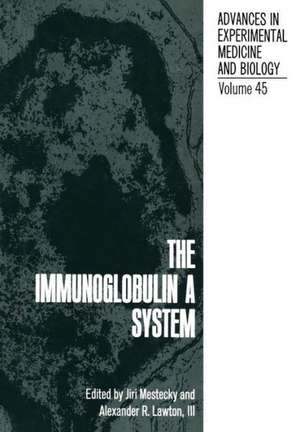
The Immunoglobulin a System: NATO Science Series B:
Editat de Jiri Mesteckyen Limba Engleză Paperback – 26 noi 2012
Din seria NATO Science Series B:
- 5%
 Preț: 1056.69 lei
 - 5%
 Preț: 1338.65 lei
 - 5%
 Preț: 1364.78 lei
 - 5%
 Preț: 1055.83 lei
 - 5%
 Preț: 1061.59 lei
 - 5%
 Preț: 722.40 lei
 - 5%
 Preț: 352.78 lei
 - 5%
 Preț: 688.09 lei
 - 5%
 Preț: 1484.56 lei
 - 5%
 Preț: 2053.03 lei
 - 5%
 Preț: 1153.72 lei
 - 5%
 Preț: 1453.49 lei
 - 5%
 Preț: 749.25 lei
 -
 Preț: 371.97 lei
 - 5%
 Preț: 1148.84 lei
 - 5%
 Preț: 358.16 lei
 - 18%
 Preț: 982.36 lei
 - 5%
 Preț: 379.31 lei
 - 5%
 Preț: 1139.55 lei
 - 5%
 Preț: 383.14 lei
 - 5%
 Preț: 1142.27 lei
 - 5%
 Preț: 1457.27 lei
 - 5%
 Preț: 2205.87 lei
 - 5%
 Preț: 740.03 lei
 - 5%
 Preț: 743.10 lei
 - 18%
 Preț: 987.42 lei
 - 18%
 Preț: 1451.01 lei
 - 5%
 Preț: 1143.20 lei
 - 5%
 Preț: 715.95 lei
 - 5%
 Preț: 746.55 lei
 - 5%
 Preț: 363.21 lei
 - 5%
 Preț: 1044.18 lei
 - 5%
 Preț: 1468.62 lei
 -
 Preț: 394.88 lei
 - 5%
 Preț: 355.17 lei
 - 5%
 Preț: 742.65 lei
 - 5%
 Preț: 358.01 lei
 - 5%
 Preț: 1143.46 lei
 - 5%
 Preț: 366.17 lei
 - 5%
 Preț: 1151.37 lei
 - 5%
 Preț: 1142.27 lei
 - 5%
 Preț: 1086.52 lei
 - 5%
 Preț: 738.86 lei
 - 5%
 Preț: 717.50 lei
 - 5%
 Preț: 1373.11 lei
Preț: 373.37 lei
Preț vechi: 393.02 lei
-5%
Puncte Express: 560
Carte tipărită la comandă
Livrare economică 20 noiembrie-04 decembrie
Livrare prin curier în România Termenul estimat este afișat lângă disponibilitate.
Transport gratuit de la 400.00 lei Plată online sau ramburs, în funcție de opțiunile comenzii.
Retur gratuit în 14 zile Comandă securizată și suport în română.
Specificații
ISBN-13: 9781461345527
ISBN-10: 1461345529
Pagini: 572
Ilustrații: XIII, 555 p.
Greutate: 0.9 kg
Ediția:Softcover reprint of the original 1st ed. 1974
Editura: Springer Us
Colecția Springer
Seria NATO Science Series B:
Locul publicării:New York, NY, United States
ISBN-10: 1461345529
Pagini: 572
Ilustrații: XIII, 555 p.
Greutate: 0.9 kg
Ediția:Softcover reprint of the original 1st ed. 1974
Editura: Springer Us
Colecția Springer
Seria NATO Science Series B:
Locul publicării:New York, NY, United States
V-ar putea interesa
-
 Virus Variability, Epidemiology and ControlEdouard Kurstak-5%Preț: 1473.78 lei1551.35 lei
 -
 Antimicrobial ResistanceDonald L. Jungkind-5%Preț: 1133.23 lei1192.87 lei
 -
 EicosanoidsGiancarlo C. Folco-5%Preț: 1130.77 lei1190.29 lei
 -
 Antiviral Chemotherapy 4John Mills-5%Preț: 1470.67 lei1548.07 lei
 -
 Analytical Use of Fluorescent Probes in OncologyJoseph G. Hirschberg-5%Preț: 1483.69 lei1561.78 lei
 -
 Dendritic Cells in Fundamental and Clinical ImmunologyPaola Ricciardi-Castagnoli-5%Preț: 1488.65 lei1567.01 lei
 -
 Cellular Peptidases in Immune Functions and DiseasesSiegfried Ansorge-5%Preț: 1115.14 lei1173.83 lei
 -
 Handbook of Immune Response GenesTak W. Mak-5%Preț: 1070.74 lei1127.09 lei
 -
 Hot Topics in Infection and Immunity in Children IIIAndrew J Pollard-5%Preț: 1109.05 lei1167.42 lei
 -
 The PapillomavirusesRobert Garcea-5%Preț: 1147.87 lei1208.29 lei
 -
 Functions of the Natural Immune SystemC.W. Reynolds-5%Preț: 364.56 lei383.75 lei
 -
 Advances in Mucosal ImmunologyJiri Mestecky-5%Preț: 408.65 lei430.16 lei
 -
 Immunology of Milk and the NeonateJiri Mestecky-5%Preț: 409.86 lei431.42 lei
 -
 Hot Topics in Infection and Immunity in Children VIINigel Curtis-5%Preț: 1363.54 lei1435.30 lei
 -
 Advances in TNF Family ResearchDavid Wallach-5%Preț: 2063.96 lei2172.58 lei
 -
 Crossroads Between Innate and Adaptive Immunity IVPeter D. Katsikis-5%Preț: 1058.65 lei1114.37 lei
 -
 Volume 4 ImmunopathologyNoel Rose-5%Preț: 736.37 lei775.14 lei
 -
 PharmacologyJohn Hadden-5%Preț: 371.27 lei390.81 lei
 -
 -5%Preț: 354.98 lei373.66 lei
 -
 PhysiologySherwood M. Reichard-5%Preț: 367.91 lei387.27 lei
 -
 The InterleukinsSteven Gillis-5%Preț: 357.76 lei376.59 lei
 -
 -5%Preț: 400.42 lei421.50 lei
 -
 Contemporary Topics in Molecular ImmunologyR. Reisfeld-5%Preț: 356.69 lei375.46 lei
 -
 -5%Preț: 354.50 lei373.16 lei
 -
 -5%Preț: 1059.94 lei1115.73 lei
 -
 Cellular Peptidases in Immune Functions and Diseases 2Siegfried Ansorge-5%Preț: 1122.12 lei1181.18 lei
 -
 Mensch im StressLudger Rensing-5%Preț: 478.85 lei504.06 lei
 -
 New Strategies for Oral ImmunizationJiri Mestecky-5%Preț: 719.55 lei757.42 lei
Public țintă
ResearchCuprins
Session A Developmental and Cellular Aspects Chairman: Lars A. Hanson.- The IgA System in Connection with Local and Systemic Immunity.- Origin, Distribution, and Differentiation of IgA-Producing Cells.- Cell Types Contributing to the Biosynthesis of sIgA.- DISCUSSION I.- Gut-Associated Lymphoblasts and Intestinal IgA Plasma Cells.- Bronchial Lymphoid Tissue.- The Origin of Monomeric and Polymeric Forms of IgA in Man.- Cytophilic Properties of IgA to Human Neutrophils.- DISCUSSION II.- Session B Structure, Biosynthesis, and Genetics Chairman: J. Claude Bennett.- Characteristics of SC-Ig Complexes Formed in vitro.- Association of S-IgA Subunits.- Modulation of the Assembly of Immunoglobulin Subunits.- DISCUSSION I - E. C. Franklin, Initial Discussant.- Mechanism of Immunoglobulin Polymer Assembly.- Assembly and Secretion of Immunoglobulin A.- Special Characteristics of the IgA2 Subclass.- Genetics and Evolution of Human Immunoglobulin A.- Physical-Chemical Characteristics of J Chains Obtained from IgM.- DISCUSSION II.- Session C Structure Chairman: Jiri Mestecky.- Isolation, Properties, and Structure of Human IgA Myeloma Globulins.- Amino Acid Sequence Studies of Human IgA Myeloma Proteins.- Structural Studies on a Human IgA1 Myeloma Protein with a Carboxy Terminal Deletion.- The Hinge Peptide of an IgA2m(2) Myeloma Protein.- The Carbohydrate Composition of Glycopeptides Isolated from IgA2 Immunoglobulin.- Mouse IgA Myeloma Proteins with Alpha Chain Deletions: A Comparison with Human Alpha Chains with Deletions.- DISCUSSION I.- Evidence for a Common Synthetic Origin for Secretory and Serum IgA.- Studies on the Primary Structure of Human Secretory Component.- Production of an Fc Fragment from Human Immunoglobulin A by an IgA-Specific Bacterial Protease.- Precipitin Cross-Reactions between Human and Animal J-Chains.- Disulfide Bridges of Human Immunoglobulins A1 and A2.- DISCUSSION II.- Session D Function Chairman: Frederick W. Kraus.- Implications of Secretory Immune System in Viral Infections.- The Role of the Secretory Immune System in Protection Against Agents Which Infect the Respiratory Tract.- The Role of Immunization in Controlling Antigen Uptake from the Small Intestine.- Lack of C3 Activation through Classical or Alternate Pathways by Human Secretory IgA Anti-Blood Group A Antibody.- DISCUSSION I.- Bacterial Adherence to Mucosal Surfaces and Its Inhibition by Secretory Antibodies.- Specificity of Antibodies to Streptococcus Mutans; Significance in Inhibition of Adherence.- Secretory Antibodies in Milk of Swine Against Transmissible Gastroenteritis Virus.- Secretory IgA and Direct Killing of Shigella by Serum Components.- DISCUSSION II.- Session E Clinical Considerations Chairman: Max D. Cooper.- Current Knowledge on Alpha Chain Disease.- The Cellular Basis of IgA Deficiency in Humans.- Alpha Chain Determinants on the Membrane of Immunoglobulin Synthesizing Cells.- Secretory and Serum IgA in Children with Protein-Calorie Malnutrition.- Studies of Secretory Antibodies to E. Coli in Human Urine Compared to the Serum Antibody Content.- Secretory IgA: An Adolescent Coming of Age.- DISCUSSION I.- Types of Size Heterogeneity of IgA Molecules Isolated from Myeloma and Normal Human Serum.- Distribution of IgA Subclasses in Sera and Bone Marrow Plasma Cells of 21 Normal Individuals.- Selective IgA Deficiency and Chronic Obstructive Pulmonary Disease — A Family Study.- DISCUSSION II.- Session F The IgA Antibody Response Implications for Oral Health Chairman: Alexander R. Lawton.- The Induction and Characterization of Secretory IgAAntibodies.- Human Nasal Exocrine IgA Antibody: Formation and Some Activities.- The IgA Antibody-Forming Cell Response in the Rabbit Submandibular Gland Following Several Different Methods of Immunization.- The Establishment of Systemic Immunity Following Antigenic Stimulation of the Lymphoid Tissue of the Gastrointestinal Mucosa.- DISCUSSION I.- The Relationship between Serum and Salivary Antibodies and Cell Mediated Immunity in Oral Disease in Man.- Oral Manifestations of IgA Deficiency.- DISCUSSION II.- Conclusion.- Impressions, Summary, and Questions Raised by the IgA Symposium.- Program Participants.