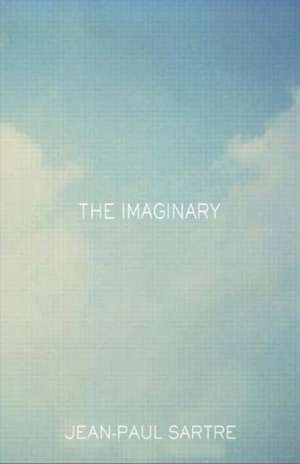
The Imaginary: A Phenomenological Psychology of the Imagination
Autor Jean-Paul Sartre Traducere de Jonathan Webber Autor revised by Arlette Elkaim-Sartreen Limba Engleză Paperback – 12 feb 2004
Against this background, The Imaginary crystallized Sartre's worldview and artistic vision. Here he presented the first extended examination of the concepts of nothingness and freedom, both of which are derived from the ability of consciousness to imagine objects both as they are and as they are not. These ideas would drive Sartre's existentialism and his entire theory of human freedom, laying the foundation for his masterwork Being and Nothingness three years later. This new translation by Jonathan Webber rectifies flaws in the terminology of the first translation and recaptures the essence of Sartre's phenomenology. Webber's perceptive new introduction helps to decipher this challenging, seminal work, placing it in the context of the author's work and the history of philosophy.
| Toate formatele și edițiile | Preț | Express |
|---|---|---|
| Paperback (1) | 300.81 lei 3-5 săpt. | |
| Taylor & Francis – 12 feb 2004 | 300.81 lei 3-5 săpt. | |
| Hardback (1) | 907.59 lei 6-8 săpt. | |
| Taylor & Francis – 12 feb 2004 | 907.59 lei 6-8 săpt. |
Preț: 300.81 lei
Recomandat
Puncte Express: 451
Preț estimativ în valută:
53.27€ • 62.22$ • 46.28£
53.27€ • 62.22$ • 46.28£
Carte disponibilă
Livrare economică 31 ianuarie-14 februarie
Preluare comenzi: 021 569.72.76
Specificații
ISBN-13: 9780415287555
ISBN-10: 0415287553
Pagini: 240
Dimensiuni: 152 x 229 x 18 mm
Greutate: 0.44 kg
Ediția:1
Editura: Taylor & Francis
Colecția Routledge
Locul publicării:Oxford, United Kingdom
ISBN-10: 0415287553
Pagini: 240
Dimensiuni: 152 x 229 x 18 mm
Greutate: 0.44 kg
Ediția:1
Editura: Taylor & Francis
Colecția Routledge
Locul publicării:Oxford, United Kingdom
V-ar putea interesa
-
 Cognitive PhenomenologyTim Bayne-7%Preț: 310.52 lei332.91 lei
 -
 -31%Preț: 503.47 lei734.94 lei
 -
 -7%Preț: 565.28 lei606.87 lei
 -
 The Origins of MusicCarl Stumpf-23%Preț: 475.47 lei615.50 lei
 -
 On the Heights of DespairE. M. CioranPreț: 203.62 lei
 -
 Preț: 361.57 lei
 -
 -18%Preț: 1344.03 lei1639.06 lei
 -
 From Soul to SelfJames CrabbePreț: 369.04 lei
 -
 Introduction to PhenomenologyDermont MoranPreț: 352.23 lei
 -
 The Phenomenology ReaderTim Mooney-18%Preț: 1243.02 lei1515.88 lei
 -
 The Phenomenology ReaderTim Mooney-8%Preț: 412.29 lei448.14 lei
 -
 Between Man and ManMartin BuberPreț: 112.37 lei
 -
 -18%Preț: 1016.02 lei1239.05 lei
 -
 Preț: 250.67 lei
 -
 The Cambridge Companion to ExistentialismSteven CrowellPreț: 236.13 lei
 -
 Freedom to FailPeter TrawnyPreț: 139.33 lei
 -
 Preț: 125.74 lei
 -
 The Deleuze and Guattari DictionaryEugene B. Young-18%Preț: 185.39 lei225.11 lei
 -
 Statues: The Second Book of FoundationsProfessor Michel Serres-43%Preț: 254.23 lei442.48 lei
 -
 The ThingDylan TriggPreț: 87.31 lei
 -
 Identity and Networks: Gender and Ethnicity in a Cross-Cultural ContextDeborah Fahy Bryceson-23%Preț: 723.70 lei939.87 lei
 -
 Jewish Identities in the New EuropeJonathan WebberPreț: 304.04 lei
 -
 Bariona oder Der Sohn des Donners / Die FliegenJean-Paul SartrePreț: 93.78 lei
 -
 Zeit der ReifeJean-Paul SartrePreț: 139.45 lei
Notă biografică
Jonathan Webber is a Lecturer in Philosophy at the University of Sheffield and a Research Associate of the Forum for European Philosophy. His research interests center on the cross-fertilization of Anglophone and European philosophy of mind and metaphysics. He earned his PhD from University College London with a study of consciousness in Sartre's early works. Arlette Elkaim-Sartre, the author's adopted daughter and literary executor, prepared this revised edition after Sartre's death.
Cuprins
Introduction Notes on the Translation Part One: The Certain The Intentional Structure of the Image I. Description 1. The Method 2. First Characteristic: The Image is a Consciousness 3. Second Characteristic: The Phenomenon of Quasi-Observation 4. Third Characteristic: The Imaging Consciousness Posits its Object as a Nothingness 5. Fourth Characteristic: Spontaneity 6. Conclusion II. The Image Family 1. Image, Portrait, Caricature 2. Sign and Portrait 3. From Sign to Image: Consciousness of Imitations 4. From Sign to Image: Schematic Drawings 5. Faces in the Fire, Spots on Walls, Rocks in Human Form 6. Hypnagogic Images, Scenes and Persons Seen in Coffee Grounds, in a Crystal Ball 7. From Portrait to Mental Image 8. Mental Image Part Two: The Probable Nature of the Analogon in the Mental Image 1. Knowledge 2. Affectivity 3. Movements 4. The Role of the Word in the Mental Image 5. The Mode of Appearance of a Thing in the Mental Image Part Three: The Role of the Image in Psychic Life 1. The Symbol 2. Symbolic Schemas and Illustrations of Thought 3. Image and Thought 4. Image and Perception Part Four: The Imaginary Life 1. The Irreal Object 2. Conduct in the Face of the Irreal 3. Pathology of the Imagination 4. The Dream Conclusion 1. Consciousness and Imagination 2. The Work of Art