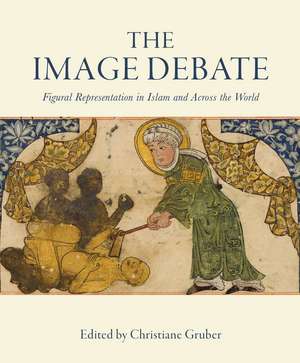
The Image Debate: Figural Representation in Islam and Across the World: Art Series
Editat de Christiane Gruberen Limba Engleză Hardback – 15 aug 2019
Prezentat într-un format monografic de tip folio, The Image Debate se distinge imediat prin calitatea tactilă și vizuală a producției sale. Notăm cu interes cum cele 197 de planșe color, de o claritate remarcabilă, nu sunt simple anexe ilustrative, ci puncte centrale de analiză care susțin argumentele celor treisprezece eseuri. Credem că această lucrare reușește să depășească simpla documentare istorică, oferind o experiență senzorială care invită cititorul să observe detaliile fine ale manuscriselor persane sau nuanțele ștergerilor epigrafice medievale.
Textul explorează tensiunea dintre interdicția religioasă și realitatea artistică, începând cu perioada Umayyadă și extinzându-se până la arta iraniană contemporană. Merită menționat că volumul nu se limitează la spațiul islamic; el propune un dialog transcultural fascinant, analizând iconoclasmul bizantin și absența reprezentării lui Buddha în primele secole ale budismului. Complementar lucrării The Human Figure in Islamic Art, care se concentrează pe colecția David din Copenhaga, The Image Debate oferă o perspectivă academică mai largă, integrând contextul socio-politic al distrugerilor de monumente din perioada 2015-2016.
Această abordare amintește de preocupările anterioare ale editorului Christiane Gruber din Revealing the Unseen, unde analiza artei Qajare servea drept poartă către înțelegerea identității culturale. În acest nou volum, Christiane Gruber rafinează explorarea „invizibilului”, transformând o dezbatere adesea abstractă într-o analiză vizuală riguroasă și accesibilă specialiștilor din domeniul istoriei artei și studiilor religioase.

Preț: 398.38 lei
Preț vechi: 576.23 lei
-31%
Carte disponibilă
Livrare economică 09-23 noiembrie
Livrare express 23-29 octombrie pentru 168.36 lei
Specificații
ISBN-10: 1909942340
Pagini: 240
Ilustrații: 197 color plates, 4 line drawings
Dimensiuni: 241 x 292 x 28 mm
Greutate: 1.76 kg
Ediția:First Edition
Editura: Gingko
Colecția Gingko
Seria Art Series
V-ar putea interesa
-
 Covering IslamEdward W. Said-20%Preț: 74.57 lei92.64 lei
 -
 Islam and the Islamic StateTim Jacoby-30%Preț: 435.66 lei621.24 lei
 -
 -13%Preț: 133.17 lei153.46 lei
 -
 Ibraheem's Perfect EidFarhana IslamPreț: 56.90 lei
 -
 My Name Is RedOrhan PamukPreț: 76.28 lei
 -
 Islamic Art Close-UpSheila R. Canby-16%Preț: 81.29 lei96.43 lei
 -
 Imagining the DivineJas ElsnerPreț: 368.30 lei
 -
 Colour, Light and Wonder in Islamic ArtIdries TrevathanPreț: 206.05 lei
 -
 Crucible of LightElizabeth Drayson-30%Preț: 99.69 lei142.10 lei
 -
 Between the Pagan Past and Christian Present in Byzantine Visual CultureParoma Chatterjee-11%Preț: 662.34 lei744.20 lei
 -
 Images at the CrossroadsJudith M Barringer-9%Preț: 223.79 lei245.43 lei
 -
 Civilisations: How Do We Look / The Eye of FaithProfessor Mary Beard-19%Preț: 87.73 lei108.13 lei
 -
 -30%Preț: 409.66 lei582.95 lei
 -
 Regime Change: New Horizons in Islamic Art and Visual CultureChristiane Gruber-26%Preț: 353.41 lei476.71 lei
 -
 Macht und Makel der BilderJacques PicardPreț: 361.01 lei
 -
 -8%Preț: 382.31 lei415.55 lei
 -
 A Companion to Byzantine IconoclasmMike Humphreys-23%Preț: 1846.65 lei2398.25 lei
 -
 Gazing at Mecca and Medina: Premodern Representations of the ḤaramaynMounia Chekhab-Abudaya-18%Preț: 756.29 lei922.30 lei
 -
 -19%Preț: 92.92 lei114.66 lei
De ce să citești această carte
Această monografie este esențială pentru cei care doresc să înțeleagă complexitatea reprezentării figurale dincolo de clișeele despre interdicțiile islamice. Cititorul câștigă o perspectivă nuanțată asupra modului în care imaginile au fost folosite pentru a afirma autoritatea politică sau spirituală. Este o recomandare certă pentru istorici, studenți la teologie și colecționari de albume de artă care apreciază rigoarea academică însoțită de o execuție grafică de excepție.
Despre autor
Christiane Gruber este profesor asociat de artă islamică la Universitatea din Michigan, fiind recunoscută la nivel internațional pentru cercetările sale asupra culturii vizuale islamice. Expertiza sa acoperă o gamă largă, de la manuscrise medievale la arta contemporană de stradă. Printre lucrările sale de referință se numără Prophet's Ascension, unde analizează adaptarea artistică a tradițiilor literare, și Regime Change, un volum ce explorează tendințele schimbătoare în istoriografia artei. Activitatea sa academică este marcată de colaborări cu instituții prestigioase precum Muzeul Luvru, consolidându-i statutul de autoritate în analiza intersecției dintre religie și estetică.
Descriere scurtă
The Image Debate is a collection of thirteen essays which examine the controversy surrounding the use of images in Islamic and other religious cultures and seek to redress some of the misunderstandings that have arisen. Written by leading academics from the United States, Australia, Turkey, Israel and the United Kingdom, the book has a foreword by Stefano Carboni, Director of the Art Gallery of Western Australia, followed by an introduction by the editor Christiane Gruber, who sets the subject in context with a detailed examination of the debates over idols and the production of figural images in Islamic traditions.
Twelve further articles are divided into three sections: the first deals with pre-modern Islam: Mika Natif looks at tensions between the Hadith prohibition on images and the praxis of image-making under the Umayyad dynasty and argues that the Umayyad rulers used imagery to establish their political and religious authority; Finbarr Barry Flood examines the practice of epigraphic erasure, i.e., the removal of names of rulers and patrons from historical inscriptions from the medieval Islamic world; and Oya Pancaroğlu focuses on the figural conventions of an illustrated manuscript of Varqa and Gulshah, a medieval Persian romance composed in the masnavi (rhyming couplet) form by the 11th-century poet ‘Ayyuqi.
The second section addresses the situation outside Islam: Alicia Walker surveys attitudes toward the production and veneration of religious images in Byzantium from the earliest years of the Christian Roman Empire (early 4th century) to the aftermath of the Iconoclast controversy (late 9th century); Steven Fine explores the history of Jewish engagement with ‘art’ from Roman antiquity through the high middle ages through a detailed exploration of the 3rd-century Dura Europos synagogue and its wall paintings; Michael Shenkar examines evidence for the employment of figural images in the cultic practices of some of the major ancient Iranian cultural and political entities, offering a broad perspective on perceptions of images in ancient Iranian worship; and Robert DeCaroli delves into the question of why no image of the Buddha was made during the first five hundred years of Buddhism.
The third section brings the reader back to Islamic lands with five articles examining aspects of the issue in the modern and contemporary periods: Yousuf Saaed investigates South Asian mass-produced images, especially posters that include illustrations of local Sufi shrines, portraits of saints and Shi‘i iconography; James Bennett explores the visual depiction of Javanese shadow puppets (wayang kulit), including the sage Begawan Abiyasa, whose narratives convey key elements of Sufi mystical philosophy; Allen and Mary Roberts consider images of Cheikh Amadu Bamba, the founding Sufi saint of the Senegalese Mouride order; Rose Issa addresses how the term ‘Islamic’ relates to contemporary art, how artists manage to create work in countries in constant turmoil and to what extent such works reflect their conceptual, aesthetic, and socio-political concerns; and finally Shiva Balaghi traces the use of the figure, along its symbolic shadows and silhouettes, in works by notable Iranian artists living in Iran and in diaspora.