Cantitate/Preț
Produs

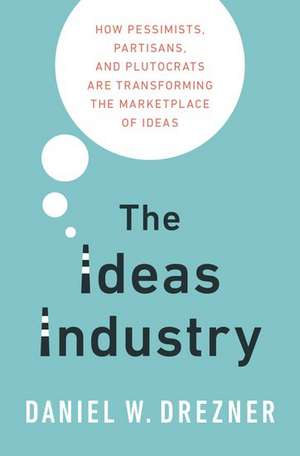
The Ideas Industry: How Pessimists, Partisans, and Plutocrats are Transforming the Marketplace of Ideas.

Autor Daniel Drezner
en Limba Engleză Hardback – 27 apr 2017

Observăm în ultimele decenii o evoluție structurală a modului în care ideile circulă în spațiul public, o trecere de la dezbaterea academică riguroasă la o piață a ideilor dominată de branding și influență. În The Ideas Industry, Daniel Drezner analizează transformarea intelectualului public tradițional — acea figură capabilă să dispute orice subiect serios în publicații de prestigiu — în ceea ce numim astăzi „thought leader”. Această nouă specie de intelectual nu mai caută neapărat validarea colegială, ci succesul pe scene globale precum TED sau Aspen Ideas.

Subliniem argumentul central al autorului: ascensiunea liderului de opinie este strâns legată de creșterea inegalității economice. O clasă de plutocrați moderni finanțează selectiv idei care rezonează cu viziunile lor, transformând gândirea critică într-un produs de consum. Reținem distincția fascinantă pe care o face Daniel Drezner între „vulpile” intelectuale, care analizează complexitatea lumii din multiple perspective, și „aricii” noii industrii a ideilor, care pariază totul pe o singură teorie de impact, ușor de digerat și de promovat.

Merită menționat că, spre deosebire de abordările pur critice, această lucrare publicată de Oxford University Press menține un echilibru analitic. Deși identifică pericolele polarizării și ale instituțiilor închise care filtrează informația, autorul recunoaște capacitatea acestei industrii de a propulsa conținutul intelectual către audiențe masive. Ca alternativă la The Public Intellectual de Arthur M. Melzer pentru cursurile de sociologie sau științe politice, lucrarea lui Drezner are avantajul de a ancora discuția în realitatea economică și tehnologică a secolului XXI, oferind o explicație pragmatică pentru declinul autorității academice clasice.

Citește tot Restrânge

Preț: 17383 lei

Preț vechi: 19983 lei
-13%

Puncte Express: 261

Carte disponibilă

Livrare economică 14-20 mai


Specificații

ISBN-13: 9780190264604
ISBN-10: 0190264608
Pagini: 360
Dimensiuni: 236 x 163 x 31 mm
Greutate: 0.61 kg
Editura: Oxford University Press
Colecția OUP USA
Locul publicării:New York, United States

De ce să citești această carte

Această carte este esențială pentru oricine dorește să înțeleagă cum se fabrică și se vând ideile în prezent. Cititorul va câștiga o perspectivă clară asupra mecanismelor din spatele conferințelor de tip TED și a modului în care interesele financiare modelează discursul public. Este o lectură necesară pentru studenții la științe politice și comunicare, dar și pentru publicul larg interesat de culisele puterii intelectuale.


Despre autor

Daniel Drezner este profesor de politică internațională la Fletcher School of Law and Diplomacy din cadrul Universității Tufts și un colaborator constant al publicației The Washington Post. Expertiza sa acoperă economia politică globală și politica externă a SUA, fiind recunoscut pentru capacitatea de a traduce dinamici politice complexe pentru publicul larg. Prin activitatea sa, Drezner întruchipează el însuși puntea dintre rigoarea academică și prezența activă în mass-media, oferind o analiză pertinentă asupra modului în care puterea și ideile interacționează.


Descriere

The concept of the "public intellectual" has a rich and colorful history. It began in the early twentieth century, when the new mass media catapulted intellectuals who were able to write for the general public to semi-stardom. The first wave included figures like Walter Lippmann--who coined the term "stereotype" and is widely considered the founder of media studies--and by the 1950s, public intellectuals as a species had become a powerful and influential force in the American cultural landscape. By the 1970s, the standard definition of the public intellectual had solidified: a person (often university-affiliated, but not always) able to discuss and dispute any serious issue, typically in venues like The New York Review of Books, and occasionally influence politics. The traditional definition of the public intellectual remains with us, but as Daniel W. Drezner shows in The Ideas Industry, it has been gradually supplanted by a new model in recent years: the "thought leader." In contrast to public intellectuals, thought leaders gain fame as purveyors of a single big idea. Also, instead of battling it out with intellectual combatants in the pages of The Partisan Review, The Public Interest, and their descendants, they often work through institutions that are closed to the public and which release information selectively. Thought leaders and their associated ideas tend to become brands--hedgehogs to the public intellectual fox. They have also proven to be quite successful, as evidenced by TED, Aspen Ideas, the Clinton Global Initiative, and the like. Furthermore, they often align with one side of a politically polarized debate and enjoy the support of ideologically friendly private funders. Drezner identifies increasing inequality as a prime mover of this shift, contending that our present-day class of plutocrats not only wants to go back to school, it wants to force "schools"-in the form of intellectuals with elite affiliations-to come to them. And they have the money to make this happen. Drezner, however, does not see the phenomenon as necessarily negative. While there are certainly some downsides to the contemporary ideas industry, he argues that it is very good at broadcasting intellectual content widely and reaching large audiences of people hungry for new thinking. Both fair-minded and trenchant, The Ideas Industry will reshape our understanding of contemporary public intellectual life in America and the West.

Recenzii

Drezner is a lively and engaging writer...Throughout the book he is balanced and measured, recognizing that the new era comes with benefits as well as drawbacks.

Notă biografică

Daniel Drezner is Professor of International Politics, Tufts University, and author of The System Worked; Theories of International Relations and Zombies; Avoiding Trivia; All Politics is Global; Locating the Proper Authorities; and The Sanctions Paradox.