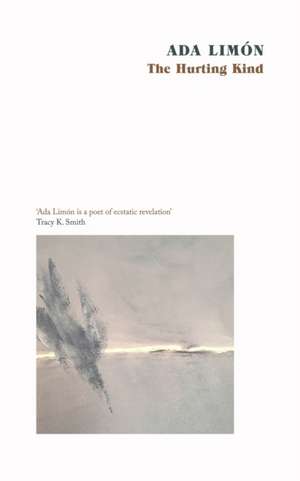
The Hurting Kind: The new collection from the US Poet Laureate
Autor Ada Limónen Limba Engleză Paperback – 18 aug 2022
'I have always been too sensitive, a weeper / from a long line of weepers,' writes Limón. 'I am the hurting kind.' What does it mean to be the hurting kind? To be sensitive not only to the world's pain and joys, but to the meanings that bend in the scrim between the natural world and the human world? To divine the relationships between us all? To perceive ourselves in other beings - and to know that those beings are resolutely their own, that they 'do not / care to be seen as symbols'?
With Limón's remarkable ability to trace thought, The Hurting Kind explores those questions - incorporating others' stories and ways of knowing, making surprising turns, and always reaching a place of startling insight. These poems slip through the seasons, teeming with horses and kingfishers and the gleaming eyes of fish. And they honour parents, stepparents, and grandparents: the sacrifices made, the separate lives lived, the tendernesses extended to a hurting child; the abundance, in retrospect, of having two families.
Along the way, we glimpse loss. There are flashes of the pandemic, ghosts whose presence manifests in unexpected memories and the mysterious behaviour of pets left behind. But The Hurting Kind is filled, above all, with connection and the delight of being in the world. 'Slippery and waddle thieving my tomatoes still / green in the morning's shade,' writes Limón of a groundhog in her garden, 'she is doing what she can to survive.'
'Limón is a poet of ecstatic revelation' Guardian
'I can always rely on an Ada Limón poem to give me hope . . . Limón gives us two brains in her poems, too, revealing new ways to view the world' New York Times Magazine
'Ada Limón is a bright light in a dark time. Her keen attention to the natural world is only matched by her incredible emotional honesty' Vanity Fair
Preț: 66.22 lei
Preț vechi: 92.02 lei
-28%
Puncte Express: 99
Carte disponibilă
Livrare economică 09-23 noiembrie
Livrare express 24-30 octombrie pentru 42.94 lei
Livrare prin curier în România Termenul estimat este afișat lângă disponibilitate.
Transport gratuit de la 400.00 lei Plată online sau ramburs, în funcție de opțiunile comenzii.
Retur gratuit în 14 zile Comandă securizată și suport în română.
Specificații
ISBN-13: 9781472157683
ISBN-10: 1472157680
Pagini: 128
Dimensiuni: 134 x 214 x 16 mm
Greutate: 0.15 kg
Editura: Little Brown
Colecția Corsair
Locul publicării:London, United Kingdom
ISBN-10: 1472157680
Pagini: 128
Dimensiuni: 134 x 214 x 16 mm
Greutate: 0.15 kg
Editura: Little Brown
Colecția Corsair
Locul publicării:London, United Kingdom
Recenzii
Praise for The Hurting Kind
'I can always rely on an Ada Limón poem to give me hope, but Limón's poems don't give us the kind of facile Hallmark hope; rather, her hope is hard-earned, even laced with grief or happiness . . . Limón is a master at making a simple idea (that of hindsight, seeing the bright side of things) askew. "And so I have/two brains now," she writes. "Two entirely different brains." Limón gives us two brains in her poems, too, revealing new ways to view the world' Victoria Chang, New York Times Magazine
'In one of Ada Limón's early poems, she asks, "Shouldn't we make fire out of everyday things?" For the past 16 years, that's exactly what she's done. [She is] fearlessly confessional and technically brilliant' Washington Post
'These poems home in on how grief makes us human . . . [Limón] reminds readers that we are nothing without connection. If you haven't read poetry in a while, this volume might be what you need to reconnect with the form' Los Angeles Times
'Brilliant . . . Throughout is the trademark wonder, and blown-out perceptivity, underscoring Limón's clarion melancholy' San Francisco Chronicle
'Limón responds in her poetry to what she identifies as an ecological imperative to re-describe our relationship to "nature" in a manner that isn't merely instrumental. The moving personal dramas that her poems detail can never be separated from the landscape in which they occur . . . Consequently, her poetry, which can feel so intimate and self-revealing, is almost constantly political at the same time . . . There are endless things to say about the articulate, complex emotional resonance of the poems in this book. Still, what Limón says about "a life" is true as well for her book: "You can't sum it up."' Forrest Gander, Brooklyn Rail
By far Limón's most self- and world-examining book, The Hurting Kind captures the hidden, marginal forces of kindness and suffering around us . . . a set of astoundingly moving poems in which the self becomes an inclusive vehicle for bridging the hurting gaps between generations, ideas and living things . . . If you only read one book this autumn, make it this one
I can always rely on an Ada Limón poem to give me hope, but Limón's poems don't give us the kind of facile Hallmark hope; rather, her hope is hard-earned, even laced with grief or happiness . . . Limón is a master at making a simple idea (that of hindsight, seeing the bright side of things) askew. "And so I have/two brains now," she writes. "Two entirely different brains." Limón gives us two brains in her poems, too, revealing new ways to view the world
In one of Ada Limón's early poems, she asks, "Shouldn't we make fire out of everyday things?" For the past 16 years, that's exactly what she's done. [She is] fearlessly confessional and technically brilliant
These poems home in on how grief makes us human . . . [Limón] reminds readers that we are nothing without connection. If you haven't read poetry in a while, this volume might be what you need to reconnect with the form
Brilliant . . . Throughout is the trademark wonder, and blown-out perceptivity, underscoring Limón's clarion melancholy
Limón is a poet of ecstatic revelation
'I can always rely on an Ada Limón poem to give me hope, but Limón's poems don't give us the kind of facile Hallmark hope; rather, her hope is hard-earned, even laced with grief or happiness . . . Limón is a master at making a simple idea (that of hindsight, seeing the bright side of things) askew. "And so I have/two brains now," she writes. "Two entirely different brains." Limón gives us two brains in her poems, too, revealing new ways to view the world' Victoria Chang, New York Times Magazine
'In one of Ada Limón's early poems, she asks, "Shouldn't we make fire out of everyday things?" For the past 16 years, that's exactly what she's done. [She is] fearlessly confessional and technically brilliant' Washington Post
'These poems home in on how grief makes us human . . . [Limón] reminds readers that we are nothing without connection. If you haven't read poetry in a while, this volume might be what you need to reconnect with the form' Los Angeles Times
'Brilliant . . . Throughout is the trademark wonder, and blown-out perceptivity, underscoring Limón's clarion melancholy' San Francisco Chronicle
'Limón responds in her poetry to what she identifies as an ecological imperative to re-describe our relationship to "nature" in a manner that isn't merely instrumental. The moving personal dramas that her poems detail can never be separated from the landscape in which they occur . . . Consequently, her poetry, which can feel so intimate and self-revealing, is almost constantly political at the same time . . . There are endless things to say about the articulate, complex emotional resonance of the poems in this book. Still, what Limón says about "a life" is true as well for her book: "You can't sum it up."' Forrest Gander, Brooklyn Rail
By far Limón's most self- and world-examining book, The Hurting Kind captures the hidden, marginal forces of kindness and suffering around us . . . a set of astoundingly moving poems in which the self becomes an inclusive vehicle for bridging the hurting gaps between generations, ideas and living things . . . If you only read one book this autumn, make it this one
I can always rely on an Ada Limón poem to give me hope, but Limón's poems don't give us the kind of facile Hallmark hope; rather, her hope is hard-earned, even laced with grief or happiness . . . Limón is a master at making a simple idea (that of hindsight, seeing the bright side of things) askew. "And so I have/two brains now," she writes. "Two entirely different brains." Limón gives us two brains in her poems, too, revealing new ways to view the world
In one of Ada Limón's early poems, she asks, "Shouldn't we make fire out of everyday things?" For the past 16 years, that's exactly what she's done. [She is] fearlessly confessional and technically brilliant
These poems home in on how grief makes us human . . . [Limón] reminds readers that we are nothing without connection. If you haven't read poetry in a while, this volume might be what you need to reconnect with the form
Brilliant . . . Throughout is the trademark wonder, and blown-out perceptivity, underscoring Limón's clarion melancholy
Limón is a poet of ecstatic revelation