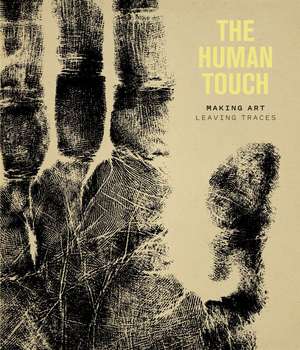
The Human Touch
Autor Elenor Ling, Jane Munro, Suzanne Reynoldsen Limba Engleză Hardback – 31 ian 2021
Drawing on artworks spanning four thousand years and stretching across the globe, this book offers new ways of looking at the fundamental role of touch in the human experience. In a series of essays, the authors explore anatomy and skin; the relationship between the brain, hand, and creativity; touch, desire, and possession; ideological touch; and reverence and iconoclasm. Nearly two hundred lavish illustrations accompany the text, including drawings, paintings, prints, and sculpture by Raphael, Michelangelo, Rembrandt, Carracci, Hogarth, Turner, Rodin, Degas, and Kollwitz, along with work by contemporary artists Judy Chicago, Frank Auerbach, Richard Long, the Chapman Brothers, and Richard Rawlins. The events of 2020 have made us newly alive to the preciousness and the dangers of touch, making this a particularly timely exploration of our most fundamental sense.
Preț: 313.61 lei
Puncte Express: 470
Carte disponibilă
Livrare economică 06-20 noiembrie
Livrare express 22-28 octombrie pentru 64.47 lei
Livrare prin curier în România Termenul estimat este afișat lângă disponibilitate.
Transport gratuit de la 400.00 lei Plată online sau ramburs, în funcție de opțiunile comenzii.
Retur gratuit în 14 zile Comandă securizată și suport în română.
Specificații
ISBN-13: 9781913645052
ISBN-10: 1913645053
Pagini: 192
Ilustrații: 192 color plates
Dimensiuni: 287 x 246 x 22 mm
Greutate: 1.14 kg
Editura: Paul Holberton Publishing Ltd
ISBN-10: 1913645053
Pagini: 192
Ilustrații: 192 color plates
Dimensiuni: 287 x 246 x 22 mm
Greutate: 1.14 kg
Editura: Paul Holberton Publishing Ltd
V-ar putea interesa
-
 -30%Preț: 520.82 lei739.28 lei
 -
 Art Is: A Journey into the LightMakoto FujimuraPreț: 186.87 lei
 -
 The Thinking HandJuhani PallasmaaPreț: 332.30 lei
 -
 -24%Preț: 94.94 lei125.31 lei
 -
 Making Matters: In Search of Creative WondersClare Hunter-27%Preț: 103.79 lei141.46 lei
 -
 -21%Preț: 163.17 lei206.47 lei
 -
 Touch is Really Strange: Graphic medicineSteve Haines-20%Preț: 81.44 lei101.34 lei
 -
 Titian's Touch: Art, Magic and PhilosophyMaria H. Loh-11%Preț: 128.46 lei144.95 lei
 -
 Civilisations: How Do We Look / The Eye of FaithProfessor Mary Beard-19%Preț: 87.73 lei108.13 lei
 -
 Preț: 219.36 lei
 -
 -14%Preț: 117.62 lei136.17 lei
 -
 New HumansMassimiliano Gioni-15%Preț: 599.79 lei705.63 lei
 -
 FaithDerek Owusu-22%Preț: 54.40 lei69.32 lei
 -
 Unfolding ClothHannah LambPreț: 195.96 lei
 -
 The Inner TouchDaniel Heller-RoazenPreț: 214.23 lei
 -
 Almuth TebbenhoffAmy DempseyPreț: 303.55 lei
 -
 -20%Preț: 107.96 lei134.77 leiRecomandat
 -
 Human Marks: Tattooing in Contemporary ArtCarrie Cushman-17%Preț: 298.52 lei358.04 lei
Notă biografică
Elenor Ling is curator of paintings, drawings, and prints at the Fitzwilliam Museum at the University of Cambridge. Suzanne Reynolds is curator of manuscripts and printed books at the Fitzwilliam Museum. Jane Munro is keeper of paintings, drawings, and prints at the Fitzwilliam Museum.
Recenzii
"It takes us through various aspects of the creative process, exploring, from our distant ancestors through to our living contemporaries, the physicality, and hence intimate nature, of mark making. It ponders, across time and space, the religious and spiritual rituals involving touch, and conversely, the strictures forbidding touch to demarcate the corporeal and non-material realms. . . . Not least of all, it explores the emotional power of touch and the meanings we bring to it. . . . The essays here are rich, dense and expansive, referencing philosophies, religious tracts, poems, literary texts, early anatomical studies (medieval and pre-Enlightenment) and so forth."
"A melancholy triumph."