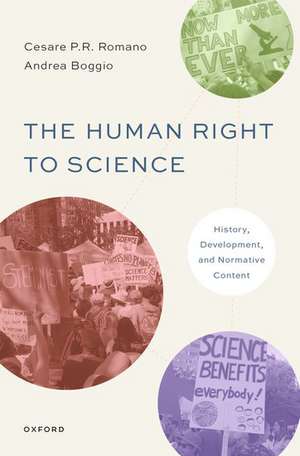
The Human Right to Science: History, Development, and Normative Content
Autor Cesare P. R. Romano, Andrea Boggioen Limba Engleză Hardback – 19 dec 2024
Remarcăm faptul că The Human Right to Science propune un model analitic fără precedent pentru un concept care, deși consacrat încă din 1948, a rămas mult timp într-o zonă de ambiguitate juridică. Autorii, Cesare P. R. Romano și Andrea Boggio, structurează acest drept fundamental într-un cadru normativ riguros, împărțit în patru piloni esențiali: accesul la progresul științific, responsabilitatea în cercetare, participarea activă și beneficiile rezultate din aplicațiile tehnologice. Această segmentare funcționează deoarece transformă un ideal abstract într-un set de 22 de drepturi specifice, fiecare fiind însoțit de obligații corelative pentru state și indicatori de monitorizare.
Putem afirma că abordarea celor doi experți diferă substanțial de lucrări precum Science as a Cultural Human Right de Helle Porsdam. În timp ce Porsdam se concentrează pe dimensiunea culturală și filosofică a accesului la cunoaștere, volumul de față este mai puțin abstract și mult mai aplicabil, oferind instrumente juridice concrete pentru practicienii dreptului internațional. De asemenea, dacă Scientific Freedom explorează autonomia cercetătorului, Romano și Boggio extind perspectiva către beneficiarul final: cetățeanul care trebuie să se bucure de rezultatele științei.
Această lucrare reprezintă punctul culminant al cercetărilor lui Cesare P. R. Romano în domeniul intersecției dintre lege și biotehnologie. Dacă în Human Germline Genome Modification and the Right to Science acesta analiza impactul tehnologiei CRISPR asupra dreptului internațional, în volumul de față extinde cadrul la o scară macro, integrând istoria diplomatică și jurisprudența globală. Merită menționat că autorii nu se limitează la analiză, ci avansează o soluție pragmatică: necesitatea unui Tratat Global al Științei, menit să armonizeze reglementările tehnologice actuale cu imperativele etice ale drepturilor omului.
Preț: 1012.62 lei
Preț vechi: 1512.32 lei
-33%
Carte disponibilă
Livrare economică 15-26 mai
Specificații
ISBN-10: 0197768997
Pagini: 904
Dimensiuni: 157 x 231 x 64 mm
Greutate: 1.36 kg
Editura: Oxford University Press
Colecția OUP USA
Locul publicării:New York, United States
V-ar putea interesa
-
 PROGRESS HBSamuel Miller McDonaldPreț: 148.60 lei
 -
 The Right to Self-Determination in International LawThomas Weatherall-26%Preț: 139.85 lei188.12 leiNou
 -
 These Strange New MindsChristopher SummerfieldPreț: 118.08 lei
 -
 Don't Burn Anyone at the Stake TodayNaomi AldermanPreț: 115.45 lei
 -
 The Right of the PeopleOsita NwanevuPreț: 177.66 lei
 -
 Against the MachinePaul KingsnorthPreț: 180.02 lei
 -
 Hacking HumanityLara LewingtonPreț: 117.95 lei
 -
 Artificial WisdomThomas R. WeaverPreț: 120.25 lei
 -
 The Cambridge History of Rights: Volume 1, The Ancient WorldBenjamin Straumann-23%Preț: 862.94 lei1120.70 lei
 -
 Human RightsMichael FreemanPreț: 151.64 lei
 -
 HydrojusticeAndreas Philippopoulos-MihalopoulosPreț: 81.95 lei
 -
 A Short History of Nearly Everything 2.0Bill BrysonPreț: 135.26 lei
 -
 International Human Rights & JusticeProfessor Doug Hodgson-26%Preț: 1248.89 lei1677.65 lei
 -
 Revisiting Human Rights in Canadian HistoryJennifer TunnicliffePreț: 181.77 lei
 -
 The Right to Have RightsStephanie DegooyerPreț: 97.36 lei
 -
 Human RightsShami ChakrabartiPreț: 75.22 lei
 -
 The Future Loves YouAriel Zeleznikow-JohnstonPreț: 89.28 lei
 -
 The ImmortalistsAleks KrotoskiPreț: 117.16 lei
 -
 Human Rights Around the WorldYvonne Vissing-45%Preț: 285.53 lei516.94 lei
De ce să citești această carte
Această carte este esențială pentru juriști, decidenți politici și cercetători care doresc să înțeleagă cum poate fi protejat accesul la inovație într-o eră a progresului tehnologic accelerat. Cititorul câștigă o viziune clară asupra obligațiilor statelor în materie de politică științifică, primind un ghid detaliat despre modul în care dreptul la știință poate fi invocat și implementat pentru a asigura o distribuție echitabilă a progresului medical și tehnologic.
Despre autor
Cesare P. R. Romano este profesor de drept la Loyola Law School Los Angeles, fiind o autoritate recunoscută în dreptul internațional public. Cu o pregătire academică vastă obținută în Italia, Elveția și Statele Unite, Romano stăpânește multiple discipline, de la științe politice la relații internaționale. Expertiza sa acoperă soluționarea disputelor internaționale, dreptul mediului și drepturile omului. Lucrările sale anterioare, precum The International Judge, demonstrează un interes constant pentru mecanismele de justiție globală, pe care acum le aplică în contextul sensibil al eticii științifice și al reglementării inovației.
Descriere
Recenzii
Bringing the historical, legal, and societal dimensions of the right to science together makes this book not merely unique, but also a crucial and necessary contribution to the advancement of this human right for its beneficiaries." - Yvonne Donders, Professor International Human Rights Law, University of Amsterdam & Member of the UN Human Rights Committee
An in-depth guide to the intriguing history and surprisingly pervasive spread of the Right to Science in legal and scientific frameworks worldwide. A highly recommended work for both scientific and legal experts, as well as for those new to the idea of science as a human right." - Drew Shindell, Nicholas Professor of Earth Sciences, Duke University
Comprehensive and systematic. Any scientist should keep a copy in the lab to be reminded of this key human right that impacts their work." - Andrea Musacchio, Director, Department of Mechanistic Cell Biology, Max Plank Institute of Molecular Physiology
Cesare Romano and Andrea Boggio's large-scale, comprehensive study of the human right to science is a major contribution not just to legal studies and human rights scholarship but to any ethical-political appraisal of public policies for the funding and regulation of science, technology, engineering, and mathematics (STEM)." - Carl Mitcham, Professor Emeritus of Humanities, Arts, and Social Sciences at the Colorado School of Mines
An incisive exploration of science and human rights that reshapes our understanding of actual and future science policy." - Bartha M. Knoppers, Professor, Centre of Genomics and Policy, McGill University