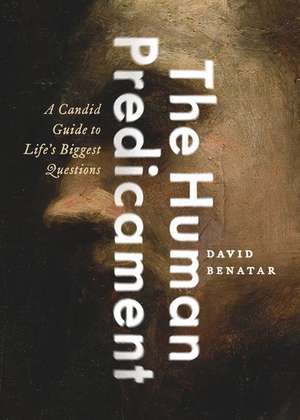
The Human Predicament: A Candid Guide to Life's Biggest Questions
Autor David Benataren Limba Engleză Hardback – 13 iul 2017
Preț: 206.30 lei
Preț vechi: 247.79 lei
-17%
Puncte Express: 309
Carte tipărită la comandă
Livrare economică 12-18 noiembrie
Livrare prin curier în România Termenul estimat este afișat lângă disponibilitate.
Transport gratuit de la 400.00 lei Plată online sau ramburs, în funcție de opțiunile comenzii.
Retur gratuit în 14 zile Comandă securizată și suport în română.
Specificații
ISBN-13: 9780190633813
ISBN-10: 0190633816
Pagini: 288
Dimensiuni: 135 x 185 x 25 mm
Greutate: 0.32 kg
Editura: Oxford University Press
Colecția OUP USA
Locul publicării:New York, United States
ISBN-10: 0190633816
Pagini: 288
Dimensiuni: 135 x 185 x 25 mm
Greutate: 0.32 kg
Editura: Oxford University Press
Colecția OUP USA
Locul publicării:New York, United States
V-ar putea interesa
-
 Being, Identity, and TruthC. J. F. Williams-30%Preț: 477.74 lei683.11 lei
 -
 Representation, Meaning, and ThoughtGrant Gillett-21%Preț: 374.56 lei474.37 lei
 -
 The Social Psychological Study of Widespread BeliefsColin Fraser-21%Preț: 369.81 lei466.24 lei
 -
 -31%Preț: 870.28 lei1263.51 lei
 -
 Debating Procreation: Is It Wrong to Reproduce?David Benatar-13%Preț: 285.09 lei328.56 lei
 -
 -13%Preț: 249.12 lei287.90 lei
 -
 The Self and Self-KnowledgeAnnalisa Coliva-31%Preț: 727.16 lei1054.57 lei
 -
 Constructivism in Practical PhilosophyJames Lenman-31%Preț: 756.81 lei1099.71 lei
 -
 The Nature and Value of Knowledge: Three InvestigationsDuncan Pritchard-11%Preț: 352.69 lei397.64 lei
 -
 Scepticism and Reliable BeliefJosé L. Zalabardo-31%Preț: 662.18 lei960.87 lei
 -
 Metaphysics: A Very Short IntroductionStephen Mumford-21%Preț: 55.41 lei69.92 lei
 -
 Knowledge AscriptionsJessica Brown-31%Preț: 680.05 lei985.26 lei
 -
 The Second SexismDavid BenatarPreț: 236.54 lei
 -
 The Girl with the Dragon Tattoo and PhilosophyEric BronsonPreț: 127.36 lei
 -
 TruthJohn D. CaputoPreț: 91.54 lei
 -
 SelfBarry DaintonPreț: 90.68 lei
Recenzii
The Human Predicament is worth reading for its often insightful discussion of the practical implications of accepting the broad pessimistic contention that all lives are bad when judged by any relevant measure.
Those readers familiar with Better Never to Have Been will find the discussion of the self in The Human Predicament worth their attention. However, I encourage first-time readers of Benetar's pessimistic philosphy to start with The Human Predicament. It is both highly accessible and engrossing -- so much so that it can be read in one day.
What thinking person doesn't care about the (possible) meaning of life, the quality of human life, the nature and disvalue of death, the option of suicide, and many other similar topics? David Benatar addresses these engaging and important topics along with many others. The book is well-argued and extremely well-written. I was struck by the sense that the quality was about as high as any philosophy I can remember reading: short, clear sentences, with not a word wasted or misplaced. Even someone who is sunnier in outlook than Benatar, yet willing to take his arguments seriously, may end up finding that he or she agrees with most of them in this volume. I do not see the human predicament as pessimistically as David Benatar does; but I found myself disagreeing less than I expected to -- for example, in his sensitive and probing discussion of suicide.
David Benatar's new book, The Human Predicament, offers justifiably pessimistic analyses of some of the most interesting and important issues of human existence, including birth, suffering, death, and suicide. Benatar's analyses are as beautifully crafted and written as they are scholarly and thoughtful. The Human Predicament is a grand work of philosophy, but contains important insights for many of the social and life sciences, including psychology, sociology, biology, as well as to medicine and law. Not only will I recommend this book to my colleagues and graduate and undergraduate students, but I also will recommend it to my family and friends. The Human Predicament is a stunning achievement by a deeply compassionate man.
Those readers familiar with Better Never to Have Been will find the discussion of the self in The Human Predicament worth their attention. However, I encourage first-time readers of Benetar's pessimistic philosphy to start with The Human Predicament. It is both highly accessible and engrossing -- so much so that it can be read in one day.
What thinking person doesn't care about the (possible) meaning of life, the quality of human life, the nature and disvalue of death, the option of suicide, and many other similar topics? David Benatar addresses these engaging and important topics along with many others. The book is well-argued and extremely well-written. I was struck by the sense that the quality was about as high as any philosophy I can remember reading: short, clear sentences, with not a word wasted or misplaced. Even someone who is sunnier in outlook than Benatar, yet willing to take his arguments seriously, may end up finding that he or she agrees with most of them in this volume. I do not see the human predicament as pessimistically as David Benatar does; but I found myself disagreeing less than I expected to -- for example, in his sensitive and probing discussion of suicide.
David Benatar's new book, The Human Predicament, offers justifiably pessimistic analyses of some of the most interesting and important issues of human existence, including birth, suffering, death, and suicide. Benatar's analyses are as beautifully crafted and written as they are scholarly and thoughtful. The Human Predicament is a grand work of philosophy, but contains important insights for many of the social and life sciences, including psychology, sociology, biology, as well as to medicine and law. Not only will I recommend this book to my colleagues and graduate and undergraduate students, but I also will recommend it to my family and friends. The Human Predicament is a stunning achievement by a deeply compassionate man.
Notă biografică
David Benatar is Professor of Philosophy and the Head of the Philosophy department at University of Cape Town, South Africa. He is the author of Better Never to Have Been: The Harm of Coming Into Existence (2006) and Debating Procreation: Is it Wrong to Reproduce? (2015).
Cuprins
- Preface
- A reader's guide
- 1. Introduction
- 2. Meaning(lessness)
- 3. Quality
- 4. Death
- 5. Immortality
- 6. Suicide
- 7. Conclusion