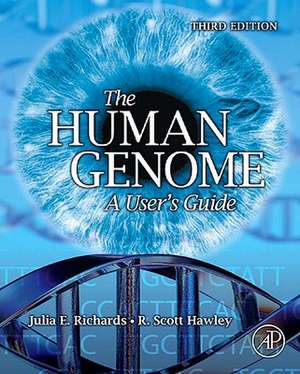
The Human Genome
Autor Julia E. Richards, R. Scott Hawleyen Limba Engleză Paperback – 13 dec 2010
Remarcăm în această a treia ediție a lucrării The Human Genome o adaptare necesară la ritmul accelerat al cercetării genetice din ultimele decenii. Tema centrală a volumului nu este doar transmiterea trăsăturilor, ci modul în care informația genetică modelează politicile publice și sănătatea individuală. Autorii Julia E. Richards și R. Scott Hawley reușesc să transforme un subiect tehnic într-o resursă accesibilă, punând accent pe capitolul dedicat „Dogmei Centrale” a biologiei moleculare și pe noile secțiuni de bioinformatică și etică.
Suntem de părere că progresia logică a conținutului facilitează învățarea. Volumul extinde cadrul propus de Human Genetics: The Basics prin integrarea unor date noi din proiectul genomului uman și studii detaliate despre celulele stem. Structura este împărțită în cinci părți fundamentale: începe cu bazele eredității și structura dublului helix, trece prin mecanismele mutațiilor și mișcarea cromozomilor, și culminează cu metodologiile de cartografiere genetică. Spre deosebire de manualele pur teoretice, această ediție utilizează peste 260 de ilustrații color și studii de caz care ancorează conceptele abstracte în realitatea clinică.
Credem că elementul distinctiv al cărții este pedagogia aplicată. Fiecare capitol este punctat de „declarații de concept” care ajută la menținerea atenției asupra ideilor cheie, prevenind pierderea în detalii tehnice excesive. De asemenea, includerea unor „interest boxes” care fac legătura directă între genetică și bolile umane oferă un context practic imediat, transformând The Human Genome într-un instrument esențial pentru alfabetizarea științifică a studenților din mediul universitar.
Preț: 442.02 lei
Preț vechi: 581.91 lei
-24%
Carte tipărită la comandă
Livrare economică 02-16 octombrie
Specificații
ISBN-10: 0123334454
Pagini: 420
Ilustrații: Approx. 260 illustrations (260 in full color)
Dimensiuni: 191 x 235 x 32 mm
Greutate: 1.22 kg
Ediția:3rd edition
Editura: ELSEVIER SCIENCE
V-ar putea interesa
-
 -38%Preț: 502.06 lei815.42 lei
 -
 Advanced Topics in Forensic DNA Typing: MethodologyJohn M. Butler-29%Preț: 555.17 lei779.14 lei
 -
 Biocomputing: Informatics and Genome ProjectsDouglas W. Smith-5%Preț: 395.63 lei416.45 lei
 -
 Preț: 282.00 lei
 -
 Computational Methods in Molecular BiologyS.L. Salzberg-23%Preț: 517.94 lei672.65 lei
 -
 -27%Preț: 1188.59 lei1628.20 lei
 -
 Biotechnology Annual ReviewM. Raafat El-Gewely-22%Preț: 1150.50 lei1483.54 lei
 -
 Genomic Selection in AnimalsWeller-9%Preț: 929.81 lei1021.78 lei
 -
 An Introduction to Molecular AnthropologyMark Stoneking-9%Preț: 802.63 lei882.01 lei
 -
 Bioinformatics and Functional GenomicsJonathan Pevsner-23%Preț: 821.83 lei1067.31 lei
 -
 Cytogenetic Laboratory ManagementSusan Mahler Zneimer-9%Preț: 814.12 lei894.64 lei
 -
 Plant GenesGrotewold-8%Preț: 476.80 lei518.26 lei
 -
 Life's Greatest Secret: The Race to Crack the Genetic CodeProfessor Matthew Cobb-19%Preț: 86.16 lei106.30 lei
 -
 Protein Bioinformatics: From Sequence to FunctionM. Michael Gromiha-24%Preț: 388.31 lei511.48 lei
Public țintă
Undergraduate students with limited science background. AP high school studentsDe ce să citești această carte
Recomandăm această carte oricărui student sau cititor pasionat de știință care dorește să înțeleagă bazele geneticii umane fără a se simți copleșit de jargon. Veți câștiga o perspectivă clară asupra modului în care genele ne influențează sănătatea și identitatea, beneficiind de o structură didactică modernă ce include studii de caz, ilustrații color și discuții despre etica în bioinformatică.
Despre autor
Julia E. Richards și R. Scott Hawley sunt experți recunoscuți în domeniul geneticii, cu o vastă experiență academică în predarea biologiei moleculare. Julia Richards contribuie cu expertiza sa în înțelegerea bazelor genetice ale sănătății umane, în timp ce Scott Hawley este apreciat pentru cercetările sale asupra meiozei și mecanismelor de mișcare a cromozomilor. Împreună, aceștia au rafinat The Human Genome de-a lungul a trei ediții, adaptând constant materialul pentru a fi accesibil publicului nespecialist, menținând în același timp rigoarea științifică impusă de editura ELSEVIER SCIENCE.
Descriere scurtă
- Includes topical material on forensics, disease studies, and the human genome project to engage non-specialist students
- Full, 4-color illustration program enhances and reinforces key concepts and themes
- Uniform organization of chapters includes interest boxes that focus on human health and disease, chapter-opening case studies, and concept statements to engage non-specialist readers
Cuprins
1: The Basics of Heredity: How Traits Are Passed Along in Families
2: The Double Helix: How Cells Preserve Genetic Information
PART II: HOW GENES FUNCTION
3: The Central Dogma of Molecular Biology: How Cells Orchestrate the Use of Genetic Information
4: The Genetic Code: How the Cell Makes Proteins from Genetic Information Encoded in mRNA Molecules
5: We Are All Mutants: How Mutation Alters Function
PART III: HOW CHROMOSOMES MOVE
6: Mitosis and Meiosis: How Cells Move Your Genes Around
7: The Odd Couple: How the X and Y Chromosomes Break the Rules
PART IV: HOW GENES CONTRIBUTE TO COMPLEX TRAITS
8: Sex Determination: How Genes Determine a Developmental Choice
9: Complexity: How Traits Can Result from Combinations of Factors
10: The Multiple-Hit Hypothesis: How Genes Play a Role in Cancer
PART V: HOW GENES ARE FOUND
11: The Gene Hunt: How Genetic Maps Are Built and Used
12: The Human Genome: How the Sequence Enables Genome-wide Studies
PART VI: HOW GENES PLAY A ROLE IN TESTING AND TREATMENT
13: Genetic Testing and Screening: How Genotyping Can Offer Important Insights
14: Magic Bullets: How Gene-based Therapies Personalize Medicine
15: Fears, Faith, and Fantasies: How the Past and Present Shape the Future of Genomic Medicine
Recenzii
-- ANTICANCER RESEARCH 33: 745-746 (2013), February 2013
""Every year, Choice subject editors single out for recognition the most significant print and electronic works reviewed in Choice during the previous calendar year. The Human Genome, 3e, appearing annually in Choice’s January issue, this prestigious list of publications reflects the best in scholarly titles and attracts extraordinary attention from the academic library community. The 2011 feature includes 629 titles in 54 disciplines and subsections.""
-- CHOICE Outstanding Academic Title, 2011
""Well written, up-to-date, and engaging, this new edition of The Human Genome (2nd ed., 2005; 1st ed., CH, May'99, 36-5066) by Richards (Univ. of Michigan) and Hawley (Stowers Institute for Medical Research) accurately reflects its subtitle. Densely packed with information, it is both easy to read and easy to understand. It includes full-color illustrations, charts, drawings, and tables. Case studies and sidebar interest boxes tell fascinating stories that capture the reader's interest and help make the material accessible to all. End-of-chapter study questions include brief essays and ideas for resource projects. A companion Web site provides additional questions, and indicates that an image bank and streaming video resources will soon be available. This work could easily be used for a freshman biology class or for individual reading for people interested in this subject. Yet, it has enough technical information and detail to be useful for an upper-level majors class in human genetics as well. It addresses all of the topics traditionally covered in a human genetics textbook without reading like a textbook. It strikes a perfect balance between being rigorous and engaging, and deserves to be included among the most popular current human genetics works.""
Summing Up: Highly recommended. Academic, general, and professional audiences, all levels.
C. A. Klevickis, James Madison University Reviewed in 2011 June CHOICE
""Better education and communication are two things that are emphasized over and over when it comes to determining the best way to make genomics a bigger part of the public's general health routine, or more mainstream. The User's Guide, as a text or reference, could be part of that conversation with the public. Because of how simply it begins, the book could be put to good use in high schools as students start to learn about the more complex fields of research and start to develop an interest in higher education in the sciences. It could also serve very well as a guide in higher education, to those pursuing more specialized fields like cancer research or personalized medicine, or even as a thought-provoking conversation-starter in ethics classes or discussions about the implications of advanced genomics research.""
-- Christie Rizk, February 2011 issue of Genome Technology, http://www.genomeweb.com
""The third edition of this comprehensive survey of the human genome provides a detailed examination of the science, both specifically biological and in a broader context, of human genetics. Intended for students and entry level researchers, the volume begins with simple gene mechanics and covers gene functions, chromosomes, complex traits, gene discovery, and genetics in testing and treatment. Chapters include numerous color illustrations, tables, sidebars and a large glossary as well as study questions with answers keys.""
-- SciTech Book News