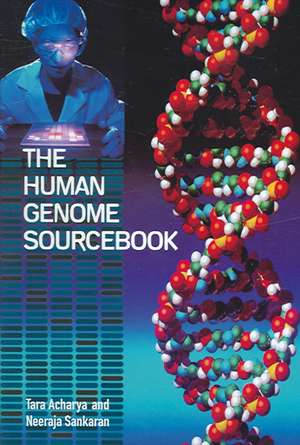
The Human Genome Sourcebook
Autor Tara Acharya, Neeraja Sankaranen Limba Engleză Hardback – 30 iun 2005
Preț: 366.49 lei
Preț vechi: 659.57 lei
-44%
Puncte Express: 550
Carte tipărită la comandă
Livrare economică 19 noiembrie-03 decembrie
Livrare prin curier în România Termenul estimat este afișat lângă disponibilitate.
Transport gratuit de la 400.00 lei Plată online sau ramburs, în funcție de opțiunile comenzii.
Retur gratuit în 14 zile Comandă securizată și suport în română.
Specificații
ISBN-13: 9781573565295
ISBN-10: 1573565296
Pagini: 408
Dimensiuni: 178 x 254 x 30 mm
Greutate: 1.02 kg
Editura: Bloomsbury Publishing
Colecția Greenwood
Locul publicării:New York, United States
ISBN-10: 1573565296
Pagini: 408
Dimensiuni: 178 x 254 x 30 mm
Greutate: 1.02 kg
Editura: Bloomsbury Publishing
Colecția Greenwood
Locul publicării:New York, United States
V-ar putea interesa
-
 -22%Preț: 377.13 lei483.22 lei
 -
 Clinical GenomicsShashikant Kulkarni-26%Preț: 727.97 lei987.46 lei
 -
 Resident Stem Cells and Regenerative TherapyRegina Coeli dos Santos Goldenberg-28%Preț: 840.28 lei1161.38 lei
 -
 BIOS Instant Notes in GeneticsHugh FletcherPreț: 333.03 lei
 -
 Why Genes Are Not Selfish and People Are NiceColin TudgePreț: 122.30 lei
 -
 Genetic Diversity: New ResearchJulian A Cervantes Amaya-27%Preț: 1252.35 lei1704.42 lei
 -
 Synthetic Biology: Prospects & ImplicationsRoger E Hamilton-27%Preț: 1601.04 lei2184.11 lei
 -
 -27%Preț: 1249.67 lei1702.65 lei
 -
 Genetics Research SummariesLyndsay E Hewitt-23%Preț: 1276.46 lei1662.94 lei
Cuprins
Preface
Organization
Acknowledgments
Introduction
Terms and Concepts in Genetics
The Chromosomes
Genes for Normal Functions
Genetic Diseases
Organization
Acknowledgments
Introduction
Terms and Concepts in Genetics
The Chromosomes
Genes for Normal Functions
Genetic Diseases
Recenzii
Acharya and Sankaran provide a remarkably thorough overview of human genetics in this readable presentation of the complex, rapidly changing field of genomics. This sourcebook presents basic biochemistry necessary for readers to understand genes' composition and function. The introduction puts current genetics research into historical context and explores its social implications. Arranged like an encyclopedia, the chapters contain alphabetical entries covering these major topics: terms and concepts in genetics, the chromosomes, genes for normal functions, and genetic diseases. Liberal cross-references link relevant sections, and a thorough index makes it easy to locate topics. The language is straightforward, including some notes on scientists' major discoveries and the development of significant research techniques..In addition to providing a good introduction to the human genome for high school readers, this work could serve as a supporting reference for students in human or medical genetics classes. Recommended. Lower- and upper-division undergraduates, general readers, and practitioners.
Despite the apparent popularity of forensic detective shows and widespread talk of DNA testing, few Americans understand the scientific basis of such ideas. In this volume, a scientist and a freelance science writer team up to explain the basics of genetic theory for the general reader. Following an overview of the progress of genetic research in the past century, the authors define 124 key concepts, from cloning and genetic codes to mutations and gene splicing..Their guide will be useful in both academic and public libraries.
The Human Genome Sourcebook is written for intelligent and curious readers who lack an advanced knowledge of genetics, but who are interested in learning more than just headlines and buzzwords. The book is about the genes that determine how our body is made, how they help us conduct our normal life's activities, and what happens when they are abnormal.
Don't look for yet another book about the Human Genome Project, though of course it's mentioned - Human Genome Sourcebook is much more, discussing what constitutes the human genome, what genes do when they are acting properly and what happens when they're damaged. And even better, it's written with non-specialists in mind: details are inclusive but not so technical the average lay person can't understand, and while it offers extensive in-depth details and chapters in everything from terms and concepts to diseases, its function as an understandable overview isn't lost. A 'must' for any high school or college collection and perfect for public library holdings, as well.
Despite the apparent popularity of forensic detective shows and widespread talk of DNA testing, few Americans understand the scientific basis of such ideas. In this volume, a scientist and a freelance science writer team up to explain the basics of genetic theory for the general reader. Following an overview of the progress of genetic research in the past century, the authors define 124 key concepts, from cloning and genetic codes to mutations and gene splicing..Their guide will be useful in both academic and public libraries.
The Human Genome Sourcebook is written for intelligent and curious readers who lack an advanced knowledge of genetics, but who are interested in learning more than just headlines and buzzwords. The book is about the genes that determine how our body is made, how they help us conduct our normal life's activities, and what happens when they are abnormal.
Don't look for yet another book about the Human Genome Project, though of course it's mentioned - Human Genome Sourcebook is much more, discussing what constitutes the human genome, what genes do when they are acting properly and what happens when they're damaged. And even better, it's written with non-specialists in mind: details are inclusive but not so technical the average lay person can't understand, and while it offers extensive in-depth details and chapters in everything from terms and concepts to diseases, its function as an understandable overview isn't lost. A 'must' for any high school or college collection and perfect for public library holdings, as well.