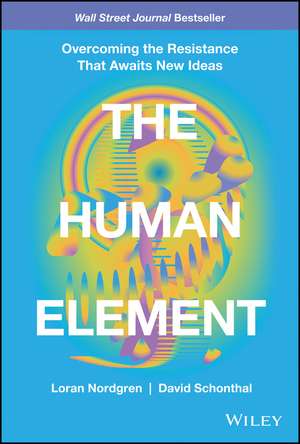
The Human Element
Autor David Schonthal, Loran Nordgrenen Limba Engleză Hardback – 18 noi 2021
Observăm o tendință aproape universală în mediul de business: atunci când o idee nouă eșuează, instinctul liderilor este să adauge mai mult „combustibil”. Această mentalitate de tip „Fuel-based”, analizată de Loran Nordgren și David Schonthal, presupune că dacă adăugăm mai multe funcționalități, beneficii sau un mesaj mai percutant, oamenii vor accepta în cele din urmă schimbarea. Suntem de părere că această abordare ignoră jumătatea critică a ecuației succesului: rezistența psihologică a publicului țintă. The Human Element demonstrează că inovația nu este doar o bătălie a atracției, ci una a eliminării barierelor invizibile. Pe linia practică a volumului Resistance to Innovation, dar cu un focus specific pe psihologia aplicată a schimbării, autorii structurează conținutul în jurul a patru forțe de frecare: Inerția (dorința de a păstra ce știm), Efortul (costul implementării), Emoția (anxietatea generată de nou) și Reactanța (impulsul de a rezista influenței externe). Putem afirma că valoarea cărții rezidă în echilibrul dintre teorie și aplicabilitate. Capitolele sunt organizate sistematic: mai întâi este explicată natura fiecărei rezistențe, urmată imediat de strategii pentru a construi idei „aerodinamice”. Spre deosebire de Creative Change, care explorează de ce liderii resping creativitatea, Nordgren și Schonthal oferă un ghid metodologic pentru a face ideile să pară familiare și sigure. Prin cele trei studii de caz finale, autorii transformă conceptele abstracte în instrumente de lucru, oferind cititorului un cadru prin care poate ajuta audiența să se convingă singură de necesitatea schimbării, în loc să fie împinsă spre ea.
Preț: 169.71 lei
Carte disponibilă
Livrare economică 24 septembrie-08 octombrie
Livrare express 10-16 septembrie pentru 31.01 lei
Specificații
ISBN-10: 1119765048
Pagini: 256
Dimensiuni: 157 x 231 x 25 mm
Greutate: 0.46 kg
Editura: John Wiley & Sons, Inc.
Locul publicării:Hoboken, United States
V-ar putea interesa
-
 VelocityAjaz Ahmed-21%Preț: 95.35 lei120.08 lei
 -
 What's Stopping You?Timothy ArmooPreț: 120.65 lei
 -
 OriginalsAdam GrantPreț: 77.98 lei
 -
 Irresistible ChangePhil GilbertPreț: 151.70 lei
 -
 Lose Your MindJosh Pais-24%Preț: 143.38 lei188.87 lei
 -
 Start With Why (15th Anniversary Edition)Simon SinekPreț: 84.24 lei
 -
 Immunity to ChangeRobert KeganPreț: 211.58 lei
 -
 Buy-InJohn P KotterPreț: 130.44 lei
 -
 The Heart of ChangeJohn P KotterPreț: 198.49 lei
 -
 Friedman's FablesEdwin H. Friedman-5%Preț: 125.29 lei131.88 lei
 -
 CatalystJonah Berger-12%Preț: 68.42 lei77.96 lei
 -
 The Problem With ChangeAshley Goodall-19%Preț: 97.51 lei120.40 lei
 -
 Disrupt EverythingJames PattersonPreț: 121.94 lei
 -
 -11%Preț: 68.76 lei77.50 lei
 -
 -19%Preț: 68.83 lei84.97 lei
 -
 Embrace the ChaosJason Fox-5%Preț: 73.65 lei77.52 lei
 -
 SwitchChip Heath-31%Preț: 63.03 lei91.50 lei
 -
 The Innovator's BookMax Mckeown-13%Preț: 60.16 lei68.89 lei
 -
 The Entrepreneur WithinMark RobertsPreț: 142.56 lei
De ce să citești această carte
Această carte este indispensabilă pentru oricine vrea să introducă o schimbare, fie că vorbim de un produs nou sau de o politică internă. Veți învăța să nu mai investiți resurse doar în promovare, ci să identificați și să eliminați „frecările” psihologice care blochează progresul. Este un manual strategic care transformă rezistența dintr-un obstacol într-un avantaj competitiv.
Despre autor
Loran Nordgren este profesor de Management și Organizații la Kellogg School of Management, fiind un expert recunoscut în psihologia influenței și a luării deciziilor. David Schonthal este, de asemenea, profesor la Kellogg și un antreprenor cu experiență, specializat în inovație și design thinking. Împreună, cei doi autori combină rigoarea academică cu experiența practică din consultanță, oferind perspective valoroase despre motivul pentru care oamenii se opun noului și cum pot fi depășite aceste bariere naturale ale naturii umane.
Descriere
Wall Street Journal bestseller
Watch your most innovative ideas take flight by overcoming the forces that resist change
The Human Element is for anyone who wants to introduce a new idea or innovation into the world. Most marketers, innovators, executives, activists, or anyone else in the business of creating change, operate on a deep assumption. It is the belief that the best (and perhaps only) way to convince people to embrace a new idea is to heighten the appeal of the idea itself.
We instinctively believe that if we add enough value, people will eventually say "yes." This reflex leads us down a path of adding features and benefits to our ideas or increasing the sizzle of our messaging - all in the hope of getting others on board. We call this instinct the "Fuel-based mindset." The Fuel-based mindset explains so much of what we do, from adding countless trivial features to software, to bolting a sixth blade onto a shaving razor. By focusing on Fuel, innovators neglect the other half of the equation - the psychological Frictions that oppose change.
Frictions create drag on innovation. And though they are rarely considered, overcoming these Frictions is essential for bringing new ideas into the world. The Human Element highlights the four Frictions that operate against innovation.
Readers will discover: Why their best ideas and initiatives often get rejected - despite their undeniable valueHow to disarm the forces of resistance that act against changeHow to transform the very Frictions that hold us back into catalysts for change Perfect for business leaders, product managers, educators, and anyone else who seeks to bring new and exciting ideas to life, The Human Element is an indispensable resource to help people overcome the powerful forces of human nature that instinctively resist change.