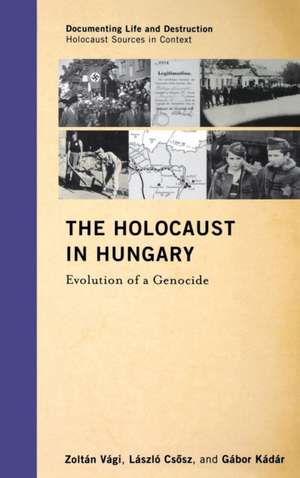
The Holocaust in Hungary: Evolution of a Genocide: Documenting Life and Destruction: Holocaust Sources in Context
Autor Zoltán Vági, László Csosz, Gábor Kádáren Limba Engleză Hardback – 5 sep 2013




Preț: 402.66 lei
Preț vechi: 584.71 lei
-31%
Puncte Express: 604
Carte tipărită la comandă
Livrare economică 16-30 noiembrie
Livrare prin curier în România Termenul estimat este afișat lângă disponibilitate.
Transport gratuit pentru acest produs Plată online sau ramburs, în funcție de opțiunile comenzii.
Retur gratuit în 14 zile Comandă securizată și suport în română.
Specificații
ISBN-13: 9780759121980
ISBN-10: 0759121982
Pagini: 510
Ilustrații: 4 b/w illustrations; 31 b/w photos; 6 tables
Dimensiuni: 162 x 235 x 34 mm
Greutate: 0.93 kg
Ediția:New.
Editura: Bloomsbury Publishing
Colecția AltaMira Press
Seria Documenting Life and Destruction: Holocaust Sources in Context
Locul publicării:New York, United States
ISBN-10: 0759121982
Pagini: 510
Ilustrații: 4 b/w illustrations; 31 b/w photos; 6 tables
Dimensiuni: 162 x 235 x 34 mm
Greutate: 0.93 kg
Ediția:New.
Editura: Bloomsbury Publishing
Colecția AltaMira Press
Seria Documenting Life and Destruction: Holocaust Sources in Context
Locul publicării:New York, United States
Cuprins
Introduction: The Evolution of a Genocide
Chapter 1: Laws against the Rule of Law
Chapter 2: Discrimination, Radicalization, and the First Mass Murders
Chapter 3: Blitzkrieg against the Jews
Chapter 4: Deportation from the Provinces and the Fate of the Budapest Jews
Chapter 5: The Arrow Cross Regime
Chapter 6: Plunder
Chapter 7: In the Nazi Camps
Chapter 8: Jewish Responses to Persecution
Chapter 9: Non-Jewish Reactions
Chapter 10: Jews in Postwar Hungary
Chapter 1: Laws against the Rule of Law
Chapter 2: Discrimination, Radicalization, and the First Mass Murders
Chapter 3: Blitzkrieg against the Jews
Chapter 4: Deportation from the Provinces and the Fate of the Budapest Jews
Chapter 5: The Arrow Cross Regime
Chapter 6: Plunder
Chapter 7: In the Nazi Camps
Chapter 8: Jewish Responses to Persecution
Chapter 9: Non-Jewish Reactions
Chapter 10: Jews in Postwar Hungary
Recenzii
This book is special because the sources it presents are not only explained in the footnotes but contextualized by an introduction that provides commentary. . . .The diversity of sources is particularly remarkable. Official pronouncements, decrees, and reports by perpetrators are contrasted with primary sources that show the victims' perspective: appeals and assessments by Jewish communities, personal writings (letters, diaries). By including a broad range of the contemporary perceptions of non-Jews the authors also document the (all too often apathetic) knowledge about the crimes committed against the Hungarian Jews. . . .[The book] presents history and historic sources in a very gripping and multi-faceted manner. Readers are not only introduced to the history of the Holocaust in Hungary, but also to the sources with their innumerable aspects and perspectives (perpetrators and victims, official declarations and private accounts). The volume is thus not only useful for Holocaust researchers, but also for classroom teaching and self-study.
As a whole, the book is a very significant contribution to the topic of the Holocaust in Hungary, which is relatively underrepresented in research literature about the Holocaust in English. It deals with the most central topics in depth and brings a rich panorama of documentation. Important concepts and persons appear in the text in bold type and the reader can find basic information about them in the rich glossary. The chronology that concludes the book is another helpful tool that orients this complicated historical narrative.
This volume...promises to "present original historical documents on the Holocaust within an explanatory narrative". [The authors] - representatives of a talented new generation of Hungarian historians - certainly deliver and provide a carefully researched and masterfully crafted account of the tragic fate of Hungary's once thriving Jewish community. . . .The volume has an extremely useful introduction. After reading it, even those unversed in the complexities of this tragic chapter of Hungarian history have the necessary information to proceed to the ten thematically and chronologically organized following chapters. . . .Amidst Hungarian controversies over commemorations, awards, and statues-and the general politicization of the Holocaust in Hungary-there has been and, as the present volume clearly indicates, continues to be quality work done on the topic. This reviewer would love to see more made accessible to English-speaking audiences. This outstanding volume will undoubtedly be much welcomed by scholars and students of the Holocaust and of Hungarian history.
The Holocaust in Hungary: Evolution of a Genocide is perhaps the most significant volume in the Documenting Life and Destruction: Holocaust Sources in Context series. Beyond featuring select sources that are made available in English for the first time, this book offers an incisive analysis on how the Holocaust in Hungary 'came about, what drove it, and what it meant for those who were targeted.' [The book] is not only an immensely useful collection of primary documents that traces the various life trajectories of their authors to great effect, but it also provides an up-to-date overview of its subject. It . . . is a seminal volume that greatly enriches Holocaust historiography.
An unusually rich and variegated account of the Holocaust in Hungary that has much to offer both to the uninitiated reader and the seasoned historian. This well-crafted work will enable both students and scholars to better understand and relate the events of the last century in East-Central Europe to larger themes in European history.
An essential addition to any library because of its detailed examination of this 'last chapter' of the Holocaust. The authors are to be applauded for their selection of documents-the majority translated into English for the first time-that capture the vast range of materials that are found in Hungary's archives. Their accompanying narrative brilliantly synthesizes the wealth of recent scholarship, bringing these military reports, diary entries, photographs, and other key primary sources to life.
This remarkable volume combines a rich variety of sources with a meticulously researched narrative. It demonstrates clearly the crucial role that Hungarian authorities played at all stages; the material on plunder and the confiscation of Jewish property is especially significant. The authors also give us the voices of Jewish Hungarians as they experienced greater restrictions, ghettoization, and deportations. It is an essential resource for scholars, teachers, and students of the Holocaust and of Hungarian history.
As a whole, the book is a very significant contribution to the topic of the Holocaust in Hungary, which is relatively underrepresented in research literature about the Holocaust in English. It deals with the most central topics in depth and brings a rich panorama of documentation. Important concepts and persons appear in the text in bold type and the reader can find basic information about them in the rich glossary. The chronology that concludes the book is another helpful tool that orients this complicated historical narrative.
This volume...promises to "present original historical documents on the Holocaust within an explanatory narrative". [The authors] - representatives of a talented new generation of Hungarian historians - certainly deliver and provide a carefully researched and masterfully crafted account of the tragic fate of Hungary's once thriving Jewish community. . . .The volume has an extremely useful introduction. After reading it, even those unversed in the complexities of this tragic chapter of Hungarian history have the necessary information to proceed to the ten thematically and chronologically organized following chapters. . . .Amidst Hungarian controversies over commemorations, awards, and statues-and the general politicization of the Holocaust in Hungary-there has been and, as the present volume clearly indicates, continues to be quality work done on the topic. This reviewer would love to see more made accessible to English-speaking audiences. This outstanding volume will undoubtedly be much welcomed by scholars and students of the Holocaust and of Hungarian history.
The Holocaust in Hungary: Evolution of a Genocide is perhaps the most significant volume in the Documenting Life and Destruction: Holocaust Sources in Context series. Beyond featuring select sources that are made available in English for the first time, this book offers an incisive analysis on how the Holocaust in Hungary 'came about, what drove it, and what it meant for those who were targeted.' [The book] is not only an immensely useful collection of primary documents that traces the various life trajectories of their authors to great effect, but it also provides an up-to-date overview of its subject. It . . . is a seminal volume that greatly enriches Holocaust historiography.
An unusually rich and variegated account of the Holocaust in Hungary that has much to offer both to the uninitiated reader and the seasoned historian. This well-crafted work will enable both students and scholars to better understand and relate the events of the last century in East-Central Europe to larger themes in European history.
An essential addition to any library because of its detailed examination of this 'last chapter' of the Holocaust. The authors are to be applauded for their selection of documents-the majority translated into English for the first time-that capture the vast range of materials that are found in Hungary's archives. Their accompanying narrative brilliantly synthesizes the wealth of recent scholarship, bringing these military reports, diary entries, photographs, and other key primary sources to life.
This remarkable volume combines a rich variety of sources with a meticulously researched narrative. It demonstrates clearly the crucial role that Hungarian authorities played at all stages; the material on plunder and the confiscation of Jewish property is especially significant. The authors also give us the voices of Jewish Hungarians as they experienced greater restrictions, ghettoization, and deportations. It is an essential resource for scholars, teachers, and students of the Holocaust and of Hungarian history.