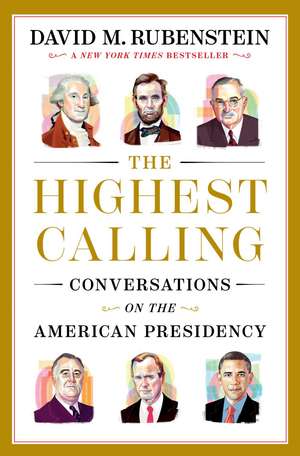
The Highest Calling: Conversations on the American Presidency
Autor David M. Rubensteinen Limba Engleză Hardback – 12 sep 2024
For years, bestselling author David M. Rubenstein has distilled the contours of American democracy through conversations with noted leaders and historians. In The Highest Calling, he offers an enlightening overview of arguably the single most important position in the world: the American presidency.
Blending history and anecdote, Rubenstein chronicles the journeys of the presidents who have defined America as it exists now, what they envision for its future, and their legacy on the world stage. Drawing from his own experience in the Carter administration, he engages in dialogues with our nation’s presidents and the historians who study them. Get exclusive access to fresh perspectives, including:
-Original interviews with most of the living US presidents
-Interviews with noted presidential historians like Annette Gordon-Reed, Ron Chernow, Candice Millard, and more
Through insightful analysis, Rubenstein captures our country’s most prominent leaders, the political genius and frays of the presidential role, and the wisdom that emerges from it.
Preț: 134.98 lei
Preț vechi: 161.19 lei
-16%
Puncte Express: 202
Carte disponibilă
Livrare economică 20 noiembrie-02 decembrie
Livrare prin curier în România Termenul estimat este afișat lângă disponibilitate.
Transport gratuit de la 400.00 lei Plată online sau ramburs, în funcție de opțiunile comenzii.
Retur gratuit în 14 zile Comandă securizată și suport în română.
Specificații
ISBN-13: 9781668067628
ISBN-10: 1668067625
Pagini: 496
Dimensiuni: 152 x 229 x 36 mm
Greutate: 0.66 kg
Editura: Simon&Schuster
Colecția Simon & Schuster
ISBN-10: 1668067625
Pagini: 496
Dimensiuni: 152 x 229 x 36 mm
Greutate: 0.66 kg
Editura: Simon&Schuster
Colecția Simon & Schuster
Notă biografică
David M. Rubenstein is the New York Times bestselling author of How to Invest, How to Lead, The American Experiment, The American Story, The Highest Calling, and Inside the Owner’s Box. He is Cofounder and Cochairman of The Carlyle Group, one of the world’s largest and most successful private investment firms. An original signer of The Giving Pledge and a recipient of the Presidential Medal of Freedom, Mr. Rubenstein is Chairman of the Boards of the Council on Foreign Relations, the National Gallery of Art, the Economic Club of Washington, and the University of Chicago. A Baltimore native, Rubenstein is the Chairman, CEO, and principal owner of Major League Baseball’s Baltimore Orioles. He is the host of The David Rubenstein Show on Bloomberg TV and PBS, and Bloomberg Wealth with David Rubenstein on Bloomberg TV.
Extras
Chapter 1: Douglas Bradburn on George Washington1 DOUGLAS BRADBURN on George Washington
(1732–1799; president from 1789 to 1797)
When the Constitution was being drafted in Philadelphia in 1787, perhaps the greatest debate involved representation in Congress. Should it be by population or by state? Should enslaved people be represented in some way, and how? Should there be two legislative bodies (as in England) or just one? These issues were resolved with equal representation in the Senate and representation by population in the House, with enslaved people being counted only as three-fifths of a white person for representation purposes.
That the shape and nature of the legislature was foremost in the mind of the delegates is perhaps best illustrated by the fact that the legislative branch of government is in Article One. The discussion over how the chief executive position would operate and function—contained in Article Two—received a fair bit of discussion. The delegates did not want a king, queen, or an aristocratic figure, but instead someone who was elected, and whose powers could be checked, if necessary, by the other two branches of the federal government.
During the Convention, there were more than a few heated discussions about the powers and authority of the chief executive, to be called a president. But there probably would have been much more debate had it not been widely accepted that the first president would be none other than the man who presided over the Convention, the hero of the Revolutionary War—George Washington.
After the Convention and the ratification process, Washington was really the only person considered for the presidency. He was not universally admired during the Revolutionary War, when he lost more battles than he won, in part because he had insufficient troops and ammunition. By the war’s successful conclusion, Washington became godlike, and was the one person whom all thirteen states seemed to feel comfortable supporting for president.
But Washington was reluctant to serve. He had left Mount Vernon for eight years to fight the war, and he allowed himself to be persuaded to attend the Constitutional Convention—and to help with the ratification process—yet he wanted to stay out of further public service. Neither his father nor grandfather had lived past 50, and he was already 55.
Washington was ultimately persuaded to be a candidate, and he was elected twice unanimously, a record that will surely never be matched again. As president, he established many of the traditions that we still use today. He left office extremely popular as well—a bit of a rare occurrence now.
Had he wanted to, Washington could have been elected to a third term or more. However, he decided eight years was enough. That became the unofficial limit on presidential service until Roosevelt broke it during World War II. (Now a constitutional amendment, the Twenty-Second Amendment, enshrines the two-term limit. Upset that Roosevelt broke the unwritten two-term limit, Republicans worked hard to get that amendment approved by Congress and ratified by the states. Ironically, many Republicans did not like the amendment as much when they realized that Eisenhower could have easily won a third term but was prohibited from seeking it.)
There are a large number of outstanding books on Washington, and it is hard to narrow it to one definitive book that everyone should read. In recent years, one won the Pulitzer Prize—the biography written by Ron Chernow, who has become better known for writing a book on Washington’s Revolutionary War aide and later secretary of the Treasury, Alexander Hamilton. (His book on Hamilton inspired Lin-Manuel Miranda to write his award-winning musical Hamilton.) For this book, though, I decided to interview Doug Bradburn, the director at Mount Vernon, the historic home of George Washington that was purchased by the Mount Vernon Ladies’ Association in 1858 and restored to its current, excellent condition. He is an American history scholar who previously ran the George Washington Presidential Library. I interviewed him on July 5, 2023.
DAVID M. RUBENSTEIN (DR): What is your responsibility as president and CEO of George Washington’s Mount Vernon?
DOUGLAS BRADBURN (DB): I am charged with maintaining the mission of the Mount Vernon Ladies’ Association, which is our corporate name, and the mission is to preserve this estate to the highest standards and educate people around the world about the life, leadership, and legacy of George Washington. I oversee a staff of about 600 employees and 300 volunteers. Our annual budget is around $60 million.
DR: When was Mount Vernon originally built?
DB: The original estate house, the Mansion House, was built in 1734. It was about a story and a half tall, and George Washington expanded it over his time running Mount Vernon in the 1750s, and then into the 1770s. The final mansion was completed by 1789.
DR: For whom is Mount Vernon actually named?
DB: It’s named for an English admiral named Edward Vernon. George Washington’s half brother Lawrence Washington served on the same ship with Admiral Vernon while he was the commander of British forces attempting to conquer the Spanish Main. Lawrence Washington came to greatly admire him, and changed the name of the estate from Little Hunting Creek to Mount Vernon in honor of Admiral Vernon.
DR: How did George Washington come into ownership of it?
DB: Lawrence Washington died, and George Washington started renting it from his widow in 1754. Essentially, he came into full ownership in 1761, when Lawrence Washington’s widow and daughter died.
DR: What was Mount Vernon during Washington’s lifetime? Was it a plantation, a farm?
DB: George Washington’s Mount Vernon was a plantation. It was a combined agricultural business, which had outlying farms producing crops for market as well as mills, distillery, ultimately fisheries. It had multiple economic purposes, all of which were agricultural.
DR: How big was it?
DB: By the time he died in 1799, it was 8,000 acres. When he inherited it, it was 2,200 acres. He expanded it over the course of his lifetime.
DR: Was it a place where the work was essentially done by enslaved people, and if so, how many slaves were there?
DB: Yes, in line with every other eighteenth-century Virginia agricultural plantation, the labor was enslaved. Over the course of his lifetime, over 540 people were enslaved there. When he died, there were 317 at Mount Vernon. When he started at Mount Vernon, there were probably about 70.
DR: What happened to Mount Vernon when Washington died in 1799?
DB: The 8,000 acres were divided up in three ways among different family members. Many of the enslaved people were freed; others moved with the Custis family (the relatives of Martha Washington’s first husband), whom they were owned by.
DR: Who was Miss Cunningham?
DB: Ann Pamela Cunningham was a South Carolina woman of some distinction, that is to say, some wealth, some family recognition, and she was the first regent of the Mount Vernon Ladies’ Association. She created the organization that purchased this place from the last descendants of the Washington family and made it public for visitation.
DR: Where did she get the money to purchase Mount Vernon? How much did she spend on it?
DB: She created the association, which in 1858 began a national fundraising campaign to raise the money. Ultimately, they raised $200,000, which in the nineteenth century was a substantial amount of money. They got it from a variety of sources. It came from schoolkids, it came from volunteer firefighter associations, it came from Masonic organizations. It came from all over the country. It really is the first national fundraising campaign in American history. Together, they used that money to purchase the estate.
DR: Is it still owned by the same organization?
DB: It is.
DR: Does the government currently support Mount Vernon?
DB: No, we do not receive any tax dollars from the federal, state, or local governments. About 70 percent of our annual revenue comes from our business operations of ticket sales for visitors, food sales, or retail sales. The rest are donor-supported funds, which means we have membership programs, people who give generously every year, a small endowment that we draw off of, and we raise money through other means.
DR: How many visitors does Mount Vernon get in a typical year?
DB: Before the COVID pandemic, we got typically a million visitors a year. Last year we had 800,000. This year we’re on pace to beat that. We’ll be back to a million a year very soon.
DR: Do presidents of the United States still visit Mount Vernon?
DB: Absolutely. Twenty-seven presidents have visited Mount Vernon. The last one to come was President Biden. He was here in 2022.
DR: Let’s start with George Washington’s early years. Where was Washington born?
DB: He was born in a place called the Pope’s Creek, which is on a branch of the Potomac River in what’s called the Northern Neck of Virginia. It’s currently Stafford County. He grew up in a place called Fairy Farm, which is right across the river from Fredericksburg, Virginia. That is mostly where he spent his youth.
DR: Who were his parents?
DB: His mother was Mary Ball Washington, who was a woman from a notable Virginia family, although she was adopted into that family, and his father was Augustine Washington, who went by Gus.
DR: Did he have any siblings?
DB: He had two half brothers from Gus’s previous marriage, and then he had three younger brothers and two sisters. One of his sisters, Mildred, died when she was very young. The other one lived a long life. George was the oldest of the second family of Augustine Washington.
DR: What did Washington do in his youth, when he wasn’t chopping down cherry trees?
DB: His youth is still quite a mystery in many ways. His father died when he was 11 years old, and that shaped him a lot because George Washington didn’t get a formal education. His two older half brothers did. They were sent to an English boarding school, the same school that his father had gone to, and so he likely was going to go to that school and get a proper classical gentlemanly education. He didn’t get that. He had reading, writing, and arithmetic from tutors. Essentially, he was self-educated. He became an autodidact. He was reading a lot when he was young. He became a great horseman at an early age. He was out and about in the farms of Virginia quite a bit. Clearly, his great passion in life was farming, so that must have been a big part of his job.
DR: What was he best known for as a teenager or young adult?
DB: I don’t think he was known for much. He had the reputation of a quiet, thoughtful, but very athletic child. We know that he had his “Rules of Civility.” He copied out 110 rules of polite behavior, which, I think, speaks to his desire to know how to behave without a father to guide him in society in eighteenth-century Virginia, which was based on manners. He always had that reputation of someone who was trying to do things the right way.
DR: Was he interested as a youth in joining the British army?
DB: He was. His brother’s experience in the War of Jenkins’ Ear with Admiral Vernon clearly had an impact on him. The army was also a potential route for him, because he really wasn’t going to inherit much property by the standards of Virginia gentry. The British military seemed like the way. His brother thought he should become a midshipman in the Navy, but his mother stopped that from happening when he was 16 years old. One thing his brother did assure is that he learned how to become a surveyor. Surveying is one of the professions you could do as a Virginian to make money and also have the opportunity to do so out West.
DR: How did he get involved with the French and Indian War?
DB: That comes directly through his surveying efforts, because he became the surveyor for the Fairfax interest of Northern Virginia. The Fairfaxes had land in what’s now the Shenandoah Valley, and they were concerned with the Ohio River Valley as well, an area that Virginians claimed. Washington was nominated for a volunteer post by his great patron here, Colonel William Fairfax, to do a diplomatic mission into the Ohio Valley to tell the French there that it was Virginian property and get them to leave. That led to Washington ultimately getting a commission in the Virginia regiment, a regiment that the colony of Virginia raised to fight the French in the Ohio Valley. That was the beginning of his military career.
DR: Was he working for the British or working for the Virginians? What did he do in that war?
DB: He was the commander in chief of the Virginia forces involved in that war. They all fell under British authority, but they weren’t formally in the British establishment, so he didn’t have, for instance, a commission from the king. He had a commission from the colony of Virginia, which was considered by the mainline British army as second-rate. They were sort of the local bumpkins. His role was to defend the frontier. With hundreds of men under his command, he was instructed to defend the frontier from Indian and French incursions.
DR: Did he get captured and almost killed during the war?
DB: He did surrender his first command at the very beginning. It wasn’t an official war yet, so he never really was an official prisoner of war. That was the loss of the Battle of Fort Necessity at the beginning of the war. In fact, he can be credited with helping to start the Seven Years’ War, which, of course, would go on to be fought between the allies of Great Britain and the allies of France. Washington’s early claim to fame is that he started a world war.
DR: Was he not in a situation where he could have been killed?
DB: He was, absolutely. He was often in harm’s way. In fact, famously, General Edward Braddock took a mission out to capture a French fort at what is now Pittsburgh, and that whole expeditionary force essentially got destroyed. Washington was there as a volunteer in Braddock’s military family. He helped with the retreat, and during that battle his horse was shot from under him two times. He had bullet holes in his coat, but he never had been wounded himself in battle. He was in harm’s way quite a bit in the French and Indian War, but fortunately for the future of America he wasn’t killed.
DR: What did he do after the war?
DB: After the war he resigned his commission in Virginia. He was frustrated by his experience in the war, because he never got the recognition from the British military establishment that he craved. They never made him an officer. They never recognized his regiment as a British regiment. He resigned in 1759, and married Martha Washington. It’s a major turning point in his career. He basically thought his military career was over. He was going to focus his efforts on becoming a Virginian businessman, a planter, and a political leader. He went from trying to be a British imperial military figure to becoming a Virginian of renown. By marrying Martha Custis, he was able to do that, because she brought a lot of wealth into his life.
DR: She was married before. Is that where she got her wealth?
DB: She was married to Daniel Parke Custis. The Custis family was one of the first families of Virginia, going back into the seventeenth century. They had massive wealth, not only in land and slaves, which is where most of the wealth was in the eighteenth century, but they even held things like Bank of England stock and British securities. They had real wealth. She, as the widow of Custis, was able to control a third of that wealth until she died. Washington himself was also in charge of the wealth of her children, who would ultimately inherit most of the Custis estate. So Washington was in a prime position to be able to make investments and expand Mount Vernon.
DR: Did he have any children with Martha? Did she have any children before they got married?
DB: She had children from her first marriage. She and George did not have any of their own. We don’t know exactly why. He wrote a letter saying that they were resigned to the fact that they weren’t going to have children. Some historians believe that Washington might have become infertile when he got smallpox in Barbados when he was 19 years old. Either way, George and Martha never had any children.
Martha had two surviving children from her first marriage—a daughter, Patsy, and a son, Jack—who became George’s stepchildren, though Patsy was an epileptic and died at 17. The son went on to have four children of his own. Two of these—George Washington Parke Custis and Nellie Custis—were raised by George and Martha Washington at Mount Vernon. There were children around Mount Vernon, in the family, but they were Martha’s grandchildren, and George’s stepgrandchildren.
DR: How would you describe George Washington’s personality?
DB: He was quite reserved. He had a reputation for being taciturn, and quiet in company. He also clearly was the type who didn’t suffer fools at all. I think he was a commanding presence from an early age. Now, with people who were intimate with him, close friends who’d been around him his whole life, it’s clear that he was much more agreeable. But with strangers he was not one to talk constantly at a dinner party.
DR: Let’s talk about the Revolutionary War. Was Washington very upset with the British imposition of taxes on the colonies after the French and Indian War?
DB: He was. George Washington had three major economic grievances toward the British system. One was the mercantilist system itself, which required Virginia planters to sell all their tobacco through British merchants. They couldn’t sell it anywhere in the world; they couldn’t try to get the highest bidder for it, and they had to go through English brokers. He always thought he was being cheated by that whole system. Then, when they imposed taxes, he felt like it was a double tax, because the system required him to sell his main product through the British and then taxed him to purchase the things he needed from the British. Finally, he had a strong interest in Western land investments. He had land that he believed he earned in the French and Indian War. It was part of the bounties that were offered to him to become an officer, yet the British Empire was denying access to this land. Washington’s grievances against the taxes were part of a broader economic frustration with the constraints placed on him.
DR: Was he involved in politics at that time in Virginia?
DB: He was. He became a leader in the local community. He was a justice for the county court, which was essentially made up of the people who ran the county. He was in the House of Burgesses, which was the main assembly of the colony of Virginia. He was a vestryman in his church, which was in charge of all the poor in the county. Then, when the opposition to Parliament’s taxes started, he was one of the leaders in that opposition. He and George Mason locally drafted something called the Fairfax Resolves, which argued that it was unconstitutional to tax the colonies, and helped create a nonimportation agreement. Because of that, he was very actively involved. In fact, he was ultimately selected to be one of the Virginians to go to the First Continental Congress.
DR: He was at the First Continental Congress in 1774.
DB: That’s right. It met in the fall of 1774, a direct response to the destruction of the tea in Boston in December 1773. The British had passed the Intolerable Acts, closing the port of Boston. That led to the gathering of the first Congress in Philadelphia.
DR: Was he also a member of the Second Continental Congress?
DB: He was, and that’s the Congress that appointed him as the first commander in chief for the American army. The First Continental Congress issued their protests and sent a petition. The Second Continental Congress actually came together after fighting had broken out at Lexington and Concord. They started to become a quasi-government. They took over that army and started to figure out how to support it. That was the beginning of the creation of the American system.
DR: Is it true that he wore his military uniform at the Second Continental Congress, more or less advertising his military background?
DB: He did, yes. It’s an important story. He wore his uniform in part because he had already been named the commander in chief of Virginia’s forces. That was really his expertise. Of all the men of the Continental Congress, very few had any military service. He was certainly in his uniform, and that would have reminded people if they didn’t already know.
DR: Did he want to command the American troops in the Revolutionary War? Who proposed him for that position?
DB: He was proposed by John Adams. Adams was an interesting person to propose him, because the army was largely a New England army. These are the people who had surrounded General Gage in Boston. But Adams wanted to make sure that Virginia was a big part of this cause for independence. He thought, politically, they needed a Virginian, and Washington fit the bill there. Did Washington want to command the troops? I think he would have absolutely wanted some kind of commission, if there was going to be an army. Would he want to be commander in chief? That’s hard to say. He claims he didn’t. That was part of what you were supposed to say. He might have thought he didn’t quite have the background yet to be the commander in chief. None of the forces he commanded in the French and Indian War were bigger than a brigade. Now, all of a sudden, he was in charge of a whole army and the navy and the operations and the strategic planning. It was a daunting effort, and any failure would be placed on him.
DR: Once he got the assignment of commanding all the American troops, what did he do? Where did he visit? What did he wear? Was he a great military tactician? What was his strength as a military leader?
DB: The first thing you do when you’re created a general officer, you go shopping. He went to Philadelphia to get a tent and get all the stuff you need, because he didn’t have any of it. The whole beginning of the army is one of creations. He’s establishing the first way to organize the army, the first way to discipline the army. He doesn’t have any maps when he gets to Boston, he doesn’t have a quartermaster staff, he doesn’t have a proper modern army. The first effort is really to get everything organized, to create some proper logistics to work with Congress.
When we think about Washington’s successes and failures in command, we always have to remember that he is the one who built the whole culture of the American army from the beginning. What is remarkable is that they not only survive but win the war. His strength as a military leader was logistics and politics, and as a strategic leader as well, thinking in broad strokes about how to make sure the cause could survive. Tactically, he had some failures early on. Some people say he wasn’t a great tactician. The reality is, in some cases, his failures had to do with the fact that the people he was commanding were completely untrained. In many of the early losses, he was dealing with an army that wasn’t an army at all, fighting against the British army, one of the most experienced professional armies in the world.
But it’s true there were times he failed on the battlefield. The Battle of Brandywine comes to mind. He didn’t protect his flank, and that’s a tactical failure. He did have some tactical brilliance. He crossed the Delaware, and beat the Hessians at Trenton. He beat the British at Princeton, which Frederick the Great, the great German general, said were the best 10 days in military history. Washington had his moments, but I think his real strength was logistics, strategy, and politics. Did he have troops that were well trained and equipped? No. The United States did not have any capacity to create clothing on any scale, let alone arms and armaments. Gunpowder was always scarce, so the troops, who were supposed to be supported by the states, oftentimes arrived with nothing—what Washington would describe as naked. Over time, the troops got better and better trained, and that’s one of the great successes of Washington’s Continental Army. It did, by the end, become an effective fighting force.
DR: What was the size and armament advantage of the British?
DB: The British army itself, at the beginning of the American Revolutionary War, was fairly modest, about 50,000 troops total. They would expand their establishment to 190,000 by the end of the war. This included a lot of what we call foreign fighters, the Hessians or the German mercenary troops. The British also had the largest navy in the world. It was the most successful and most professional navy in the world, with over 500 ships at a time, when the Americans had none. They had no navy at all.
The American army was never really more than 16,000 to 20,000 in the field at any time. Over the course of the war, over 250,000 Americans would serve in the Army, but never more than 40,000 at a time. George Washington never commanded more than 16,000 healthy troops at one time. For instance, in the early battles at Long Island, when he was trying to defend New York City, he was outnumbered two-to-one by the British. That’s a typical ratio throughout the war.
DR: How many battles did Washington win in the Revolutionary War? How many did he lose?
DB: He fought 17 battles. I think he won 6 and lost 7. There were four draws. Some people argue about the draws. You could claim the Battle of Monmouth was a victory. He lost more than he won, as people famously say, but in war you have to win the last battle, and that was critical. The other great thing about his losses was that they always kept the army intact. He never surrendered it. The Army would oftentimes have these sort of brilliant retreats. Of course, brilliant retreats don’t win a war, but they allowed him to keep fighting until opportunity gave him the chance to make a decisive victory.
DR: Was it so bad at some points that he thought winning was impossible?
DB: He regularly invoked divine authority to help, because he thought it was impossible. It needed a miracle. In fact, he wrote a letter to his brother at the end of 1776, when he was being chased by the British across New Jersey and his army had dwindled from 20,000 to about 3,000 men, in which he said the game was pretty well up. He felt he needed to strike a blow like crossing the Delaware on Christmas night. Otherwise, they would definitely lose the war.
DR: He managed to win the battle at Yorktown. Was it brilliant tactics or the French navy that made the difference?
DB: The French navy made it possible for the combined American and French armies to win at Yorktown, because it kept the British from escaping from the York River and kept them from being reinforced by other British forces. The French navy was there because Washington was working with the French expeditionary force in America. The leader of that force, General Rochambeau, and others were communicating with Washington, trying to figure out how to have a decisive victory. The French navy was going to be in the Capes of the Chesapeake to help contain Cornwallis. What was brilliant about Washington’s role in that siege was his ability to get the Army there without the British even knowing that he had left New York for the first month of the campaign. That was critical, because getting from New York to the outskirts of Yorktown, Virginia, was much more difficult in the eighteenth century than today. It had to be done by land and sea, and you had to bring everything along by hand, by foot, by horseback. It was an incredible logistical success, and a great success of the allies working in concert.
DR: What happened after Yorktown? What did Washington do?
DB: The critical thing Washington did after Yorktown was he kept the Army together. The Army mutinied in Pennsylvania, it complained and almost mutinied in New York, and he was still the commander in chief, who constantly worked with Congress to try to make sure that the troops were mollified, that they were paid, that they were kept under control. After Yorktown the challenge was that it was clear the war was ending, and the Army wasn’t getting paid. They insisted. How do you keep people calm and at peace in that situation? It was a challenge for him, but he successfully did it.
DR: What did Washington do during the two-year period it took to get a peace treaty? Was he just holding down the fort, in effect?
DB: Essentially holding down the fort. He was stationed largely at West Point, at Verplanck’s Point on the Hudson River, on the north side of Manhattan. The British main army was in Manhattan. He was there, making sure they weren’t making any moves to go anywhere else. In the meantime, he was making sure the Army was getting paid and that there was a plan for officers after the war. That came to a head in 1783, when there was a near rebellion of the officers, called the Newburgh conspiracy, which happened at Newburgh, New York. He was able to convince them not to march on Congress and demand their pay. He was able to demobilize that army successfully, one of his first great gifts to the United States after the victories.
DR: At Newburgh, he gave a famous talk to his troops. To their surprise, he took out his eyeglasses, which people hadn’t seen him wear before. What did he say about that?
DB: That was a powerful moment. George Washington came into this meeting of officers unannounced—they didn’t know he was coming—and he told them: you can’t do this, you can’t go to Congress, we have to wait, we have to be patient. Then, to finally try to convince them, he pulled a letter out of his pocket from one of the members of the Continental Congress, and he said: “Excuse me, I’ve not only gone gray but also blind in the service of the country” as he put on these spectacles, which is an incredible true story. He had not before been seen wearing spectacles. That dissipated any kind of resistance to Washington, and it was a great theatrical moment. He was a wonderful performer. He had been there through the whole war, and he had sacrificed as much as anyone, so I think that was powerful and moving.
DR: Let’s talk about the postrevolutionary period. Why did Washington not take over the whole government, as military leaders overseas had frequently done when they won a war?
DB: Great revolutions often end with the army taking over because they haven’t been paid. That’s what Oliver Cromwell did when he kicked out Parliament and became a dictator, because he felt like there was still too much to be done and he was the only one to do it. George Washington had promised that he would give up his commission once the job was done. He was a member of the Continental Congress. He kept his word, despite believing that there was much to be done and that the country was in danger of breaking apart. He did it because he promised he would do it. Ultimately he did it, I think, because he believed that this experiment in self-governance needed to be civilian-led, have popular representation, and not be led by military figures, because the military would ultimately lead to dictatorship and destroy the very liberty they were fighting for.
DR: Where did he say farewell to his troops and resign his commission?
DB: He said farewell to his troops and officers at Fraunces Tavern in New York City, which is still there, one of the rare survivors of the eighteenth-century New York world. He resigned his commission at the State Capitol in Annapolis, which is also still there. You can see him in statue form in that wonderful old chamber at the Statehouse, nicely restored.
DR: What did he do next? How long had he been gone from Mount Vernon at that point?
DB: He resigned his commission and rode to Mount Vernon to return on Christmas Eve. He’d only been in Mount Vernon a handful of days in the eight years of the war, which is really remarkable. Usually eighteenth-century field generals, in the wintertime, go on long furloughs. They go somewhere much more comfortable. Washington had stayed with the troops. If he hadn’t stayed with the army, it probably would have fallen apart, because it was oftentimes desperate to survive. He was finally back at Mount Vernon, and he began turning his attention to his great passion: agriculture. He had not only seen many estates and different ways of farming across North America, but he was also a deep reader of English literature on agricultural reform. He was a man of the Enlightenment. He believed that human beings can improve the world that they’ve inherited, that they can use the latest technologies and techniques to make and do things better. He thought that his major contribution was going to be helping this newly independent country to become the breadbasket of the world, to become an agricultural powerhouse. To do that he thought they needed to reform many practices.
DR: Why was it, at that time, that when the winter came, soldiers would just not fight? They would just stay in their camps. Didn’t anybody attack them in the wintertime?
DB: Winter campaigns were notoriously challenging in the eighteenth century because you didn’t have modern ways to move a lot of troops, or easy ways to feed them and carry resources. Resources were harder to come by. Horses died quickly. In the eighteenth century, traditionally, you didn’t have winter campaigns. Armies essentially hunkered down and tried to get through to the spring. That’s what’s so remarkable about some of Washington’s early winter campaigns, the Battle of Trenton and the Battle of Princeton, when it was almost impossible to move these armies around and be sure that they would still be there when you actually wanted to fight.
DR: At that time, did Washington have any interest in serving further in government?
DB: He did not. He thought his resignation was his big goodbye. His last “Circular to the Governors of all the States” was a political statement—“I won’t be here, but here are the things we should focus on”—and a promise to the public that he would take no more role in any office.
DR: Who persuaded him to get involved with the Constitutional Convention?
DB: A lot of people did. One of the critical figures is James Madison, because he saw that Washington was interested in the future of the country, interested in the West. Washington had land out west. He wanted to figure out what to do with his land. He also knew that tens of thousands of people were moving west of the Appalachian Mountains. He visited, he went out there and saw that it was chaos. He was concerned that they were going to leave the country, and wondered, “How can we make sure that these Westerners are connected to the East?” He believed that the Potomac River, which is closely connected to the Ohio River Valley, could be improved and become a great commercial highway into the West. He created the first corporation in the United States, incorporated in multiple states, called the Potomac Navigation Company, which intended to improve the Potomac River and make it navigable.
To do that, they had to create a special agreement between Virginia and Maryland. It was done at Mount Vernon, and it’s called the Mount Vernon Compact. It’s still in existence today. It’s a treaty between the two states about how to share the river. This was so successful, they said, “We should have another convention next year in Annapolis.” That was a failure, but they said, “Let’s meet again next year in Philadelphia.” The Philadelphia Constitutional Convention came directly out of Washington’s efforts to create the Potomac Navigation Company. Madison and Hamilton were of the opinion that if George Washington didn’t go to Philadelphia, this constitutional convention wouldn’t succeed. It wouldn’t have the reputation to do what it needed to do.
DR: What was his role at the Constitutional Convention?
DB: Washington was ultimately made the president of the Convention, the formal chair. He sat as the chair for almost the entirety of the convention.
DR: Did he speak up much to let others know his views?
DB: He did not. He was very quiet at the Convention itself. He was active outside of chambers. He would often have dinner with different members. He met with the Virginia delegation often. He voted with the Virginia delegation when he wasn’t in the chair. He was not trying to use his influence to shape debate, but it is highly likely, and I think provable in some cases, that he was orchestrating some of the great compromises behind the scenes. In fact, he often had dinner with people who would be the first speaker the next day, at a time when the delegates were starting to figure out some of the great compromises.
DR: Would the Constitution have been adopted without Washington’s support?
DB: I don’t think it would have. It was very controversial. We can just take the example of Virginia. James Monroe said that it was Washington’s interest that carried the day. Virginia almost didn’t ratify the Constitution, even with James Madison there at the ratification convention. Washington wasn’t there in person, but everybody knew he supported the Constitution. In fact, when it circulated in newspapers around the country, it was always with a preamble, which was a letter that George Washington wrote introducing the Constitution and saying that he believed that it was a great opportunity, a great thing.
DR: What did Washington propose at the end of the convention? Did he not talk at the end?
DB: He did talk at the end. One of the things he advocated for was to increase the number of people represented by a member of the House of Representatives, to make it more democratic than it was. Then there were only 30,000 citizens that were represented by one congressperson. Today it’s much more than that. In some ways it’s less democratic in the House than it was.
DR: What did he do upon returning from the Constitution Convention to Mount Vernon? Did he get back into being a farmer?
DB: They were in the process of getting the Constitution ratified. Mount Vernon became a center of political intelligence for the Federalists’ movement to ratify. Washington was regularly sending, for instance, copies of the Federalist Papers around the country to his political allies.
DR: Did he want to be the leader of the new government and just feign a lack of interest? Or did he really not want to be the leader?
DB: This is always hard to get at. I don’t think he really wanted to. I do think he wanted the union to survive and ultimately came to believe that without him in the presidential chair, the union might fail, and that they had a better chance with him, for he had a strong reputation across the United States. For that reason he was the unanimous choice for the first president of the United States, because he had been commander in chief, because he won the war, because he was beloved and popular. That was the deciding factor for him.
DR: Who persuaded him in the end to be a candidate for president?
DB: A number of people. Henry Knox was a good friend from the war. Madison, Hamilton, John Jay, the great jurist from New York—they were all saying, “Without you, this thing won’t work.”
DR: What was the vote for him in the end? Was it close or not?
DB: The vote in the Electoral College was unanimous. In that first election, many of the electors were chosen by assemblies, not by direct ballot from the people, but there were a couple of cases in which it was a popular election that chose the electors. He won unanimously in both his first and second elections.
DR: Where did he move to lead the government?
DB: He had to move to New York. The first place the government met was in New York. As the Constitution called for, one of the first things they had to do was figure out what the permanent seat of the national government would be. That could have been New York, it could have been Philadelphia, it could have been somewhere else.
DR: Was he very popular in the country at that time, because he was the winning general of the war?
DB: He was extremely popular, beloved. When he was going to his inauguration as president, he was greeted by thousands of people, women and men, in parades. They would write poems and songs about him. He was the one indispensable national figure, maybe with the exception of Benjamin Franklin, who probably wasn’t as well-known by the general citizenry as Washington was but was still similarly thought of as one of the fathers of the country.
DR: Who did Washington appoint to his cabinet, and how big was the cabinet in those days?
DB: The cabinet was small. The secretary of war was Henry Knox from Massachusetts, who was great. George Washington had made him the head of the artillery. Alexander Hamilton from New York was ultimately appointed the secretary of the Treasury. Washington had been trying to get Robert Morris to do it. Morris was the great financier of the American Revolution, but he didn’t want to and recommended Hamilton. Thomas Jefferson, a Virginian, was made Washington’s first secretary of state. Edmund Randolph was the first attorney general. He was also Virginian, a former governor of Virginia, and, in fact, had been one of Washington’s personal attorneys in some cases there.
The cabinet was regionally diverse. You had New England, New York, the middle colonies, and the South represented. That was one of the critical things Washington was trying to assure, that the cabinet could represent the geographic diversity of interests in the Union itself. John Adams was vice president, but Washington considered him part of the legislature, not part of the cabinet, because Adams also served as the president pro tem of the Senate. So Washington often kept Adams away from cabinet discussions.
DR: What were Washington’s major initiatives during his first term as president?
DB: The first term was about setting up the government and trying to make sure that it could run. He was also dealing with Native American problems in the West, and also figuring out how to make trade come back with the British. He had to appoint every officer of the country. There was no civil list, there was no civil test, and so he had to make over 4,000 appointments with people all over the United States. He had to appoint all the first Supreme Court justices, he had to get the government up and running. That meant creating the departments of the executive branch that would execute the laws passed in Congress. You had the first patent laws passed during that time, you had a number of lighthouses created. You had the Naturalization Acts to figure out how to naturalize people. You had the Native American policy. The first treaty of the United States was with the Creek Federation in the Southeast, which established peace with the Native Americans in that region for many years. The first U.S. census had to be managed. Then the taxes, of course. One of the critical things of Washington’s administration was Alexander Hamilton’s efforts to establish the credit of the United States. The United States had borrowed a lot of money from Europe and from a lot of Americans. It hadn’t paid any of its bills on time. The full faith and credit of the United States was a nonexistent thing. Interest rates were extremely high, so to establish a proper national debt that could be funded and managed was the major administrative success, I think, of his administration.
DR: Did he enjoy being president? Did he consider quitting before the term was over?
DB: He did not enjoy it. He tried to quit after his first two years. He mentioned that going to his inauguration he felt like a prisoner going to the gallows, which is maybe a little hyperbolic, but it was, again, another challenging role. He had a lot to lose by taking it on. He tried to quit after two years. Thomas Jefferson, Alexander Hamilton, and many others, including his family friend Elizabeth Powel, convinced him the government was too unstable, he couldn’t go anywhere. He wanted to leave after his first term, but at that point, the country started to get really polarized. This major war, the French Revolution, had exploded in the world, and navigating those waters became very treacherous. He was convinced that he was the only one to do it. He did resign after his second full term, even though he could have been elected for the rest of his life, probably unanimously.
DR: What did he accomplish in his second term?
DB: The second term was critical, because he kept the United States out of war. It seems easy to stay out of war, but in fact it was very popular to try to get involved in the French Revolution on the side of the French people. He didn’t want to do that at all. In the second term, he expanded the U.S. Navy. The creation of the first six frigates of the United States Navy was done during that time. The Naturalization Act was critical. He established peace in the Ohio Valley by defeating a coalition of Native Americans who had been receiving support from the British. They had been at war with the United States for a long time.
One thing I didn’t mention about his first term, which is important, is that he traveled to every state in the union. The next president to do that was James Monroe. It helped Washington understand what people thought of this new form of government. As he said, he walked on untrodden ground, and everything he was doing was establishing a precedent. He also understood that this was government based on popular opinion, and he needed to have a way to directly reach people.
During those visits, he also established the role of the presidency as an aspirational voice for what America is about. For instance, on his famous visit to the Touro Synagogue in Rhode Island, he assured the Jews of Newport that they not only would be tolerated, but they had freedom of conscience. They had the right to exercise their religion. Washington advocated over 18 times the principle of religious freedom throughout the country before the First Amendment to the Constitution was passed. As president, he was establishing not only the institutions of office but some of the aspirational values of what it means to be American.
DR: Why is his farewell address so well-known?
DB: The farewell address was circulated widely at the time. Throughout the nineteenth century, it was memorized by school kids and taught in various forms. The Senate still reads it every year on Presidents’ Day. I don’t know if they’re paying attention when they read it, but it’s a critical warning to the citizenry of the United States of the things they need to do to make sure that their great experiment in democracy will survive.
DR: Was it written by Alexander Hamilton?
DB: It was written largely by Hamilton with pieces from Madison that Washington had asked for when he tried to resign the first time. These are themes that Washington had been hammering on his whole life, including a call for a national university, something that Hamilton never supported. So Hamilton is the speechwriter, but Washington is the author.
DR: How much time did Washington put into designing and helping to build the new nation’s capital?
DB: A lot. He was named by Congress the head of the commission that helped create the Federal District. That not only meant laying it out but hiring the architects and picking the plans. Washington laid the cornerstone of the Capitol Building in 1792 in a Masonic ritual, which included a big barbecue. He was associated with the planning and the creation of the capital. In typical congressional fashion, Congress didn’t fund any of the buildings. Washington had to raise money privately to build the Capitol Building and the White House itself. We must be the only great nation in the world whose major public buildings were built through private efforts. To do that, Washington had to sell land, he had to borrow money. He had to get those buildings built, at least started and almost finished, when he was president. Otherwise, it was likely that the capital would never move to what became known as Washington, D.C.
DR: Washington retired after two terms, but he never actually served as president in Washington?
DB: That’s right. He’s the only president never to have served in Washington, D.C.
DR: What did he do upon returning to Mount Vernon?
DB: He once again jumped into his agricultural projects with enthusiasm. He was one of the most famous men in the world, so people were constantly coming to see him and get his advice. But even then he started new businesses. He started a distillery when he came back after the presidency. By the time he died, it was producing over 11,000 gallons of whiskey a year, one of the largest distilleries we can identify at the end of the eighteenth century. He was still very much engaged in business. He was also planning for his own future, and struggling to figure out how to deal with his estate. He’d been trying to figure out a way to free the people he held in slavery for years, which he began in earnest while president. In 1793, he wrote to some English agricultural reformers about his desire to try to figure out a way to emancipate the people he owned. It’s clear that he tried to purchase the people who were enslaved here by the Custis family, whom he couldn’t legally free. That’s a really interesting part of his history, because his reputation was on the line as much as his feelings of humanity.
DR: But in the end, he did free the enslaved people on his property upon his death and was the only founding father to do so, is that correct?
DB: That’s absolutely correct. He freed them in his will, and not only freed them, he provided for education for the ones who were too young to have professional work on their own. He established pensions for the ones who were too old. These pensions were paid out from his estate into the 1840s.
DR: How did Washington die?
DB: Washington died of an infection of the throat. His epiglottis eventually swelled up and kept him from being able to breathe, something like strep throat. It’s not clear when or how he got it. It is clear that the day he felt ill, he had been out on his horse all morning, in the snow and sleet and rain, then came back to Mount Vernon to dine with some visitors in the afternoon, at three o’clock. He didn’t change out of his wet clothes until after that, and that evening he had a sore throat. That was the beginning of the end.
DR: He used a technique that was common then, as I understand it, to let blood out of your veins. Theoretically, bad spirits go away.
DB: Medicine in the eighteenth century was still dependent on the Galenic system, tracing back to ancient Greece. There was an idea of humors that needed to be drained out, and so you bled people to do that. Washington was a great proponent of bleeding, asking to be bled before his physicians arrived. When his physicians arrived, they felt like he’d been bled enough. They did do other things like blister him. They gave him enemas. It sounds like an awful last 24 hours. He wasn’t getting better. He asked to get dressed, get out of bed, then he got back into bed. It was a long death. His final words were “?’Tis well.” He asked Martha to bring up multiple wills from his study, and asked her to throw the ones he didn’t want into the fire and make sure that the latest will—which is critical, because it’s the will that freed all of his enslaved people—was the one that was recognized as the legal will.
DR: Where is Washington buried?
DB: He is entombed here at Mount Vernon, in a new tomb in a location that he asked for in his will. It is an interesting story, though, because Congress voted to have him entombed at the site of the new Capitol Building in Washington. John Adams wrote Martha and asked if Washington could be entombed there. Her only condition was that when she passed, she’d be able to be next to him. That was the plan. He was going to be moved to the Capitol. In fact, the Capitol vault was a tomb that was built for Washington and Martha, directly underneath the dome, which has that incredible mural of Washington floating up into heaven. He would have been buried in our Capitol. But the Capitol was burned by the British during the War of 1812. Congress later never got its act together. Ultimately, the executors of Washington’s estate would build his tomb here at Mount Vernon in the 1820s and’30s, and he was entombed here then.
DR: Has his coffin ever been open since he was buried?
DB: Between when he was first laid to rest in 1799 in the old tomb here, and then moved to his new location, his coffin was opened. There’s an oral history of a boy who claims that when he saw Washington, he looked as fresh as the day he was buried. Whether or not that was imagined or real, who knows, but it certainly hasn’t been opened since. But I think one of the reasons that Mount Vernon exists today is because he’s here. If the body had been moved to the Capitol, this place would have fallen apart. It’s made of wood. It wouldn’t have been preserved. It wouldn’t be the pilgrimage site that it became because people visited Mount Vernon to pay their respects to the father of their country and his tomb. That’s the reason this place became the birthplace of American preservation. The house itself was kind of an afterthought.
DR: What do you see as George Washington’s greatest legacy?
DB: The great experiment, democracy, the country that we have today is his legacy. Our independence was won by him, with help. He was the first president of the United States. He was an indispensable leader for us, and those institutions that are still governed by the Constitution would not exist without his leadership. The institutions he created are still with us. That’s a basic point. Another that bears talking about is that he gave us a model of republican leadership, that is to say nonmonarchical, noncorrupt leadership based in public service, with leaders who serve the public good and then go back into the citizenry. This is a model that we want our politicians to aspire to. When we complain about our presidents and say they’re not acting presidential, in some ways we’re thinking of the kind of president that Washington established in that office.
DR: Finally, what would you like to ask George Washington? If he were to come back at some point, what would you like to interview him and say?
DB: I have too many questions. As the head of Mount Vernon, I have all kinds of technical questions about how the house looks now, and what kind of wallpaper he had here and there. But aside from that, there are two things I’d want to know. One, who did he want to be the second president of the United States? If he could have chosen anybody, who would he have chosen? Because I don’t think he wanted Adams per se. Nobody had anything against Adams. I think Washington originally wanted Jefferson, but that became untenable when Jefferson became too much of an enthusiast for the French. The question is, would Washington have wanted Hamilton? Did he love Hamilton, like Hamilton claimed he did? Or was Hamilton a useful, powerful figure who would have been a bad president? I don’t know. So I want to know who would Washington have chosen as his next president.
A more modern question would be to understand his attitudes toward slavery and how they evolved over his lifetime. Why didn’t he free his slaves earlier? Was it impossible, was it political? Did he not want to do it? We might need to give him a truth serum first to answer that question.
(1732–1799; president from 1789 to 1797)
When the Constitution was being drafted in Philadelphia in 1787, perhaps the greatest debate involved representation in Congress. Should it be by population or by state? Should enslaved people be represented in some way, and how? Should there be two legislative bodies (as in England) or just one? These issues were resolved with equal representation in the Senate and representation by population in the House, with enslaved people being counted only as three-fifths of a white person for representation purposes.
That the shape and nature of the legislature was foremost in the mind of the delegates is perhaps best illustrated by the fact that the legislative branch of government is in Article One. The discussion over how the chief executive position would operate and function—contained in Article Two—received a fair bit of discussion. The delegates did not want a king, queen, or an aristocratic figure, but instead someone who was elected, and whose powers could be checked, if necessary, by the other two branches of the federal government.
During the Convention, there were more than a few heated discussions about the powers and authority of the chief executive, to be called a president. But there probably would have been much more debate had it not been widely accepted that the first president would be none other than the man who presided over the Convention, the hero of the Revolutionary War—George Washington.
After the Convention and the ratification process, Washington was really the only person considered for the presidency. He was not universally admired during the Revolutionary War, when he lost more battles than he won, in part because he had insufficient troops and ammunition. By the war’s successful conclusion, Washington became godlike, and was the one person whom all thirteen states seemed to feel comfortable supporting for president.
But Washington was reluctant to serve. He had left Mount Vernon for eight years to fight the war, and he allowed himself to be persuaded to attend the Constitutional Convention—and to help with the ratification process—yet he wanted to stay out of further public service. Neither his father nor grandfather had lived past 50, and he was already 55.
Washington was ultimately persuaded to be a candidate, and he was elected twice unanimously, a record that will surely never be matched again. As president, he established many of the traditions that we still use today. He left office extremely popular as well—a bit of a rare occurrence now.
Had he wanted to, Washington could have been elected to a third term or more. However, he decided eight years was enough. That became the unofficial limit on presidential service until Roosevelt broke it during World War II. (Now a constitutional amendment, the Twenty-Second Amendment, enshrines the two-term limit. Upset that Roosevelt broke the unwritten two-term limit, Republicans worked hard to get that amendment approved by Congress and ratified by the states. Ironically, many Republicans did not like the amendment as much when they realized that Eisenhower could have easily won a third term but was prohibited from seeking it.)
There are a large number of outstanding books on Washington, and it is hard to narrow it to one definitive book that everyone should read. In recent years, one won the Pulitzer Prize—the biography written by Ron Chernow, who has become better known for writing a book on Washington’s Revolutionary War aide and later secretary of the Treasury, Alexander Hamilton. (His book on Hamilton inspired Lin-Manuel Miranda to write his award-winning musical Hamilton.) For this book, though, I decided to interview Doug Bradburn, the director at Mount Vernon, the historic home of George Washington that was purchased by the Mount Vernon Ladies’ Association in 1858 and restored to its current, excellent condition. He is an American history scholar who previously ran the George Washington Presidential Library. I interviewed him on July 5, 2023.
DAVID M. RUBENSTEIN (DR): What is your responsibility as president and CEO of George Washington’s Mount Vernon?
DOUGLAS BRADBURN (DB): I am charged with maintaining the mission of the Mount Vernon Ladies’ Association, which is our corporate name, and the mission is to preserve this estate to the highest standards and educate people around the world about the life, leadership, and legacy of George Washington. I oversee a staff of about 600 employees and 300 volunteers. Our annual budget is around $60 million.
DR: When was Mount Vernon originally built?
DB: The original estate house, the Mansion House, was built in 1734. It was about a story and a half tall, and George Washington expanded it over his time running Mount Vernon in the 1750s, and then into the 1770s. The final mansion was completed by 1789.
DR: For whom is Mount Vernon actually named?
DB: It’s named for an English admiral named Edward Vernon. George Washington’s half brother Lawrence Washington served on the same ship with Admiral Vernon while he was the commander of British forces attempting to conquer the Spanish Main. Lawrence Washington came to greatly admire him, and changed the name of the estate from Little Hunting Creek to Mount Vernon in honor of Admiral Vernon.
DR: How did George Washington come into ownership of it?
DB: Lawrence Washington died, and George Washington started renting it from his widow in 1754. Essentially, he came into full ownership in 1761, when Lawrence Washington’s widow and daughter died.
DR: What was Mount Vernon during Washington’s lifetime? Was it a plantation, a farm?
DB: George Washington’s Mount Vernon was a plantation. It was a combined agricultural business, which had outlying farms producing crops for market as well as mills, distillery, ultimately fisheries. It had multiple economic purposes, all of which were agricultural.
DR: How big was it?
DB: By the time he died in 1799, it was 8,000 acres. When he inherited it, it was 2,200 acres. He expanded it over the course of his lifetime.
DR: Was it a place where the work was essentially done by enslaved people, and if so, how many slaves were there?
DB: Yes, in line with every other eighteenth-century Virginia agricultural plantation, the labor was enslaved. Over the course of his lifetime, over 540 people were enslaved there. When he died, there were 317 at Mount Vernon. When he started at Mount Vernon, there were probably about 70.
DR: What happened to Mount Vernon when Washington died in 1799?
DB: The 8,000 acres were divided up in three ways among different family members. Many of the enslaved people were freed; others moved with the Custis family (the relatives of Martha Washington’s first husband), whom they were owned by.
DR: Who was Miss Cunningham?
DB: Ann Pamela Cunningham was a South Carolina woman of some distinction, that is to say, some wealth, some family recognition, and she was the first regent of the Mount Vernon Ladies’ Association. She created the organization that purchased this place from the last descendants of the Washington family and made it public for visitation.
DR: Where did she get the money to purchase Mount Vernon? How much did she spend on it?
DB: She created the association, which in 1858 began a national fundraising campaign to raise the money. Ultimately, they raised $200,000, which in the nineteenth century was a substantial amount of money. They got it from a variety of sources. It came from schoolkids, it came from volunteer firefighter associations, it came from Masonic organizations. It came from all over the country. It really is the first national fundraising campaign in American history. Together, they used that money to purchase the estate.
DR: Is it still owned by the same organization?
DB: It is.
DR: Does the government currently support Mount Vernon?
DB: No, we do not receive any tax dollars from the federal, state, or local governments. About 70 percent of our annual revenue comes from our business operations of ticket sales for visitors, food sales, or retail sales. The rest are donor-supported funds, which means we have membership programs, people who give generously every year, a small endowment that we draw off of, and we raise money through other means.
DR: How many visitors does Mount Vernon get in a typical year?
DB: Before the COVID pandemic, we got typically a million visitors a year. Last year we had 800,000. This year we’re on pace to beat that. We’ll be back to a million a year very soon.
DR: Do presidents of the United States still visit Mount Vernon?
DB: Absolutely. Twenty-seven presidents have visited Mount Vernon. The last one to come was President Biden. He was here in 2022.
DR: Let’s start with George Washington’s early years. Where was Washington born?
DB: He was born in a place called the Pope’s Creek, which is on a branch of the Potomac River in what’s called the Northern Neck of Virginia. It’s currently Stafford County. He grew up in a place called Fairy Farm, which is right across the river from Fredericksburg, Virginia. That is mostly where he spent his youth.
DR: Who were his parents?
DB: His mother was Mary Ball Washington, who was a woman from a notable Virginia family, although she was adopted into that family, and his father was Augustine Washington, who went by Gus.
DR: Did he have any siblings?
DB: He had two half brothers from Gus’s previous marriage, and then he had three younger brothers and two sisters. One of his sisters, Mildred, died when she was very young. The other one lived a long life. George was the oldest of the second family of Augustine Washington.
DR: What did Washington do in his youth, when he wasn’t chopping down cherry trees?
DB: His youth is still quite a mystery in many ways. His father died when he was 11 years old, and that shaped him a lot because George Washington didn’t get a formal education. His two older half brothers did. They were sent to an English boarding school, the same school that his father had gone to, and so he likely was going to go to that school and get a proper classical gentlemanly education. He didn’t get that. He had reading, writing, and arithmetic from tutors. Essentially, he was self-educated. He became an autodidact. He was reading a lot when he was young. He became a great horseman at an early age. He was out and about in the farms of Virginia quite a bit. Clearly, his great passion in life was farming, so that must have been a big part of his job.
DR: What was he best known for as a teenager or young adult?
DB: I don’t think he was known for much. He had the reputation of a quiet, thoughtful, but very athletic child. We know that he had his “Rules of Civility.” He copied out 110 rules of polite behavior, which, I think, speaks to his desire to know how to behave without a father to guide him in society in eighteenth-century Virginia, which was based on manners. He always had that reputation of someone who was trying to do things the right way.
DR: Was he interested as a youth in joining the British army?
DB: He was. His brother’s experience in the War of Jenkins’ Ear with Admiral Vernon clearly had an impact on him. The army was also a potential route for him, because he really wasn’t going to inherit much property by the standards of Virginia gentry. The British military seemed like the way. His brother thought he should become a midshipman in the Navy, but his mother stopped that from happening when he was 16 years old. One thing his brother did assure is that he learned how to become a surveyor. Surveying is one of the professions you could do as a Virginian to make money and also have the opportunity to do so out West.
DR: How did he get involved with the French and Indian War?
DB: That comes directly through his surveying efforts, because he became the surveyor for the Fairfax interest of Northern Virginia. The Fairfaxes had land in what’s now the Shenandoah Valley, and they were concerned with the Ohio River Valley as well, an area that Virginians claimed. Washington was nominated for a volunteer post by his great patron here, Colonel William Fairfax, to do a diplomatic mission into the Ohio Valley to tell the French there that it was Virginian property and get them to leave. That led to Washington ultimately getting a commission in the Virginia regiment, a regiment that the colony of Virginia raised to fight the French in the Ohio Valley. That was the beginning of his military career.
DR: Was he working for the British or working for the Virginians? What did he do in that war?
DB: He was the commander in chief of the Virginia forces involved in that war. They all fell under British authority, but they weren’t formally in the British establishment, so he didn’t have, for instance, a commission from the king. He had a commission from the colony of Virginia, which was considered by the mainline British army as second-rate. They were sort of the local bumpkins. His role was to defend the frontier. With hundreds of men under his command, he was instructed to defend the frontier from Indian and French incursions.
DR: Did he get captured and almost killed during the war?
DB: He did surrender his first command at the very beginning. It wasn’t an official war yet, so he never really was an official prisoner of war. That was the loss of the Battle of Fort Necessity at the beginning of the war. In fact, he can be credited with helping to start the Seven Years’ War, which, of course, would go on to be fought between the allies of Great Britain and the allies of France. Washington’s early claim to fame is that he started a world war.
DR: Was he not in a situation where he could have been killed?
DB: He was, absolutely. He was often in harm’s way. In fact, famously, General Edward Braddock took a mission out to capture a French fort at what is now Pittsburgh, and that whole expeditionary force essentially got destroyed. Washington was there as a volunteer in Braddock’s military family. He helped with the retreat, and during that battle his horse was shot from under him two times. He had bullet holes in his coat, but he never had been wounded himself in battle. He was in harm’s way quite a bit in the French and Indian War, but fortunately for the future of America he wasn’t killed.
DR: What did he do after the war?
DB: After the war he resigned his commission in Virginia. He was frustrated by his experience in the war, because he never got the recognition from the British military establishment that he craved. They never made him an officer. They never recognized his regiment as a British regiment. He resigned in 1759, and married Martha Washington. It’s a major turning point in his career. He basically thought his military career was over. He was going to focus his efforts on becoming a Virginian businessman, a planter, and a political leader. He went from trying to be a British imperial military figure to becoming a Virginian of renown. By marrying Martha Custis, he was able to do that, because she brought a lot of wealth into his life.
DR: She was married before. Is that where she got her wealth?
DB: She was married to Daniel Parke Custis. The Custis family was one of the first families of Virginia, going back into the seventeenth century. They had massive wealth, not only in land and slaves, which is where most of the wealth was in the eighteenth century, but they even held things like Bank of England stock and British securities. They had real wealth. She, as the widow of Custis, was able to control a third of that wealth until she died. Washington himself was also in charge of the wealth of her children, who would ultimately inherit most of the Custis estate. So Washington was in a prime position to be able to make investments and expand Mount Vernon.
DR: Did he have any children with Martha? Did she have any children before they got married?
DB: She had children from her first marriage. She and George did not have any of their own. We don’t know exactly why. He wrote a letter saying that they were resigned to the fact that they weren’t going to have children. Some historians believe that Washington might have become infertile when he got smallpox in Barbados when he was 19 years old. Either way, George and Martha never had any children.
Martha had two surviving children from her first marriage—a daughter, Patsy, and a son, Jack—who became George’s stepchildren, though Patsy was an epileptic and died at 17. The son went on to have four children of his own. Two of these—George Washington Parke Custis and Nellie Custis—were raised by George and Martha Washington at Mount Vernon. There were children around Mount Vernon, in the family, but they were Martha’s grandchildren, and George’s stepgrandchildren.
DR: How would you describe George Washington’s personality?
DB: He was quite reserved. He had a reputation for being taciturn, and quiet in company. He also clearly was the type who didn’t suffer fools at all. I think he was a commanding presence from an early age. Now, with people who were intimate with him, close friends who’d been around him his whole life, it’s clear that he was much more agreeable. But with strangers he was not one to talk constantly at a dinner party.
DR: Let’s talk about the Revolutionary War. Was Washington very upset with the British imposition of taxes on the colonies after the French and Indian War?
DB: He was. George Washington had three major economic grievances toward the British system. One was the mercantilist system itself, which required Virginia planters to sell all their tobacco through British merchants. They couldn’t sell it anywhere in the world; they couldn’t try to get the highest bidder for it, and they had to go through English brokers. He always thought he was being cheated by that whole system. Then, when they imposed taxes, he felt like it was a double tax, because the system required him to sell his main product through the British and then taxed him to purchase the things he needed from the British. Finally, he had a strong interest in Western land investments. He had land that he believed he earned in the French and Indian War. It was part of the bounties that were offered to him to become an officer, yet the British Empire was denying access to this land. Washington’s grievances against the taxes were part of a broader economic frustration with the constraints placed on him.
DR: Was he involved in politics at that time in Virginia?
DB: He was. He became a leader in the local community. He was a justice for the county court, which was essentially made up of the people who ran the county. He was in the House of Burgesses, which was the main assembly of the colony of Virginia. He was a vestryman in his church, which was in charge of all the poor in the county. Then, when the opposition to Parliament’s taxes started, he was one of the leaders in that opposition. He and George Mason locally drafted something called the Fairfax Resolves, which argued that it was unconstitutional to tax the colonies, and helped create a nonimportation agreement. Because of that, he was very actively involved. In fact, he was ultimately selected to be one of the Virginians to go to the First Continental Congress.
DR: He was at the First Continental Congress in 1774.
DB: That’s right. It met in the fall of 1774, a direct response to the destruction of the tea in Boston in December 1773. The British had passed the Intolerable Acts, closing the port of Boston. That led to the gathering of the first Congress in Philadelphia.
DR: Was he also a member of the Second Continental Congress?
DB: He was, and that’s the Congress that appointed him as the first commander in chief for the American army. The First Continental Congress issued their protests and sent a petition. The Second Continental Congress actually came together after fighting had broken out at Lexington and Concord. They started to become a quasi-government. They took over that army and started to figure out how to support it. That was the beginning of the creation of the American system.
DR: Is it true that he wore his military uniform at the Second Continental Congress, more or less advertising his military background?
DB: He did, yes. It’s an important story. He wore his uniform in part because he had already been named the commander in chief of Virginia’s forces. That was really his expertise. Of all the men of the Continental Congress, very few had any military service. He was certainly in his uniform, and that would have reminded people if they didn’t already know.
DR: Did he want to command the American troops in the Revolutionary War? Who proposed him for that position?
DB: He was proposed by John Adams. Adams was an interesting person to propose him, because the army was largely a New England army. These are the people who had surrounded General Gage in Boston. But Adams wanted to make sure that Virginia was a big part of this cause for independence. He thought, politically, they needed a Virginian, and Washington fit the bill there. Did Washington want to command the troops? I think he would have absolutely wanted some kind of commission, if there was going to be an army. Would he want to be commander in chief? That’s hard to say. He claims he didn’t. That was part of what you were supposed to say. He might have thought he didn’t quite have the background yet to be the commander in chief. None of the forces he commanded in the French and Indian War were bigger than a brigade. Now, all of a sudden, he was in charge of a whole army and the navy and the operations and the strategic planning. It was a daunting effort, and any failure would be placed on him.
DR: Once he got the assignment of commanding all the American troops, what did he do? Where did he visit? What did he wear? Was he a great military tactician? What was his strength as a military leader?
DB: The first thing you do when you’re created a general officer, you go shopping. He went to Philadelphia to get a tent and get all the stuff you need, because he didn’t have any of it. The whole beginning of the army is one of creations. He’s establishing the first way to organize the army, the first way to discipline the army. He doesn’t have any maps when he gets to Boston, he doesn’t have a quartermaster staff, he doesn’t have a proper modern army. The first effort is really to get everything organized, to create some proper logistics to work with Congress.
When we think about Washington’s successes and failures in command, we always have to remember that he is the one who built the whole culture of the American army from the beginning. What is remarkable is that they not only survive but win the war. His strength as a military leader was logistics and politics, and as a strategic leader as well, thinking in broad strokes about how to make sure the cause could survive. Tactically, he had some failures early on. Some people say he wasn’t a great tactician. The reality is, in some cases, his failures had to do with the fact that the people he was commanding were completely untrained. In many of the early losses, he was dealing with an army that wasn’t an army at all, fighting against the British army, one of the most experienced professional armies in the world.
But it’s true there were times he failed on the battlefield. The Battle of Brandywine comes to mind. He didn’t protect his flank, and that’s a tactical failure. He did have some tactical brilliance. He crossed the Delaware, and beat the Hessians at Trenton. He beat the British at Princeton, which Frederick the Great, the great German general, said were the best 10 days in military history. Washington had his moments, but I think his real strength was logistics, strategy, and politics. Did he have troops that were well trained and equipped? No. The United States did not have any capacity to create clothing on any scale, let alone arms and armaments. Gunpowder was always scarce, so the troops, who were supposed to be supported by the states, oftentimes arrived with nothing—what Washington would describe as naked. Over time, the troops got better and better trained, and that’s one of the great successes of Washington’s Continental Army. It did, by the end, become an effective fighting force.
DR: What was the size and armament advantage of the British?
DB: The British army itself, at the beginning of the American Revolutionary War, was fairly modest, about 50,000 troops total. They would expand their establishment to 190,000 by the end of the war. This included a lot of what we call foreign fighters, the Hessians or the German mercenary troops. The British also had the largest navy in the world. It was the most successful and most professional navy in the world, with over 500 ships at a time, when the Americans had none. They had no navy at all.
The American army was never really more than 16,000 to 20,000 in the field at any time. Over the course of the war, over 250,000 Americans would serve in the Army, but never more than 40,000 at a time. George Washington never commanded more than 16,000 healthy troops at one time. For instance, in the early battles at Long Island, when he was trying to defend New York City, he was outnumbered two-to-one by the British. That’s a typical ratio throughout the war.
DR: How many battles did Washington win in the Revolutionary War? How many did he lose?
DB: He fought 17 battles. I think he won 6 and lost 7. There were four draws. Some people argue about the draws. You could claim the Battle of Monmouth was a victory. He lost more than he won, as people famously say, but in war you have to win the last battle, and that was critical. The other great thing about his losses was that they always kept the army intact. He never surrendered it. The Army would oftentimes have these sort of brilliant retreats. Of course, brilliant retreats don’t win a war, but they allowed him to keep fighting until opportunity gave him the chance to make a decisive victory.
DR: Was it so bad at some points that he thought winning was impossible?
DB: He regularly invoked divine authority to help, because he thought it was impossible. It needed a miracle. In fact, he wrote a letter to his brother at the end of 1776, when he was being chased by the British across New Jersey and his army had dwindled from 20,000 to about 3,000 men, in which he said the game was pretty well up. He felt he needed to strike a blow like crossing the Delaware on Christmas night. Otherwise, they would definitely lose the war.
DR: He managed to win the battle at Yorktown. Was it brilliant tactics or the French navy that made the difference?
DB: The French navy made it possible for the combined American and French armies to win at Yorktown, because it kept the British from escaping from the York River and kept them from being reinforced by other British forces. The French navy was there because Washington was working with the French expeditionary force in America. The leader of that force, General Rochambeau, and others were communicating with Washington, trying to figure out how to have a decisive victory. The French navy was going to be in the Capes of the Chesapeake to help contain Cornwallis. What was brilliant about Washington’s role in that siege was his ability to get the Army there without the British even knowing that he had left New York for the first month of the campaign. That was critical, because getting from New York to the outskirts of Yorktown, Virginia, was much more difficult in the eighteenth century than today. It had to be done by land and sea, and you had to bring everything along by hand, by foot, by horseback. It was an incredible logistical success, and a great success of the allies working in concert.
DR: What happened after Yorktown? What did Washington do?
DB: The critical thing Washington did after Yorktown was he kept the Army together. The Army mutinied in Pennsylvania, it complained and almost mutinied in New York, and he was still the commander in chief, who constantly worked with Congress to try to make sure that the troops were mollified, that they were paid, that they were kept under control. After Yorktown the challenge was that it was clear the war was ending, and the Army wasn’t getting paid. They insisted. How do you keep people calm and at peace in that situation? It was a challenge for him, but he successfully did it.
DR: What did Washington do during the two-year period it took to get a peace treaty? Was he just holding down the fort, in effect?
DB: Essentially holding down the fort. He was stationed largely at West Point, at Verplanck’s Point on the Hudson River, on the north side of Manhattan. The British main army was in Manhattan. He was there, making sure they weren’t making any moves to go anywhere else. In the meantime, he was making sure the Army was getting paid and that there was a plan for officers after the war. That came to a head in 1783, when there was a near rebellion of the officers, called the Newburgh conspiracy, which happened at Newburgh, New York. He was able to convince them not to march on Congress and demand their pay. He was able to demobilize that army successfully, one of his first great gifts to the United States after the victories.
DR: At Newburgh, he gave a famous talk to his troops. To their surprise, he took out his eyeglasses, which people hadn’t seen him wear before. What did he say about that?
DB: That was a powerful moment. George Washington came into this meeting of officers unannounced—they didn’t know he was coming—and he told them: you can’t do this, you can’t go to Congress, we have to wait, we have to be patient. Then, to finally try to convince them, he pulled a letter out of his pocket from one of the members of the Continental Congress, and he said: “Excuse me, I’ve not only gone gray but also blind in the service of the country” as he put on these spectacles, which is an incredible true story. He had not before been seen wearing spectacles. That dissipated any kind of resistance to Washington, and it was a great theatrical moment. He was a wonderful performer. He had been there through the whole war, and he had sacrificed as much as anyone, so I think that was powerful and moving.
DR: Let’s talk about the postrevolutionary period. Why did Washington not take over the whole government, as military leaders overseas had frequently done when they won a war?
DB: Great revolutions often end with the army taking over because they haven’t been paid. That’s what Oliver Cromwell did when he kicked out Parliament and became a dictator, because he felt like there was still too much to be done and he was the only one to do it. George Washington had promised that he would give up his commission once the job was done. He was a member of the Continental Congress. He kept his word, despite believing that there was much to be done and that the country was in danger of breaking apart. He did it because he promised he would do it. Ultimately he did it, I think, because he believed that this experiment in self-governance needed to be civilian-led, have popular representation, and not be led by military figures, because the military would ultimately lead to dictatorship and destroy the very liberty they were fighting for.
DR: Where did he say farewell to his troops and resign his commission?
DB: He said farewell to his troops and officers at Fraunces Tavern in New York City, which is still there, one of the rare survivors of the eighteenth-century New York world. He resigned his commission at the State Capitol in Annapolis, which is also still there. You can see him in statue form in that wonderful old chamber at the Statehouse, nicely restored.
DR: What did he do next? How long had he been gone from Mount Vernon at that point?
DB: He resigned his commission and rode to Mount Vernon to return on Christmas Eve. He’d only been in Mount Vernon a handful of days in the eight years of the war, which is really remarkable. Usually eighteenth-century field generals, in the wintertime, go on long furloughs. They go somewhere much more comfortable. Washington had stayed with the troops. If he hadn’t stayed with the army, it probably would have fallen apart, because it was oftentimes desperate to survive. He was finally back at Mount Vernon, and he began turning his attention to his great passion: agriculture. He had not only seen many estates and different ways of farming across North America, but he was also a deep reader of English literature on agricultural reform. He was a man of the Enlightenment. He believed that human beings can improve the world that they’ve inherited, that they can use the latest technologies and techniques to make and do things better. He thought that his major contribution was going to be helping this newly independent country to become the breadbasket of the world, to become an agricultural powerhouse. To do that he thought they needed to reform many practices.
DR: Why was it, at that time, that when the winter came, soldiers would just not fight? They would just stay in their camps. Didn’t anybody attack them in the wintertime?
DB: Winter campaigns were notoriously challenging in the eighteenth century because you didn’t have modern ways to move a lot of troops, or easy ways to feed them and carry resources. Resources were harder to come by. Horses died quickly. In the eighteenth century, traditionally, you didn’t have winter campaigns. Armies essentially hunkered down and tried to get through to the spring. That’s what’s so remarkable about some of Washington’s early winter campaigns, the Battle of Trenton and the Battle of Princeton, when it was almost impossible to move these armies around and be sure that they would still be there when you actually wanted to fight.
DR: At that time, did Washington have any interest in serving further in government?
DB: He did not. He thought his resignation was his big goodbye. His last “Circular to the Governors of all the States” was a political statement—“I won’t be here, but here are the things we should focus on”—and a promise to the public that he would take no more role in any office.
DR: Who persuaded him to get involved with the Constitutional Convention?
DB: A lot of people did. One of the critical figures is James Madison, because he saw that Washington was interested in the future of the country, interested in the West. Washington had land out west. He wanted to figure out what to do with his land. He also knew that tens of thousands of people were moving west of the Appalachian Mountains. He visited, he went out there and saw that it was chaos. He was concerned that they were going to leave the country, and wondered, “How can we make sure that these Westerners are connected to the East?” He believed that the Potomac River, which is closely connected to the Ohio River Valley, could be improved and become a great commercial highway into the West. He created the first corporation in the United States, incorporated in multiple states, called the Potomac Navigation Company, which intended to improve the Potomac River and make it navigable.
To do that, they had to create a special agreement between Virginia and Maryland. It was done at Mount Vernon, and it’s called the Mount Vernon Compact. It’s still in existence today. It’s a treaty between the two states about how to share the river. This was so successful, they said, “We should have another convention next year in Annapolis.” That was a failure, but they said, “Let’s meet again next year in Philadelphia.” The Philadelphia Constitutional Convention came directly out of Washington’s efforts to create the Potomac Navigation Company. Madison and Hamilton were of the opinion that if George Washington didn’t go to Philadelphia, this constitutional convention wouldn’t succeed. It wouldn’t have the reputation to do what it needed to do.
DR: What was his role at the Constitutional Convention?
DB: Washington was ultimately made the president of the Convention, the formal chair. He sat as the chair for almost the entirety of the convention.
DR: Did he speak up much to let others know his views?
DB: He did not. He was very quiet at the Convention itself. He was active outside of chambers. He would often have dinner with different members. He met with the Virginia delegation often. He voted with the Virginia delegation when he wasn’t in the chair. He was not trying to use his influence to shape debate, but it is highly likely, and I think provable in some cases, that he was orchestrating some of the great compromises behind the scenes. In fact, he often had dinner with people who would be the first speaker the next day, at a time when the delegates were starting to figure out some of the great compromises.
DR: Would the Constitution have been adopted without Washington’s support?
DB: I don’t think it would have. It was very controversial. We can just take the example of Virginia. James Monroe said that it was Washington’s interest that carried the day. Virginia almost didn’t ratify the Constitution, even with James Madison there at the ratification convention. Washington wasn’t there in person, but everybody knew he supported the Constitution. In fact, when it circulated in newspapers around the country, it was always with a preamble, which was a letter that George Washington wrote introducing the Constitution and saying that he believed that it was a great opportunity, a great thing.
DR: What did Washington propose at the end of the convention? Did he not talk at the end?
DB: He did talk at the end. One of the things he advocated for was to increase the number of people represented by a member of the House of Representatives, to make it more democratic than it was. Then there were only 30,000 citizens that were represented by one congressperson. Today it’s much more than that. In some ways it’s less democratic in the House than it was.
DR: What did he do upon returning from the Constitution Convention to Mount Vernon? Did he get back into being a farmer?
DB: They were in the process of getting the Constitution ratified. Mount Vernon became a center of political intelligence for the Federalists’ movement to ratify. Washington was regularly sending, for instance, copies of the Federalist Papers around the country to his political allies.
DR: Did he want to be the leader of the new government and just feign a lack of interest? Or did he really not want to be the leader?
DB: This is always hard to get at. I don’t think he really wanted to. I do think he wanted the union to survive and ultimately came to believe that without him in the presidential chair, the union might fail, and that they had a better chance with him, for he had a strong reputation across the United States. For that reason he was the unanimous choice for the first president of the United States, because he had been commander in chief, because he won the war, because he was beloved and popular. That was the deciding factor for him.
DR: Who persuaded him in the end to be a candidate for president?
DB: A number of people. Henry Knox was a good friend from the war. Madison, Hamilton, John Jay, the great jurist from New York—they were all saying, “Without you, this thing won’t work.”
DR: What was the vote for him in the end? Was it close or not?
DB: The vote in the Electoral College was unanimous. In that first election, many of the electors were chosen by assemblies, not by direct ballot from the people, but there were a couple of cases in which it was a popular election that chose the electors. He won unanimously in both his first and second elections.
DR: Where did he move to lead the government?
DB: He had to move to New York. The first place the government met was in New York. As the Constitution called for, one of the first things they had to do was figure out what the permanent seat of the national government would be. That could have been New York, it could have been Philadelphia, it could have been somewhere else.
DR: Was he very popular in the country at that time, because he was the winning general of the war?
DB: He was extremely popular, beloved. When he was going to his inauguration as president, he was greeted by thousands of people, women and men, in parades. They would write poems and songs about him. He was the one indispensable national figure, maybe with the exception of Benjamin Franklin, who probably wasn’t as well-known by the general citizenry as Washington was but was still similarly thought of as one of the fathers of the country.
DR: Who did Washington appoint to his cabinet, and how big was the cabinet in those days?
DB: The cabinet was small. The secretary of war was Henry Knox from Massachusetts, who was great. George Washington had made him the head of the artillery. Alexander Hamilton from New York was ultimately appointed the secretary of the Treasury. Washington had been trying to get Robert Morris to do it. Morris was the great financier of the American Revolution, but he didn’t want to and recommended Hamilton. Thomas Jefferson, a Virginian, was made Washington’s first secretary of state. Edmund Randolph was the first attorney general. He was also Virginian, a former governor of Virginia, and, in fact, had been one of Washington’s personal attorneys in some cases there.
The cabinet was regionally diverse. You had New England, New York, the middle colonies, and the South represented. That was one of the critical things Washington was trying to assure, that the cabinet could represent the geographic diversity of interests in the Union itself. John Adams was vice president, but Washington considered him part of the legislature, not part of the cabinet, because Adams also served as the president pro tem of the Senate. So Washington often kept Adams away from cabinet discussions.
DR: What were Washington’s major initiatives during his first term as president?
DB: The first term was about setting up the government and trying to make sure that it could run. He was also dealing with Native American problems in the West, and also figuring out how to make trade come back with the British. He had to appoint every officer of the country. There was no civil list, there was no civil test, and so he had to make over 4,000 appointments with people all over the United States. He had to appoint all the first Supreme Court justices, he had to get the government up and running. That meant creating the departments of the executive branch that would execute the laws passed in Congress. You had the first patent laws passed during that time, you had a number of lighthouses created. You had the Naturalization Acts to figure out how to naturalize people. You had the Native American policy. The first treaty of the United States was with the Creek Federation in the Southeast, which established peace with the Native Americans in that region for many years. The first U.S. census had to be managed. Then the taxes, of course. One of the critical things of Washington’s administration was Alexander Hamilton’s efforts to establish the credit of the United States. The United States had borrowed a lot of money from Europe and from a lot of Americans. It hadn’t paid any of its bills on time. The full faith and credit of the United States was a nonexistent thing. Interest rates were extremely high, so to establish a proper national debt that could be funded and managed was the major administrative success, I think, of his administration.
DR: Did he enjoy being president? Did he consider quitting before the term was over?
DB: He did not enjoy it. He tried to quit after his first two years. He mentioned that going to his inauguration he felt like a prisoner going to the gallows, which is maybe a little hyperbolic, but it was, again, another challenging role. He had a lot to lose by taking it on. He tried to quit after two years. Thomas Jefferson, Alexander Hamilton, and many others, including his family friend Elizabeth Powel, convinced him the government was too unstable, he couldn’t go anywhere. He wanted to leave after his first term, but at that point, the country started to get really polarized. This major war, the French Revolution, had exploded in the world, and navigating those waters became very treacherous. He was convinced that he was the only one to do it. He did resign after his second full term, even though he could have been elected for the rest of his life, probably unanimously.
DR: What did he accomplish in his second term?
DB: The second term was critical, because he kept the United States out of war. It seems easy to stay out of war, but in fact it was very popular to try to get involved in the French Revolution on the side of the French people. He didn’t want to do that at all. In the second term, he expanded the U.S. Navy. The creation of the first six frigates of the United States Navy was done during that time. The Naturalization Act was critical. He established peace in the Ohio Valley by defeating a coalition of Native Americans who had been receiving support from the British. They had been at war with the United States for a long time.
One thing I didn’t mention about his first term, which is important, is that he traveled to every state in the union. The next president to do that was James Monroe. It helped Washington understand what people thought of this new form of government. As he said, he walked on untrodden ground, and everything he was doing was establishing a precedent. He also understood that this was government based on popular opinion, and he needed to have a way to directly reach people.
During those visits, he also established the role of the presidency as an aspirational voice for what America is about. For instance, on his famous visit to the Touro Synagogue in Rhode Island, he assured the Jews of Newport that they not only would be tolerated, but they had freedom of conscience. They had the right to exercise their religion. Washington advocated over 18 times the principle of religious freedom throughout the country before the First Amendment to the Constitution was passed. As president, he was establishing not only the institutions of office but some of the aspirational values of what it means to be American.
DR: Why is his farewell address so well-known?
DB: The farewell address was circulated widely at the time. Throughout the nineteenth century, it was memorized by school kids and taught in various forms. The Senate still reads it every year on Presidents’ Day. I don’t know if they’re paying attention when they read it, but it’s a critical warning to the citizenry of the United States of the things they need to do to make sure that their great experiment in democracy will survive.
DR: Was it written by Alexander Hamilton?
DB: It was written largely by Hamilton with pieces from Madison that Washington had asked for when he tried to resign the first time. These are themes that Washington had been hammering on his whole life, including a call for a national university, something that Hamilton never supported. So Hamilton is the speechwriter, but Washington is the author.
DR: How much time did Washington put into designing and helping to build the new nation’s capital?
DB: A lot. He was named by Congress the head of the commission that helped create the Federal District. That not only meant laying it out but hiring the architects and picking the plans. Washington laid the cornerstone of the Capitol Building in 1792 in a Masonic ritual, which included a big barbecue. He was associated with the planning and the creation of the capital. In typical congressional fashion, Congress didn’t fund any of the buildings. Washington had to raise money privately to build the Capitol Building and the White House itself. We must be the only great nation in the world whose major public buildings were built through private efforts. To do that, Washington had to sell land, he had to borrow money. He had to get those buildings built, at least started and almost finished, when he was president. Otherwise, it was likely that the capital would never move to what became known as Washington, D.C.
DR: Washington retired after two terms, but he never actually served as president in Washington?
DB: That’s right. He’s the only president never to have served in Washington, D.C.
DR: What did he do upon returning to Mount Vernon?
DB: He once again jumped into his agricultural projects with enthusiasm. He was one of the most famous men in the world, so people were constantly coming to see him and get his advice. But even then he started new businesses. He started a distillery when he came back after the presidency. By the time he died, it was producing over 11,000 gallons of whiskey a year, one of the largest distilleries we can identify at the end of the eighteenth century. He was still very much engaged in business. He was also planning for his own future, and struggling to figure out how to deal with his estate. He’d been trying to figure out a way to free the people he held in slavery for years, which he began in earnest while president. In 1793, he wrote to some English agricultural reformers about his desire to try to figure out a way to emancipate the people he owned. It’s clear that he tried to purchase the people who were enslaved here by the Custis family, whom he couldn’t legally free. That’s a really interesting part of his history, because his reputation was on the line as much as his feelings of humanity.
DR: But in the end, he did free the enslaved people on his property upon his death and was the only founding father to do so, is that correct?
DB: That’s absolutely correct. He freed them in his will, and not only freed them, he provided for education for the ones who were too young to have professional work on their own. He established pensions for the ones who were too old. These pensions were paid out from his estate into the 1840s.
DR: How did Washington die?
DB: Washington died of an infection of the throat. His epiglottis eventually swelled up and kept him from being able to breathe, something like strep throat. It’s not clear when or how he got it. It is clear that the day he felt ill, he had been out on his horse all morning, in the snow and sleet and rain, then came back to Mount Vernon to dine with some visitors in the afternoon, at three o’clock. He didn’t change out of his wet clothes until after that, and that evening he had a sore throat. That was the beginning of the end.
DR: He used a technique that was common then, as I understand it, to let blood out of your veins. Theoretically, bad spirits go away.
DB: Medicine in the eighteenth century was still dependent on the Galenic system, tracing back to ancient Greece. There was an idea of humors that needed to be drained out, and so you bled people to do that. Washington was a great proponent of bleeding, asking to be bled before his physicians arrived. When his physicians arrived, they felt like he’d been bled enough. They did do other things like blister him. They gave him enemas. It sounds like an awful last 24 hours. He wasn’t getting better. He asked to get dressed, get out of bed, then he got back into bed. It was a long death. His final words were “?’Tis well.” He asked Martha to bring up multiple wills from his study, and asked her to throw the ones he didn’t want into the fire and make sure that the latest will—which is critical, because it’s the will that freed all of his enslaved people—was the one that was recognized as the legal will.
DR: Where is Washington buried?
DB: He is entombed here at Mount Vernon, in a new tomb in a location that he asked for in his will. It is an interesting story, though, because Congress voted to have him entombed at the site of the new Capitol Building in Washington. John Adams wrote Martha and asked if Washington could be entombed there. Her only condition was that when she passed, she’d be able to be next to him. That was the plan. He was going to be moved to the Capitol. In fact, the Capitol vault was a tomb that was built for Washington and Martha, directly underneath the dome, which has that incredible mural of Washington floating up into heaven. He would have been buried in our Capitol. But the Capitol was burned by the British during the War of 1812. Congress later never got its act together. Ultimately, the executors of Washington’s estate would build his tomb here at Mount Vernon in the 1820s and’30s, and he was entombed here then.
DR: Has his coffin ever been open since he was buried?
DB: Between when he was first laid to rest in 1799 in the old tomb here, and then moved to his new location, his coffin was opened. There’s an oral history of a boy who claims that when he saw Washington, he looked as fresh as the day he was buried. Whether or not that was imagined or real, who knows, but it certainly hasn’t been opened since. But I think one of the reasons that Mount Vernon exists today is because he’s here. If the body had been moved to the Capitol, this place would have fallen apart. It’s made of wood. It wouldn’t have been preserved. It wouldn’t be the pilgrimage site that it became because people visited Mount Vernon to pay their respects to the father of their country and his tomb. That’s the reason this place became the birthplace of American preservation. The house itself was kind of an afterthought.
DR: What do you see as George Washington’s greatest legacy?
DB: The great experiment, democracy, the country that we have today is his legacy. Our independence was won by him, with help. He was the first president of the United States. He was an indispensable leader for us, and those institutions that are still governed by the Constitution would not exist without his leadership. The institutions he created are still with us. That’s a basic point. Another that bears talking about is that he gave us a model of republican leadership, that is to say nonmonarchical, noncorrupt leadership based in public service, with leaders who serve the public good and then go back into the citizenry. This is a model that we want our politicians to aspire to. When we complain about our presidents and say they’re not acting presidential, in some ways we’re thinking of the kind of president that Washington established in that office.
DR: Finally, what would you like to ask George Washington? If he were to come back at some point, what would you like to interview him and say?
DB: I have too many questions. As the head of Mount Vernon, I have all kinds of technical questions about how the house looks now, and what kind of wallpaper he had here and there. But aside from that, there are two things I’d want to know. One, who did he want to be the second president of the United States? If he could have chosen anybody, who would he have chosen? Because I don’t think he wanted Adams per se. Nobody had anything against Adams. I think Washington originally wanted Jefferson, but that became untenable when Jefferson became too much of an enthusiast for the French. The question is, would Washington have wanted Hamilton? Did he love Hamilton, like Hamilton claimed he did? Or was Hamilton a useful, powerful figure who would have been a bad president? I don’t know. So I want to know who would Washington have chosen as his next president.
A more modern question would be to understand his attitudes toward slavery and how they evolved over his lifetime. Why didn’t he free his slaves earlier? Was it impossible, was it political? Did he not want to do it? We might need to give him a truth serum first to answer that question.
Recenzii
PRAISE FOR THE HIGHEST CALLING
“A rare feat… An invaluable record of what some of the greatest minds on the presidency have to say about some of the greatest presidents.”
—THE WASHINGTON POST
“With this formidable, wise, riveting book, David Rubenstein draws on his own White House experience and his long study of American presidents to show us some of the most important lessons of presidential leadership—both the failures and the triumphs. The author here collaborates with a dazzling, well-chosen array of experts on crucial past presidents, as well as George W. Bush and the Clintons. At this moment of political crisis, Rubenstein has brought us fresh history that can throw a vital light on the decisions that we Americans have to make about our future."
—MICHAEL BESCHLOSS, award-winning historian and New York Times bestselling author of Presidents of War
“At this critical moment for our country, David Rubenstein uses his consummate skill as an interviewer to explore the history of the U.S. presidency with a dazzling array of historians, journalists—and even some presidents themselves. This is a book of stimulating conversations and deep insights—both historical and contemporary—that illuminate the lives, times and legacies of American leaders over the course of nearly two and a half centuries. Rubenstein's reflections on his own interactions with presidents since the years of his work in the Carter White House provide a powerful framework for his interviews and remind us of our responsibilities as citizens in a story that is still being written.”
—DREW G. FAUST, author of This Republic of Suffering, and President Emerita and Lincoln Professor of History of Harvard University
“David Rubenstein’s latest book, The Highest Calling: Conversations on the American Presidency, is a masterful journey through the history of those who stood at the center of the world stage to lead mankind’s most powerful nation. His probing interviews with scholars and biographers detail the strengths and frailties of 21 presidents from Washington to Biden who shaped the history of the United States and the consequences of their time in the White House. As someone who served six of those presidents, I highly recommend The Highest Calling for anyone wanting a full-throated understanding about how this critical component of the American experiment in democracy truly works.”
—JAMES A. BAKER, III, 61st U.S. Secretary of State
“David M. Rubenstein’s The Highest Calling is an exemplary, close-up study of twenty-one U.S. presidents from George Washington to Joe Biden. Based on interviews with first-rate biographers like Annette Gordon-Reed (Thomas Jefferson) and Ron Chernow (Ulysses S. Grant) Rubenstein—our foremost expeditionary on the evolution of the U.S. presidency—brilliantly illuminates the distinctive personalities and visionary policies of past residents of 1600 Pennsylvania Avenue. His sharp portraits of misunderstood leaders like James Garfield, Gerald Ford, and Jimmy Carter are especially good. The Highest Calling is also a timely reminder that Barack Obama’s famous dictum “Don’t boo, vote” constitutes the beating heart of our democracy. Highly Recommended!”
—DOUGLAS BRINKLEY, Chair in Humanities and Professor of History at Rice University and author of American Moonshot: John F. Kennedy and the Great Space Race
“A rare feat… An invaluable record of what some of the greatest minds on the presidency have to say about some of the greatest presidents.”
—THE WASHINGTON POST
“With this formidable, wise, riveting book, David Rubenstein draws on his own White House experience and his long study of American presidents to show us some of the most important lessons of presidential leadership—both the failures and the triumphs. The author here collaborates with a dazzling, well-chosen array of experts on crucial past presidents, as well as George W. Bush and the Clintons. At this moment of political crisis, Rubenstein has brought us fresh history that can throw a vital light on the decisions that we Americans have to make about our future."
—MICHAEL BESCHLOSS, award-winning historian and New York Times bestselling author of Presidents of War
“At this critical moment for our country, David Rubenstein uses his consummate skill as an interviewer to explore the history of the U.S. presidency with a dazzling array of historians, journalists—and even some presidents themselves. This is a book of stimulating conversations and deep insights—both historical and contemporary—that illuminate the lives, times and legacies of American leaders over the course of nearly two and a half centuries. Rubenstein's reflections on his own interactions with presidents since the years of his work in the Carter White House provide a powerful framework for his interviews and remind us of our responsibilities as citizens in a story that is still being written.”
—DREW G. FAUST, author of This Republic of Suffering, and President Emerita and Lincoln Professor of History of Harvard University
“David Rubenstein’s latest book, The Highest Calling: Conversations on the American Presidency, is a masterful journey through the history of those who stood at the center of the world stage to lead mankind’s most powerful nation. His probing interviews with scholars and biographers detail the strengths and frailties of 21 presidents from Washington to Biden who shaped the history of the United States and the consequences of their time in the White House. As someone who served six of those presidents, I highly recommend The Highest Calling for anyone wanting a full-throated understanding about how this critical component of the American experiment in democracy truly works.”
—JAMES A. BAKER, III, 61st U.S. Secretary of State
“David M. Rubenstein’s The Highest Calling is an exemplary, close-up study of twenty-one U.S. presidents from George Washington to Joe Biden. Based on interviews with first-rate biographers like Annette Gordon-Reed (Thomas Jefferson) and Ron Chernow (Ulysses S. Grant) Rubenstein—our foremost expeditionary on the evolution of the U.S. presidency—brilliantly illuminates the distinctive personalities and visionary policies of past residents of 1600 Pennsylvania Avenue. His sharp portraits of misunderstood leaders like James Garfield, Gerald Ford, and Jimmy Carter are especially good. The Highest Calling is also a timely reminder that Barack Obama’s famous dictum “Don’t boo, vote” constitutes the beating heart of our democracy. Highly Recommended!”
—DOUGLAS BRINKLEY, Chair in Humanities and Professor of History at Rice University and author of American Moonshot: John F. Kennedy and the Great Space Race
Descriere
From the New York Times bestselling author of The American Story and How to Lead and host of PBS's History with David Rubenstein—living American presidents and top historians reflect on the U.S. presidency, featuring Joe Biden, Barack Obama, George H. and H.W. Bush, Bill and Hillary Clinton, Maggie Haberman, Doris Kearns Goodwin, Ken Burns, Robert Caro, Bob Woodward, and more.