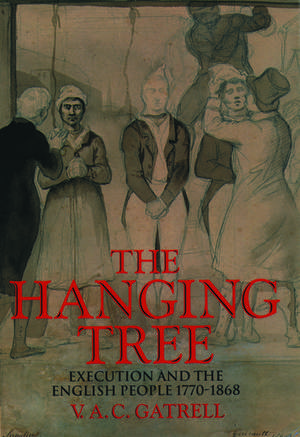
The Hanging Tree: Execution and the English People 1770-1868
V. A. C. Gatrellen Limba Engleză Paperback – 17 oct 1996
Preț: 682.66 lei
Preț vechi: 981.46 lei
-30%
Puncte Express: 1024
Carte tipărită la comandă
Livrare economică 03-08 decembrie
Livrare prin curier în România Termenul estimat este afișat lângă disponibilitate.
Transport gratuit pentru acest produs Plată online sau ramburs, în funcție de opțiunile comenzii.
Retur gratuit în 14 zile Comandă securizată și suport în română.
Specificații
ISBN-13: 9780192853325
ISBN-10: 0192853325
Pagini: 656
Ilustrații: halftones
Dimensiuni: 155 x 234 x 34 mm
Greutate: 0.94 kg
Ediția:Revised
Editura: OUP OXFORD
Colecția OUP Oxford
Locul publicării:Oxford, United Kingdom
ISBN-10: 0192853325
Pagini: 656
Ilustrații: halftones
Dimensiuni: 155 x 234 x 34 mm
Greutate: 0.94 kg
Ediția:Revised
Editura: OUP OXFORD
Colecția OUP Oxford
Locul publicării:Oxford, United Kingdom
V-ar putea interesa
-
 Dirty BertieStephen ClarkePreț: 115.55 lei
 -
 The Oxford Companion to Black British HistoryDavid Dabydeen-18%Preț: 277.38 lei339.54 lei
 -
 Eighteenth-Century Britain: A Very Short IntroductionPaul Langford-21%Preț: 55.39 lei69.91 lei
 -
 -31%Preț: 617.85 lei901.93 lei
 -
 English Pasts: Essays in History and CultureStefan Collini-28%Preț: 399.16 lei556.94 lei
 -
 The People's Peace: British History 1945-1989Kenneth O. Morgan-30%Preț: 645.73 lei926.42 lei
 -
 Gender and EmpirePhilippa Levine-11%Preț: 361.55 lei406.84 lei
 -
 England under the Norman and Angevin Kings: 1075-1225Robert Bartlett-20%Preț: 421.66 lei525.02 lei
 -
 The Battle of BritainKate Moore-22%Preț: 87.29 lei111.85 lei
 -
 SpitfireTony Holmes-38%Preț: 41.48 lei66.88 lei
 -
 The Dignity of ChartismDorothy ThompsonPreț: 144.83 lei
Recenzii
`a mammoth study, penetrating and poignant...a vast panorama, expertly interweaving history high and low, politics and passions, judges, jurors and journalists'New Statesman and Society
`brilliant account ... magnificent book ... beautifully produced, well-illustrated and relatively inexpensive'Guardian
`quite outstanding ...book'Observer
`magnificent new study ... a book of extraordinary quality ... the monumental scale of his achievement, and subtlety and richness of the argument.'Sunday Telegraph
'brilliant book'Richard Gott, The Guardian
'This is a powerful, committed and well-written book with a problematic theme ... much of his fascinating book was more redolent of the 1960s than of the Victorian era ... this is a continually interesting book, by the standards of modern scholarly publishing excellent value for money, and a study that ably bridges modern and historical concerns.'Jeremy Black, Financial Times
'Its strengths are originality of research and force of statement. Above all, no praise can be too high for the author and publisher in the choice, appositeness, captioning and reproduction of the illustrations. They are so closely interwoven with the argument that they form a brilliant summary of it.'Richard Ollard, The Independent
`a richly imaginative evocation of what public executions meant to onlookers - and to those struggling from the rope.'Independent on Sunday
`There is plenty to incite horror, but the cleverness of the book is the way it puts the English way of execution into a political context.'Jeremy Paxman, The Independent
`this massive study of public executions in England during the late eighteenth and early nineteenth century ... Gatrell's sensitive and elaborate reconstructions of criminal cases, appeals to mercy, and executions are the strength of this important and provocative study.'Times Literary Supplement
`This is an unusual book, in that it approaches history from the viewpoint of emotion ... not a book for the squeamish. The descriptions of hangings, gibbeting, anatomising and the behaviour of the crowds and prisoners make almost unbearable reading ... this is a work of meticulous scholarship and extensive research which, in concentrating on emotion, brings the history of the period vividly to life.'The Friend
'An excellent secondary source; recommended for academic and larger public library history collections.'Nancy L Whitfield, Library Journal, October 1994
'magnificent though grim and haunting book ... Some may find it, as the telly news puts it, "disturbing" or even "distressing".'Colin Welch, The Times
'As is often the case, all that gets in the way of this cosy explanation is one or two facts, and the author of this book has done a magnificent job in bringing quite a few to our attention.'Jack Robertson, Socialist Review, February 1995
passionately argued book...Gatrell makes much use of a source hitherto scarcely touched by historians, namely the appeals of pardon from those sentenced to suffer the supreme penalty...There is clearly much more to be gleaned from this source...Gatrell has a string of similarly painful and shocking stories. This is a rich, powerful and stimulating volume which deserves an audience far beyond specialists in the topic and period.
impressive, distasteful, prize-winning study
Gatrell's prize-winning investigation into the phenomenon tries to focus on how the 'entertainment' affected the thousands who turned up to watch, but is never shy of elaborating in gruesome detail on the savagery of the deed.
massive in size, formidable in scholarship, yet compelling and highly readable
A. C. Gatrell takes us down a bone-chilling journey into an age seldom fully explored and not so long ago in our nation's history.
Gatrell's scholarship combines with his passion to produce an excellent study
`brilliant account ... magnificent book ... beautifully produced, well-illustrated and relatively inexpensive'Guardian
`quite outstanding ...book'Observer
`magnificent new study ... a book of extraordinary quality ... the monumental scale of his achievement, and subtlety and richness of the argument.'Sunday Telegraph
'brilliant book'Richard Gott, The Guardian
'This is a powerful, committed and well-written book with a problematic theme ... much of his fascinating book was more redolent of the 1960s than of the Victorian era ... this is a continually interesting book, by the standards of modern scholarly publishing excellent value for money, and a study that ably bridges modern and historical concerns.'Jeremy Black, Financial Times
'Its strengths are originality of research and force of statement. Above all, no praise can be too high for the author and publisher in the choice, appositeness, captioning and reproduction of the illustrations. They are so closely interwoven with the argument that they form a brilliant summary of it.'Richard Ollard, The Independent
`a richly imaginative evocation of what public executions meant to onlookers - and to those struggling from the rope.'Independent on Sunday
`There is plenty to incite horror, but the cleverness of the book is the way it puts the English way of execution into a political context.'Jeremy Paxman, The Independent
`this massive study of public executions in England during the late eighteenth and early nineteenth century ... Gatrell's sensitive and elaborate reconstructions of criminal cases, appeals to mercy, and executions are the strength of this important and provocative study.'Times Literary Supplement
`This is an unusual book, in that it approaches history from the viewpoint of emotion ... not a book for the squeamish. The descriptions of hangings, gibbeting, anatomising and the behaviour of the crowds and prisoners make almost unbearable reading ... this is a work of meticulous scholarship and extensive research which, in concentrating on emotion, brings the history of the period vividly to life.'The Friend
'An excellent secondary source; recommended for academic and larger public library history collections.'Nancy L Whitfield, Library Journal, October 1994
'magnificent though grim and haunting book ... Some may find it, as the telly news puts it, "disturbing" or even "distressing".'Colin Welch, The Times
'As is often the case, all that gets in the way of this cosy explanation is one or two facts, and the author of this book has done a magnificent job in bringing quite a few to our attention.'Jack Robertson, Socialist Review, February 1995
passionately argued book...Gatrell makes much use of a source hitherto scarcely touched by historians, namely the appeals of pardon from those sentenced to suffer the supreme penalty...There is clearly much more to be gleaned from this source...Gatrell has a string of similarly painful and shocking stories. This is a rich, powerful and stimulating volume which deserves an audience far beyond specialists in the topic and period.
impressive, distasteful, prize-winning study
Gatrell's prize-winning investigation into the phenomenon tries to focus on how the 'entertainment' affected the thousands who turned up to watch, but is never shy of elaborating in gruesome detail on the savagery of the deed.
massive in size, formidable in scholarship, yet compelling and highly readable
A. C. Gatrell takes us down a bone-chilling journey into an age seldom fully explored and not so long ago in our nation's history.
Gatrell's scholarship combines with his passion to produce an excellent study
Notă biografică
V. A. C. Gatrell is University Lecturer and Fellow of Gonville & Caius College, Cambridge. He is editor of Robert Owen: A New View of Society (Pelican, 1971) and Crime and Law: The Social History of Crime in Western Europe since 1500 (Europa, 1980), and a well-known author of numerous articles in social and economic history. He lives in Cambridge.