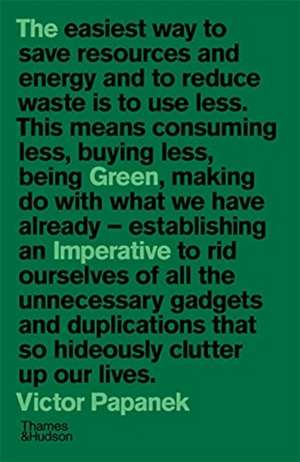
The Green Imperative
Autor Victor Papaneken Limba Engleză Paperback – feb 2022
În cadrul programelor de studiu dedicate designului industrial și eticii mediului, The Green Imperative ocupă un loc central, fiind o continuare directă a viziunii radicale propuse de Victor Papanek. Dacă în lucrarea sa anterioară de referință, Design for the Real World, autorul punea bazele designului responsabil social, în acest volum publicat de Thames & Hudson, el extinde analiza către imperativul ecologic. Ne-a atras atenția modul în care Papanek nu se limitează la teorie, ci oferă o critică tăioasă a esteticii de dragul esteticii, propunând în schimb un model de proiectare axat pe senzorial, scară redusă și respect față de resurse. Considerăm această ediție esențială pentru înțelegerea evoluției sustenabilității. Deși textele au fost scrise inițial acum un sfert de secol, argumentele împotriva ambalajelor inutile și pentru utilizarea materialelor reciclabile par mai actuale ca niciodată în contextul actual al deșeurilor plastice. Volumul este o alternativă excelentă la Routledge Handbook of Sustainable Product Design pentru cursurile de design sustenabil, având avantajul unei abordări mult mai personale și critice, care forțează cititorul să regândească actul cumpărării înainte de cel al creației. Această perspectivă etică este ancorată în întreaga operă a lui Papanek. Analizând legătura cu Nomadic Furniture, observăm aceeași dorință de a democratiza designul și de a reduce amprenta ecologică prin soluții ingenioase. Cele 141 de ilustrații incluse în formatul paperback completează discursul teoretic, oferind exemple vizuale concrete care transformă cartea dintr-un manifest filozofic într-un ghid practic pentru viitorul designului.
Preț: 75.69 lei
Preț vechi: 92.73 lei
-18%
Carte disponibilă
Livrare economică 06-20 noiembrie
Livrare express 22-28 octombrie pentru 42.03 lei
Specificații
ISBN-10: 0500296197
Pagini: 352
Ilustrații: 115 Illustrations, black and white; 26 Illustrations, color
Dimensiuni: 128 x 196 x 36 mm
Greutate: 0.33 kg
Editura: Thames & Hudson
V-ar putea interesa
-
 Cradle to CradleMichael Braungart-19%Preț: 57.49 lei71.32 lei
 -
 Design for ResilienceStuart Walker-17%Preț: 200.75 lei240.87 lei
 -
 Design and Ethics: Reflections on PracticeEmma FeltonPreț: 387.51 lei
 -
 Design for the Real WorldVictor Papanek-18%Preț: 89.39 lei108.89 lei
 -
 The superREUSE ManifestoGraeme BrookerPreț: 254.15 lei
 -
 Sustainable Design from Vision to ActionJeremy Faludi-5%Preț: 357.34 lei376.12 lei
 -
 -32%Preț: 566.23 lei831.96 lei
 -
 -14%Preț: 191.41 lei223.76 lei
 -
 -35%Preț: 131.83 lei204.24 lei
 -
 The Reimagined HomeNicole GrayPreț: 279.48 lei
 -
 -21%Preț: 155.82 lei197.87 lei
 -
 Preț: 381.38 lei
 -
 -28%Preț: 76.27 lei105.84 lei
 -
 How to Design a GardenJohn Brookes (landscape designer)-18%Preț: 118.03 lei143.63 lei
 -
 Designing Hope: Visions to Shape Our FutureSarah Housley-19%Preț: 87.09 lei107.53 lei
 -
 The Package Design Book 8Pentawards-2%Preț: 549.25 lei560.46 lei
 -
 Circular MaterialsJoe GibbsPreț: 280.26 lei
De ce să citești această carte
Recomandăm această carte oricărui student sau profesionist din domeniul creativ care dorește să înțeleagă rădăcinile designului ecologic. Cititorul câștigă o bază etică solidă și o perspectivă critică asupra consumismului. Este un motiv concret pentru a trece de la designul orientat spre profit la cel orientat spre supraviețuirea planetei, oferind soluții aplicabile chiar și la decenii de la prima publicare.
Descriere scurtă
First published at the end of the twentieth century, this book offered a plethora of honest advice, clear examples, and withering critiques, laying out the flaws of and opportunities for the design world at that time. A quarter of a century on, Papanek's lucid prose has lost none of its verve, and the problems he highlights have only become more urgent, giving today's reader both a fascinating historical perspective on the issues at hand and a blueprint for how they might be solved.
Notă biografică
Cuprins
1. HERE TODAY, GONE TOMORROW?
Our damaged planet . The historical view . The acceleration of disaster . Healing on a human scale . Is time on our side?
2. DESIGNING FOR A SAFER FUTURE
Production and pollution . Product assessment . Packaging and shrouding . The problem with plastics . Millions of tyres . Green Design . Profit and politics . Design in the 21st century
3. TOWARD THE SPIRITUAL IN DESIGN
The function of beauty . The designer's intent . Design for Disassembly . Exploiting every scrap . People participation . Designer as entrepreneur . Evaluating new technologies . Design ethics . Transforming the assignment
4. SENSING A DWELLING
Mood and environment . The dimension of light . Footfalls . Feeling the fabric . The sense of smell . Responses to space . Sounds and rhythms . Organic geometry . The collective unconscious . Benign architecture
5. THE BIOTECHNOLOGY OF COMMUNITIES
Finding the centre once more . People not traffic . The aesthetics of site . The sense of location . Nature's magic numbers . Ideal community size
6. THE LESSONS OF VERNACULAR ARCHITECTURE
Too humble for history . Six fallacies about vernacular architecture . Process not Product . Six explanations . The dynamic web
7. FORM FOLLOWS FUN
Designing for the moment . The fun object . Fashions in form . 'Anti-design' . Toy or tool . The meaning of objects
8. IS CONVENIENCE THE ENEMY?
Longing and dissatisfaction . Ten 'convenience' traps . Design as signifier . Chair as design gesture . Fashion and cuteness
9. SHARING NOT BUYING
The consumer triangle . The quality of life . Ten questions before buying . Three further questions . Possible answers
10. GENERATIONS TO COME
Drawing from different disciplines . The search for good form . Design education for all . World information network . The quality of learning . Creative problem-solving
11. THE BEST DESIGNERS IN THE WORLD?
The edge of survival . Inuit design skills . Space concepts . Thinking in three dimensions . Art is life . Learning from the Inuit
12. THE NEW AESTHETIC: MAKING THE FUTURE WORK