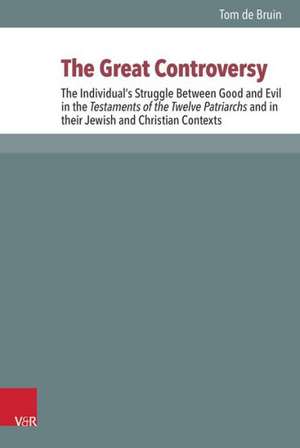
The Great Controversy: The Individual’s Struggle Between Good and Evil in the Testaments of the Twelve Patriarchs and in their Jewish and Christian Contexts
Autor Dr. Tom de Bruinen Limba Engleză Hardback – 10 dec 2014
Adresat studenților în teologie, cercetătorilor biblici și practicienilor interesați de rădăcinile eticii creștine, volumul The Great Controversy semnat de Dr. Tom de Bruin oferă o perspectivă riguroasă asupra „Testamentelor celor Doisprezece Patriarhi” (T12P). Remarcăm modul în care autorul reușește să transforme un text adesea catalogat drept pur apocaliptic într-o resursă fundamentală pentru înțelegerea antropologiei antice. Lucrarea demonstrează cum discursurile de adio ale fiilor lui Iacob nu sunt simple exerciții de retorică, ci instrumente de redefinire a moralității individuale.
Autorul abordează T12P din trei unghiuri complementare: analiza parenetică, structura antropologică și contextul istoric. Această metodologie extinde cadrul propus de Jewish Eschatology, Early Christian Christology and the Testaments of the Twelve Patriarchs de Marinus De Jonge cu date noi privind procesul de „eticizare” a tradițiilor apocaliptice. În timp ce De Jonge se concentrează pe titlurile mesianice și escatologie, De Bruin mută centrul de greutate către bătălia interioară a individului, situând textul la intersecția dintre iudaismul târziu și creștinismul timpuriu.
Merită menționat că această cercetare continuă preocuparea autorului pentru modul în care textele religioase sunt receptate și adaptate, temă explorată și în Fan Fiction and Early Christian Writings. Dacă în lucrarea menționată Dr. Tom de Bruin analiza derivatele creștine prin prisma fandom-ului modern, în The Great Controversy el aplică o rigoare academică similară pentru a explica transformarea cosmologiei în etică personală. Structura densă a celor 264 de pagini, publicate de VANDENHOECK & RUPRECHT, asigură un parcurs critic esențial pentru oricine dorește să înțeleagă cum lupta dintre bine și rău a devenit, din temă universală, o responsabilitate individuală în gândirea creștină timpurie.
Preț: 650.24 lei
Preț vechi: 868.84 lei
-25%
Carte disponibilă
Livrare economică 18 mai-01 iunie
Specificații
ISBN-10: 3525540353
Pagini: 264
Dimensiuni: 160 x 237 x 23 mm
Greutate: 0.57 kg
Editura: VANDENHOECK & RUPRECHT
Locul publicării:Göttingen, Germany
V-ar putea interesa
-
 Language, Theology, and the Bible: Essays in Honour of James BarrSamuel E. Balentine-34%Preț: 707.67 lei1077.47 lei
 -
 -37%Preț: 1051.66 lei1667.74 lei
 -
 The Death of Scripture and the Rise of Biblical StudiesMichael C. LegaspiPreț: 313.32 lei
 -
 Lent for EveryoneTom WrightPreț: 85.53 lei
 -
 HeavenPaula GooderPreț: 75.08 lei
 -
 The NailStephen CottrellPreț: 74.06 lei
 -
 The Reliability of the New TestamentRobert B StewartPreț: 196.33 lei
 -
 Theological Wordbook of the Old TestamentR Laird HarrisPreț: 383.76 lei
 -
 Contextualization in the New TestamentDean FlemmingPreț: 204.77 lei
De ce să citești această carte
Recomandăm această carte cercetătorilor care doresc să înțeleagă tranziția de la apocaliptic la etic în literatura pseudepigrafă. Cititorul câștigă o viziune clară asupra modului în care textele vechi au modelat conștiința individuală și moralitatea creștină. Este un instrument academic precis care explică de ce lupta interioară a rămas pilonul central al antropologiei religioase europene, oferind o analiză comparativă rară între contextul iudaic și cel creștin.