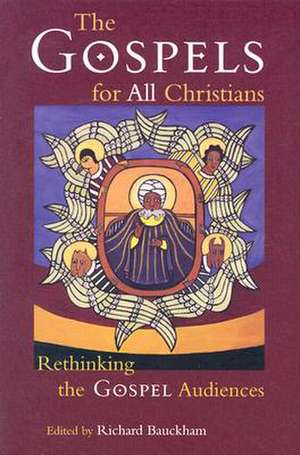
The Gospels for All Christians
Editat de Richard Bauckhamen Limba Engleză Paperback – noi 1997
Loveday Alexander, Stephen C. Barton, Richard Bauckham, Richard Burridge, Michael B. Thompson, and Francis Watson examine such topics as the extent of communication between early Christian churches, book production and circulation in the Graeco-Roman world, the Gospel genre and its audience, the relationships between the Gospels, the faulty enterprise of reconstructing Gospel communities, and the hermeneutical and theological pitfalls of reading the Gospels as community texts. By putting in question a large body of assumptions that are almost universally accepted in contemporary scholarship, this book could fundamentally change both the method and the findings of Gospel interpretation.
Preț: 158.55 lei
Puncte Express: 238
Carte disponibilă
Livrare economică 31 octombrie-14 noiembrie
Livrare prin curier în România Termenul estimat este afișat lângă disponibilitate.
Transport gratuit de la 400.00 lei Plată online sau ramburs, în funcție de opțiunile comenzii.
Retur gratuit în 14 zile Comandă securizată și suport în română.
Specificații
ISBN-13: 9780802844446
ISBN-10: 0802844448
Pagini: 228
Dimensiuni: 152 x 229 x 14 mm
Greutate: 0.35 kg
Editura: EERDMANS
ISBN-10: 0802844448
Pagini: 228
Dimensiuni: 152 x 229 x 14 mm
Greutate: 0.35 kg
Editura: EERDMANS
V-ar putea interesa
-
 Language, Theology, and the Bible: Essays in Honour of James BarrSamuel E. Balentine-33%Preț: 774.82 lei1149.43 lei
 -
 Jesus: A Very Short IntroductionRichard Bauckham-20%Preț: 56.42 lei70.77 lei
 -
 Finding God in the PsalmsTom WrightPreț: 85.23 lei
 -
 Theology of the Book of RevelationRichard BauckhamPreț: 246.78 lei
 -
 God and the Crisis of FreedomRichard BauckhamPreț: 214.50 lei
 -
 The Testimony of the Beloved DiscipleRichard BauckhamPreț: 247.33 lei
 -
 Theological Wordbook of the Old TestamentR Laird HarrisPreț: 410.57 lei
 -
 The New Testament DocumentsF. F. BrucePreț: 101.76 lei
 -
 The Gospel of John and Christian TheologyRichard BauckhamPreț: 259.06 lei
 -
 Powers, Weakness, and the Tabernacling of GodMarva J. DawnPreț: 131.72 lei
 -
 Gospel WomenRichard BauckhamPreț: 189.72 lei
 -
 Sensing the ScripturesKarlfried FroehlichPreț: 150.12 lei
Textul de pe ultima copertă
This volume challenges the current consensus in New Testament scholarship that each of the Gospels was written for a specific church or group of churches. These essays argue, from a wide range of evidence, that the Gospels were intended for general circulation throughout all the early churches and, hence, were written for all Christians.
Loveday Alexander, Stephen C. Barton, Richard Bauckham, Richard Burridge, Michael B. Thompson, and Francis Watson examine such topics as the extent of communication between early Christian churches, book production and circulation in the Graeco-Roman world, the Gospel genre and its audience, the relationships between the Gospels, the faulty enterprise of reconstructing Gospel communities, and the hermeneutical and theological pitfalls of reading the Gospels as community texts. By putting in question a large body of assumptions that are almost universally accepted in contemporary scholarship, this book could fundamentally change both the method and the findings of Gospel interpretation.