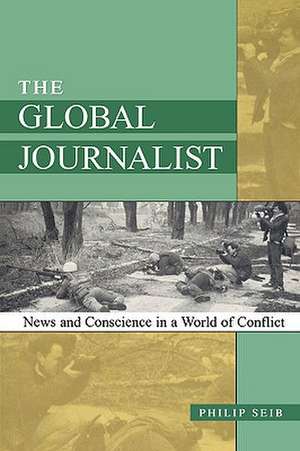
The Global Journalist: News and Conscience in a World of Conflict
Autor Philip Seiben Limba Engleză Paperback – 11 dec 2001
Preț: 304.89 lei
Preț vechi: 387.65 lei
-21%
Puncte Express: 457
Carte tipărită la comandă
Livrare economică 01-15 decembrie
Livrare prin curier în România Termenul estimat este afișat lângă disponibilitate.
Transport gratuit de la 400.00 lei Plată online sau ramburs, în funcție de opțiunile comenzii.
Retur gratuit în 14 zile Comandă securizată și suport în română.
Specificații
ISBN-13: 9780742511026
ISBN-10: 0742511022
Pagini: 192
Dimensiuni: 148 x 226 x 12 mm
Greutate: 0.25 kg
Ediția:0168
Editura: Bloomsbury Publishing
Colecția Rowman & Littlefield
Locul publicării:New York, United States
ISBN-10: 0742511022
Pagini: 192
Dimensiuni: 148 x 226 x 12 mm
Greutate: 0.25 kg
Ediția:0168
Editura: Bloomsbury Publishing
Colecția Rowman & Littlefield
Locul publicării:New York, United States
V-ar putea interesa
-
 Misadventures of a Big Mouth BritPiers MorganPreț: 124.43 lei
 -
 Preț: 140.36 lei
 -
 The Democratic Value of News: Why Public Service Media MatterStephen CushionPreț: 277.20 lei
 -
 Lunch with the FTLionel BarberPreț: 110.98 lei
 -
 -30%Preț: 373.58 lei531.81 lei
 -
 Routledge Handbook of Media, Conflict and SecurityPiers Robinson-18%Preț: 1808.56 lei2205.56 lei
 -
 News and Politics: The Rise of Live and Interpretive JournalismStephen CushionPreț: 393.73 lei
 -
 Preț: 455.20 lei
 -
 -25%Preț: 228.52 lei305.34 lei
 -
 Sex, Religion, MediaDane S. Claussen-23%Preț: 279.34 lei362.78 lei
 -
 Covering the Courts: A Handbook for JournalistsS. L. Alexander-22%Preț: 276.36 lei353.27 lei
 -
 FrostNeil HegartyPreț: 123.38 lei
 -
 How to Start a MagazineJames B. KobakPreț: 226.96 lei
 -
 -19%Preț: 485.16 lei598.96 lei
 -
 European Media in Crisis: Values, Risks and PoliciesJosef Trappel-18%Preț: 1245.04 lei1518.35 lei
 -
 Preț: 107.48 lei
 -
 LebenslaufAlice SchwarzerPreț: 120.72 lei
 -
 Kommunikationspsychologie für FührungskräfteJohannes RuppelPreț: 95.33 lei
Cuprins
Chapter 1 Collision: Technology, Money, and Ethics
Chapter 2 Tearing down the Wall: History Begins Anew
Chapter 3 Passion and Dispassion
Chapter 4 Witness
Chapter 5 Covering "Humanitarian War"
Chapter 6 Watching the World
Chapter 7 Notes
Chapter 8 Bibliography
Chapter 9 Index
Chapter 2 Tearing down the Wall: History Begins Anew
Chapter 3 Passion and Dispassion
Chapter 4 Witness
Chapter 5 Covering "Humanitarian War"
Chapter 6 Watching the World
Chapter 7 Notes
Chapter 8 Bibliography
Chapter 9 Index
Recenzii
Seib spells out economic and political complexities leading to an extreme reduction of foreign coverage by American news bureaus. Case studies present news reporting in Somalia, Bosnia, Rwanda, Sierra Leone, East Timor, and Kosovo, providing useful understanding of how coverage (or lack of it) produces political and social consequences and places moral burdens on news organizations. All levels.
Philip Seib makes a compelling case for the journalistic responsibility to determine foreign news and against corporate profit incentives that deprive the American public and decision makers of contextual reporting about crucial developments and events abroad. Our lack of understanding of the Muslim world before 9/11 is but one example. This book is an ideal choice not only for students of communication and journalism but also for American government courses that explore the role of the media in domestic and foreign policymaking.
Provocatively argues that U.S. media has the duty to 'shake awake the world's conscience' by covering more international stories and highlighting global suffering and conflict.
Phillip Seib's <The Global Journalist> is a clear, concise argument for global journalism as a moral enterprise. . . . A timely work made more so by the events of Sept. 11, should enlighten readers concerned about world affairs.....
The book is a must-read for journalists, journalism scholars, policy-makers and anyone interested in the issues of world affairs. Philip Seib knows how to merge the voices of journalists, policy-makers and scholars to give a full report on the current situation and problems in global journalism.
Philip Seib's The Global Journalist makes a strong case for the need for more international coverage by the U.S. media. In the wake of the September 11th terrorist attacks, we have seen the sad results of the media ignoring important global issues. The American public needs much more, not less, news about the rest of the world. Seib does an excellent job of explaining the global trends in the '90s that led many U.S. media companies to make the shortsighted decision to downplay international news. The Global Journalist presents compelling examples of how major international stories were uncovered or under-covered by the media. The result of this lack of coverage is an uninformed U.S. public that doesn't have the information it needs to respond to a fast-changing world.
A highly relevant, readable book. The book can appeal as much to a policy decision maker, a journalist, or an academician, as to a lay person.
Philip Seib makes a compelling case for the journalistic responsibility to determine foreign news and against corporate profit incentives that deprive the American public and decision makers of contextual reporting about crucial developments and events abroad. Our lack of understanding of the Muslim world before 9/11 is but one example. This book is an ideal choice not only for students of communication and journalism but also for American government courses that explore the role of the media in domestic and foreign policymaking.
Provocatively argues that U.S. media has the duty to 'shake awake the world's conscience' by covering more international stories and highlighting global suffering and conflict.
Phillip Seib's <The Global Journalist> is a clear, concise argument for global journalism as a moral enterprise. . . . A timely work made more so by the events of Sept. 11, should enlighten readers concerned about world affairs.....
The book is a must-read for journalists, journalism scholars, policy-makers and anyone interested in the issues of world affairs. Philip Seib knows how to merge the voices of journalists, policy-makers and scholars to give a full report on the current situation and problems in global journalism.
Philip Seib's The Global Journalist makes a strong case for the need for more international coverage by the U.S. media. In the wake of the September 11th terrorist attacks, we have seen the sad results of the media ignoring important global issues. The American public needs much more, not less, news about the rest of the world. Seib does an excellent job of explaining the global trends in the '90s that led many U.S. media companies to make the shortsighted decision to downplay international news. The Global Journalist presents compelling examples of how major international stories were uncovered or under-covered by the media. The result of this lack of coverage is an uninformed U.S. public that doesn't have the information it needs to respond to a fast-changing world.
A highly relevant, readable book. The book can appeal as much to a policy decision maker, a journalist, or an academician, as to a lay person.