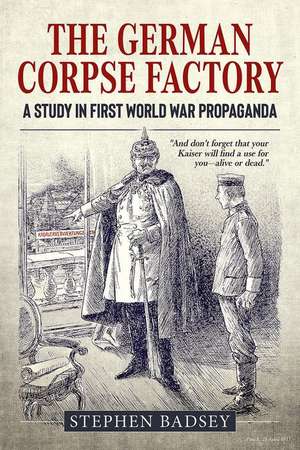
The German Corpse Factory: Wolverhampton Military Studies
Autor Stephen Badseyen Limba Engleză Paperback – oct 2019
Apreciem rigurozitatea cu care Stephen Badsey, un istoric militar de renume și profesor specializat în studiul conflictelor, abordează unul dintre cele mai persistente mituri ale Marelui Război. Autorul, cunoscut pentru lucrări fundamentale precum The Franco-Prussian War sau studiile sale despre cavaleria britanică din Doctrine and Reform in the British Cavalry 1880–1918, își folosește expertiza pentru a deconstrui celebrul scandal al „fabricii de cadavre”. Această lucrare nu este doar o cronică a unei știri false, ci o investigație asupra modului în care zvonurile pot influența diplomația internațională pe parcursul mai multor decenii. Reținem că The German Corpse Factory analizează incidentul din primăvara anului 1917, când presa britanică a susținut că Germania, aflată în criză de resurse, fierbea corpurile propriilor soldați pentru a obține glicerină. Credem că valoarea cărții rezidă în documentarea reacțiilor oficiale: deși experții în propagandă știau că povestea este falsă, guvernul britanic a refuzat inițial să o nege. Comparabil cu German Atrocities, 1914 de John Horne în ceea ce privește rigoarea cercetării de arhivă, volumul lui Badsey se diferențiază prin concentrarea pe evoluția post-factum a acestui mit, arătând cum a fost instrumentalizat de guvernul german după 1918 și de grupuri de interese americane după 1925. Spre deosebire de British First World War Propaganda de David Monger, care oferă o privire de ansamblu asupra tehnicilor de comunicare, lucrarea de față funcționează ca un studiu de caz chirurgical. Tonul este unul analitic, evitând senzaționalismul, și demonstrează cum un singur episod de dezinformare a alterat înțelegerea publică a Primului Război Mondial și a contribuit la instabilitatea păcii europene. Este o lectură esențială pentru a înțelege limitele etice ale propagandei oficiale.
Din seria Wolverhampton Military Studies
-
 Preț: 185.45 lei
 -
 Preț: 261.01 lei
 -
 Preț: 262.49 lei
 -
 Preț: 292.04 lei
 -
 Preț: 182.23 lei
 -
 Preț: 220.68 lei
 -
 Preț: 261.84 lei
 -
 Preț: 187.29 lei
 -
 Preț: 336.46 lei
 -
 Preț: 263.08 lei
 -
 Preț: 262.76 lei
 -
 Preț: 221.16 lei
 -
 Preț: 220.50 lei
 -
 Preț: 264.22 lei
 -
 Preț: 220.06 lei
 -
 Preț: 264.70 lei
 -
 Preț: 216.83 lei
 -
 Preț: 260.49 lei
 - nou
 Preț: 184.78 lei
 - nou
 Preț: 324.05 lei
 - nou
 Preț: 278.87 lei
Preț: 218.60 lei
Carte disponibilă
Livrare economică 18 mai-01 iunie
Livrare express 01-07 mai pentru 36.63 lei
Specificații
ISBN-10: 1911628275
Pagini: 372
Ilustrații: 10 b/w photos, ills
Dimensiuni: 156 x 227 x 25 mm
Greutate: 0.56 kg
Editura: HELION & COMPANY
Colecția Wolverhampton Military Studies
Seria Wolverhampton Military Studies
De ce să citești această carte
Această carte este indispensabilă pentru cititorii pasionați de istorie militară și de mecanismele manipulării informației. Veți înțelege cum o minciună evidentă a supraviețuit zeci de ani, influențând relațiile diplomatice dintre marile puteri. Stephen Badsey oferă o lecție de istorie despre consecințele pe termen lung ale propagandei, fiind un instrument util pentru oricine dorește să analizeze critic sursele de informare în perioade de conflict.
Despre autor
Stephen Badsey este un istoric militar britanic de prestigiu, membru al Royal Historical Society și profesor universitar. Cariera sa este marcată de o analiză profundă a relației dintre media, propagandă și operațiunile militare. A publicat numeroase volume care acoperă o perioadă vastă, de la conflictele secolului al XIX-lea, în The Franco-Prussian War, până la analize moderne precum The Falklands Conflict Twenty Years On. Expertiza sa în transformarea doctrinei militare și în rolul presei în timpul războiului îl poziționează ca una dintre cele mai autoritare voci în studiul istoriei Primului Război Mondial.
Descriere scurtă
Behind the scenes, British propaganda experts opposed exploiting the story as it was obviously false, and contrary to their basic principles of never telling an obvious lie in an official statement. But at the time, the British government refused to deny that the 'German Corpse Factory' might really exist. In 1925 the scandal re-erupted in New York, when the former head of British military intelligence on the Western Front, in the United States on a speaking tour, was quoted in newspapers as having confessed to making the whole German Corpse Factory story up, a claim that he immediately denied. As a gesture of friendship on the occasion of the Locarno treaties, the British government now accepted the German government position that the story was a lie, but in fact neither government knew what had really happened in 1917.
This book provides the answers to these questions according to the best historical evidence available. It uses the scandal of the 'German Corpse Factory' as a case-study to explore the true nature of British official propaganda and its organizations in the First World War, including the events of 1917 and who might really have been responsible for the story. It also shows how this brief episode was taken up by the German government after 1918, and by interest groups in Britain and the United States after 1925, to paint a false picture of British propaganda, with far-reaching consequences for the peace of Europe, and for our subsequent understanding of the First World War.