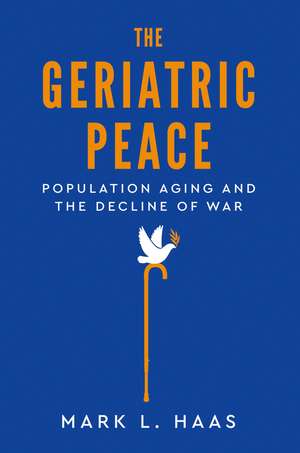
The Geriatric Peace: Population Aging and the Decline of War
Autor Mark L. Haasen Limba Engleză Hardback – 17 sep 2025
Preț: 154.36 lei
Preț vechi: 178.91 lei
-14%
Puncte Express: 232
Carte tipărită la comandă
Livrare economică 20-25 noiembrie
Livrare prin curier în România Termenul estimat este afișat lângă disponibilitate.
Transport gratuit de la 400.00 lei Plată online sau ramburs, în funcție de opțiunile comenzii.
Retur gratuit în 14 zile Comandă securizată și suport în română.
Specificații
ISBN-13: 9780197511732
ISBN-10: 0197511732
Pagini: 360
Dimensiuni: 156 x 234 x 24 mm
Greutate: 0.66 kg
Editura: Oxford University Press
Colecția OUP USA
Locul publicării:New York, United States
ISBN-10: 0197511732
Pagini: 360
Dimensiuni: 156 x 234 x 24 mm
Greutate: 0.66 kg
Editura: Oxford University Press
Colecția OUP USA
Locul publicării:New York, United States
Recenzii
At a time of much hand-wringing over low fertility and population aging, Mark L. Haas makes a brilliant argument for a golden lining, showing in persuasive detail how these trends will make war less feasible and less desirable for all the great powers. Combining insights from economics, demography, and international relations, Haas shows how Russia, China, Japan and the U.S. will face increasing obstacles to successful war-making, while U.S. hegemony is likely to endure. A fascinating and provocative work.
For over a decade and a half, Mark L. Haas has been pioneering research on 'geriatric peace' theory. Now that a geriatric world is almost upon us, this presentation of his thinking and findings seems especially timely. The key question of whether autocracies, andÃÂ not just democracies, fall under the sway of geriatric peace is a central concern of this study. Scholars and policymakers alike need to read his arguments.
Will the fact that the populations of the world's main powers, including China and the United States, are aging increase the probability of long-term global peace? Read this book. Simply put, it is the definitive take on this critical subject.
Mark L. Haas compellingly argues that declining birth rates and aging populations reduce the likelihood and appeal of war among major powers. By integrating economic, demographic, and international relations insights, Haas demonstrates how Russia, China, Japan, and the U.S. will face growing obstacles to warfare, potentially ensuring continued U.S. dominance. This insightful analysis of unprecedented low fertility and aging trends is a must-read for scholars and policymakers.
Haas's description of demographic trends can make for a sobering read.
For over a decade and a half, Mark L. Haas has been pioneering research on 'geriatric peace' theory. Now that a geriatric world is almost upon us, this presentation of his thinking and findings seems especially timely. The key question of whether autocracies, andÃÂ not just democracies, fall under the sway of geriatric peace is a central concern of this study. Scholars and policymakers alike need to read his arguments.
Will the fact that the populations of the world's main powers, including China and the United States, are aging increase the probability of long-term global peace? Read this book. Simply put, it is the definitive take on this critical subject.
Mark L. Haas compellingly argues that declining birth rates and aging populations reduce the likelihood and appeal of war among major powers. By integrating economic, demographic, and international relations insights, Haas demonstrates how Russia, China, Japan, and the U.S. will face growing obstacles to warfare, potentially ensuring continued U.S. dominance. This insightful analysis of unprecedented low fertility and aging trends is a must-read for scholars and policymakers.
Haas's description of demographic trends can make for a sobering read.
Notă biografică
Mark L. Haas is the Duquesne Professor of Political Science at Duquesne University in Pittsburgh. He formerly was a National Security Fellow at the Olin Institute for Strategic Studies and an International Security Fellow at the Belfer Center for Science and International Affairs, both at Harvard University. Haas received his Ph.D. in political science from the University of Virginia and his B.A. in political science, economics, and history from Duke University.